


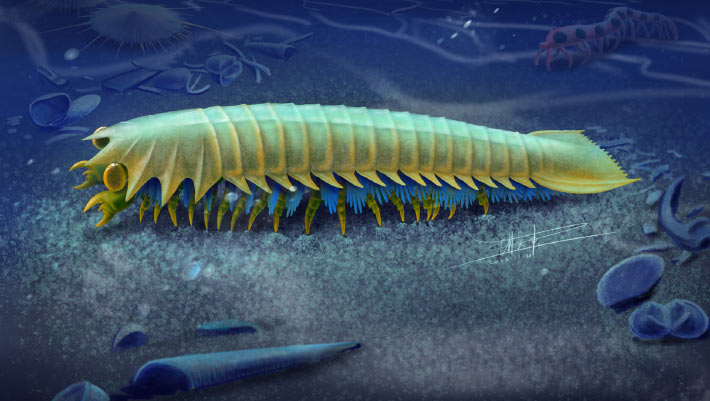
Urocodia equalis: An Early Cambrian marine predator from the Chengjiang Biota in China, showcasing the earliest known evidence of chelicerae. This species features a scissor-like structure that evolved into the fangs of spiders and pincers of scorpions.
Artist’s impression of Urocodia equalis, a marine predator that inhabited the Cambrian seas about 518 million years ago. Image credit: Xiaodong Wang.
Alongside scorpions and ticks, spiders belong to a group of invertebrates known as chelicerates, encompassing over 100,000 identified species.
These creatures exhibit articulated limbs and external skeletons, notably possessing specialized structures called chelicerae at the front, functioning as pincers or fangs for gripping prey.
Interestingly, the earliest fossil evidence of chelicerates originates from marine habitats rather than terrestrial ones, tracing back over 500 million years to the Cambrian period.
In a recent study, paleontologists concentrated on the marine organism Urocodia equalis, found at the renowned Chengjiang Fossil Site in Yunnan Province, China.
This diminutive creature spans only 2 to 3 centimeters in length, characterized by large, stalked eyes, a segmented skeleton, and articulated limbs extending beneath its elongated body.
“Urocodia equalis was integral to an ancient ecosystem comprising over 200 species inhabiting the seas more than 500 million years ago,” stated Professor Mark Williams from the University of Leicester.
“These exceptionally preserved fossils provide invaluable insights into the evolutionary trajectory of life on Earth during the dawn of animal existence.”
Utilizing X-ray tomography, Professor Williams and his team examined the Urocodia equalis specimens and discovered remarkable preservation of the creature’s soft tissues.
Scans unveiled two small, scissor-like limbs positioned behind its eyes, representing an early form of the chelicerae eventually seen in spiders and scorpions.
“Employing X-ray tomography to analyze these fossils revealed soft anatomical structures that had remained buried for hundreds of millions of years, leading us to identify scissor-like limbs at the front of the creature,” remarked Professor Yu Liu, a paleontologist at Yunnan University and the University of Leicester.
“This fascinating fossil represents a distant ancestor of modern chelicerates, including scorpions and spiders.”
Moreover, Urocodia equalis exhibits leg features reminiscent of gills, a respiratory structure that persists in horseshoe crabs today.
This significant discovery extends the fossil record of this trait and offers a rare, in-depth perspective on how one of evolution’s most effective predatory adaptations originated in ancient oceans.
“Urocodia equalis displays a seven-segmented head with a hardened lower mouth, pincer-like appendages, and bilobed body appendages featuring overlapping exit valves,” the paleontologists noted.
“Its scissor-like appendages act as a transitional structure between the emergence of multi-segmented appendages and true chelicerae; megacheiran origins of book gills.”
These findings are published in today’s issue of Nature.
_____
Y. Liu et al.. Urocodia: Shedding light on the origin of chelicerae and cheliceral book gills. Nature published online on July 1, 2026. doi: 10.1038/s41586-026-10713-2
Source: www.sci.news