


Paleontologists have identified a new species of Late Jurassic ichthyosaur in Germany’s famous Solnhofen Limestone deposits. Named Jabalisaurus tethyensis, the newly recognized marine reptile was previously misidentified as Aegirosaurus leptospondylus. The discovery doubles the known ichthyosaur diversity of the region, which is also renowned for preserving the iconic fossil bird Archaeopteryx.
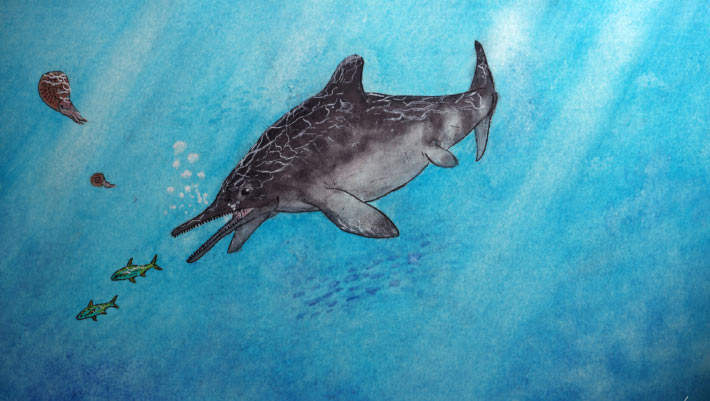
An artistic reconstruction of Jabalisaurus tethyensis swimming near the surface while pursuing halecomorph fishes. Image credit: Giovanni Serafini.
Jabalisaurus tethyensis lived in the warm waters of the ancient Tethys Ocean during the Late Jurassic, approximately 150 million years ago.
The newly described ophthalmosaurian ichthyosaur was a medium-sized marine reptile measuring an estimated 2-2.9 m (6.6-9.5 feet) in length.
Its anatomy included a slender, high-crowned skull and finely ridged teeth, suggesting that it likely hunted small bony fish. Like other closely related ichthyosaurs, it probably had smooth skin.
“Ichthyosaurs are Mesozoic marine reptiles that first appeared in the fossil record in the Early Triassic and persisted until the early Late Cretaceous,” Dr. Erin Maxwell of the Staatliches Museum für Naturkunde Stuttgart and her colleagues wrote in their study.
“The high point of ichthyopterygian diversity and disparity is widely understood to have been attained during the first 8.7 million years of the group’s evolution, attributed to high rates of morphological evolution early in the history of the clade during their initial radiation into diverse marine habitats and dietary niches.”
“By the Jurassic, and especially by the end of the Aalenian (early Middle Jurassic), ichthyosaurs occupied a reduced range of ecomorphotypes, and historically were viewed as being correspondingly reduced in taxonomic diversity.”
The researchers described Jabalisaurus tethyensis primarily from a small, immature skeleton housed at the Bavarian State Collection for Palaeontology and Geology in Munich. The fossil was originally collected at the Geisberg quarry near Apfelthal in Bavaria.
Two additional fossils were assigned to the new species: one held by the Staatliches Museum für Naturkunde Stuttgart and another exceptionally well-preserved specimen from the Jura-Museum Eichstätt. The latter retains the complete outline of the animal’s soft tissues.
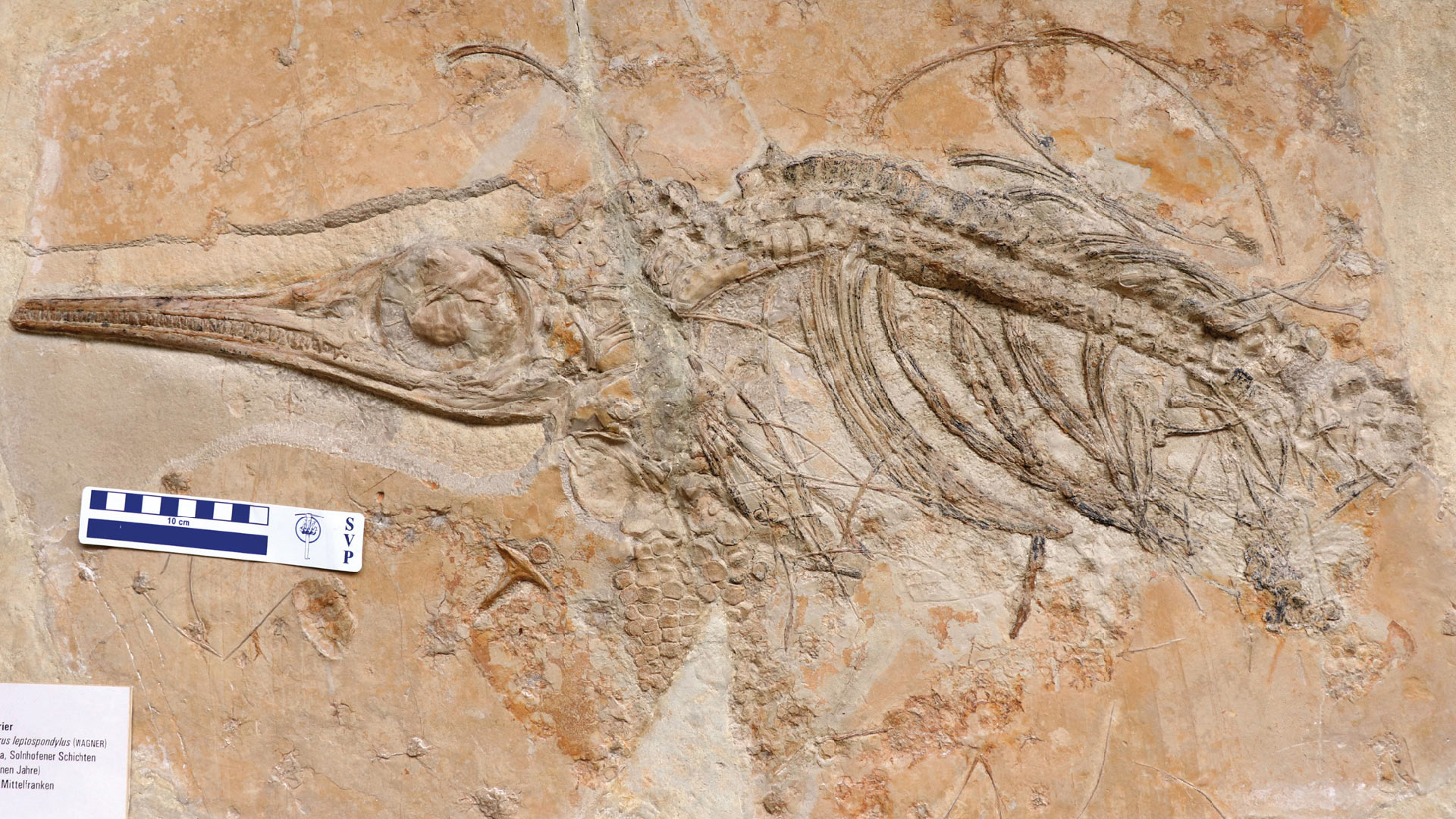
Jabalisaurus tethyensis holotype specimen. Image credit: Maxwell et al., doi: 10.26879/1676.
The discovery of Jabalisaurus tethyensis is significant because the genus was previously known only from the Gulf of Mexico region, approximately 9,000 km from Bavaria.
Before this study, scientists believed that only one ichthyosaur species, Aegirosaurus leptospondylus, was represented in the Late Jurassic Plattenkalk limestone deposits of southern Germany.
The presence of Jabalisaurus in Bavaria indicates that these marine reptiles may have traveled across a wide area of the ancient Tethys Ocean and its connected proto-Caribbean seaway. The finding challenges the idea that ichthyosaurs from the proto-Gulf of Mexico evolved in geographic isolation.
“Despite the apparent high Late Jurassic marine habitat connectivity, the Late Jurassic ichthyosaurian fauna from the proto-Gulf of Mexico has been interpreted as being highly endemic,” the researchers wrote.
“With the description of Jabalisaurus tethyensis, two closely related species-pairs have now been recovered from the German Plattenkalk deposits and the Gulf of Mexico region, namely Jabalisaurus meztli and Jabalisaurus tethyensis, and Parrassaurus yacahuitztli and Aegirosaurus leptospondylus.”
“These findings challenge the hypothesis of strong endemicity in the proto-Caribbean, and suggest instead a similar warm-temperate to tropical ichthyosaurian fauna across the northwestern Tethys and proto-Caribbean, possibly showing regional species-level divergence.”
The researchers concluded that the discovery weakens the idea that the proto-Caribbean was a hotspot of ichthyosaur endemism during the Late Jurassic. Instead, tropical Tethyan ichthyosaurs may have been widely distributed, while more temperate and polar species occupied regions such as the United Kingdom, Svalbard, Eastern Europe, and Argentina.
The team’s study was published online in the journal Palaeontologia Electronica.
_____
Erin E. Maxwell et al. Late Jurassic ichthyosaurs from Germany. Palaeontologia Electronica 29 (2): a30; doi: 10.26879/1676
Source: www.sci.news