


A new mathematical model suggests that early mammals may have prevented non-avian dinosaurs from evolving into the smallest land animals, while the emergence of flight allowed birds to occupy tiny-body-size niches.
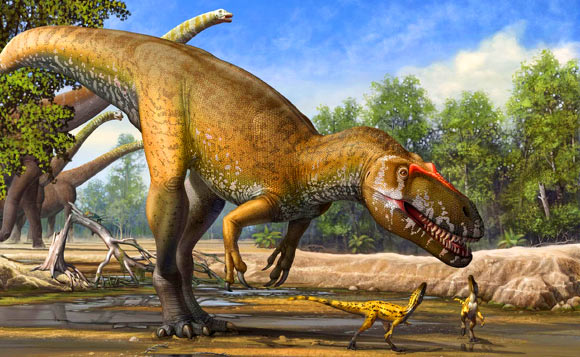
Torvosaurus gurneyi. Image credit: © Sergey Krasovskiy.
Dinosaurs evolved into some of the largest animals ever to walk on Earth. However, new research indicates that ecological competition from early mammals may have kept dinosaurs from evolving into truly tiny species.
“Across vertebrates living today, tiny animals are everywhere. Mice, hummingbirds, geckos, and shrews all weigh just a few grams or less,” said Princeton University’s Dr. Stephanie Lechki and Dr. Roger Benson of the American Museum of Natural History.
“Yet even the smallest known non-avian dinosaurs weighed around 450 grams — approximately the size of a large rabbit. As a result, most living mammals and birds are smaller than the tiniest dinosaurs discovered so far.”
“What prevented dinosaurs from becoming extremely small? Our findings suggest that the answer may not be dinosaur physiology, but the ecosystems in which these animals lived.”
For the study, the researchers examined whether a mathematical model of “energetic fitness” could explain the body sizes seen across different animal groups. They focused especially on why the smallest non-avian dinosaurs were still hundreds of times heavier than the smallest living birds, mammals, and reptiles.
The team assembled body-mass data from thousands of species representing mammals, birds, lizards, snakes, turtles, and crocodylians, along with data from 515 non-avian dinosaur species.
Using statistical regression analyses, the researchers calculated energy-acquisition and energy-conversion constants for each group. They then used those values to generate predicted body-size distributions.
Finally, the predicted distributions were compared with the actual body sizes observed in each animal group.
The energetic fitness model accurately described body-size patterns in mammals, birds, and turtles. However, it did not perform as well for lizards, snakes, or crocodylians.
Importantly, no realistic combination of physiological parameters could explain why non-avian dinosaurs had such a large minimum body mass.
These results suggest that ecological factors — including competition and predation, potentially involving early mammals — may have prevented small-bodied dinosaurs from evolving. That restriction appears to have changed when flight evolved in birds.
“Everyone agrees that dinosaurs restricted mammals to small body sizes before the end-Cretaceous mass extinction,” Dr. Benson said.
“Here, we suggest that mammals may have restricted dinosaurs in the opposite direction, keeping them relatively large and preventing the evolution of tiny dinosaur species.”
“The evolution of flight may have opened entirely new ecological opportunities,” Dr. Lechki added.
“Once birds entered these new niches, they were able to evolve body sizes that may not have been available to other dinosaurs.”
The researchers say additional studies are needed to determine why certain body sizes evolved successfully while others appear to have been absent from the fossil record.
“We have this unusual situation in which the ancestors of dinosaurs could be tiny. The living descendants of dinosaurs — birds — can also be tiny. But dinosaurs themselves seemed to be prevented from becoming very small,” Dr. Benson said.
“We do not yet fully understand why this happened, but it is a question worth exploring to better understand dinosaur evolution and biology.”
The study was published August 5 in the journal Evolution.
_____
Stephanie C. Lechki & Roger B.J. Benson. The explanatory power of energetic fitness models across living amniotes and extinct non-avian dinosaurs. Evolution, published online August 5, 2026; doi: 10.1093/evolut/qpag117
Source: www.sci.news