


700-Year-Old Skull Reveals How Medieval Soldiers Fought at the Battle of Visby
Archaeologists may have identified the weapon that created a mysterious square hole in the skull of a soldier killed during the Battle of Visby in 1361. Experiments using replica medieval weapons, ballistic gelatin and 4D motion-capture technology suggest that a spiked club, rather than an arrow, spear or axe, caused the unusual injury.
The findings also offer new insight into medieval combat. According to researchers from Uppsala University in Sweden, the evidence indicates that fighters may have operated in coordinated groups to disable opponents before delivering a final, potentially fatal blow.
Patrick Randolph-Quinney, a biological anthropologist at Uppsala University, presented the research on August 5 at the 25th European Paleopathological Society Conference in Berlin. The study has not yet been published in a peer-reviewed journal.
The Battle of Visby mass graves
The Battle of Visby took place on the Swedish island of Gotland in July 1361. Danish king Valdemar Atterdag, also known as Valdemar IV, invaded the island with the aim of capturing Visby, an important trading center linked to the Hanseatic League.
Although the Danish and Gotlandic forces were reportedly similar in size, Atterdag’s army won the battle. Historical estimates suggest that around 1,800 Gotlandic defenders and approximately 300 Danish soldiers died.
Many of the dead were buried soon after the fighting while still wearing their armor. Their remains were later discovered in mass graves near the battlefield, which were excavated during the early 20th century. The skeletons provide a rare opportunity to study medieval weapons, armor and battlefield injuries.
One of the 700-year-old skulls recovered from the Battle of Visby mass graves has a distinctive square hole.
Image credit: Patrick Randolph-Quinney
What caused the square skull injuries?
Earlier archaeologists proposed that spearheads or arrows may have caused the square-shaped wounds found in some of the skulls. However, Ronja Böglin, a graduate student in archaeology at Uppsala University, suggested that a spiked club could better explain the unusual injuries.
To test the theory, Randolph-Quinney and his colleagues used replicas of medieval weapons. The team covered cow bones with a thick layer of ballistic gelatin and built a model designed to mimic the muscles and soft tissue of the human body. A replica of medieval armor was placed over the model to recreate battlefield conditions.
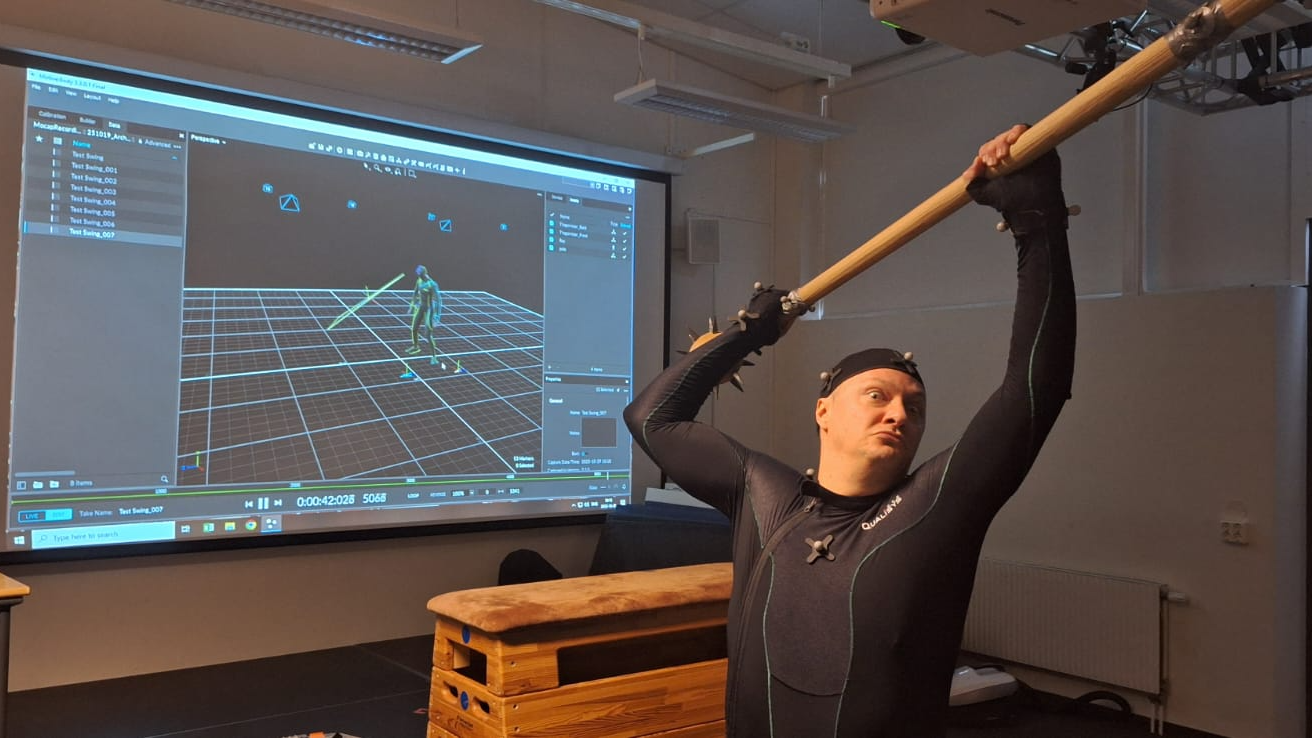
Ray Witcher, a medieval re-enactor, then wore a 4D motion-capture suit capable of recording his movements from multiple angles. Using replica weapons, he recreated powerful combat strikes against the gelatin-covered bones.
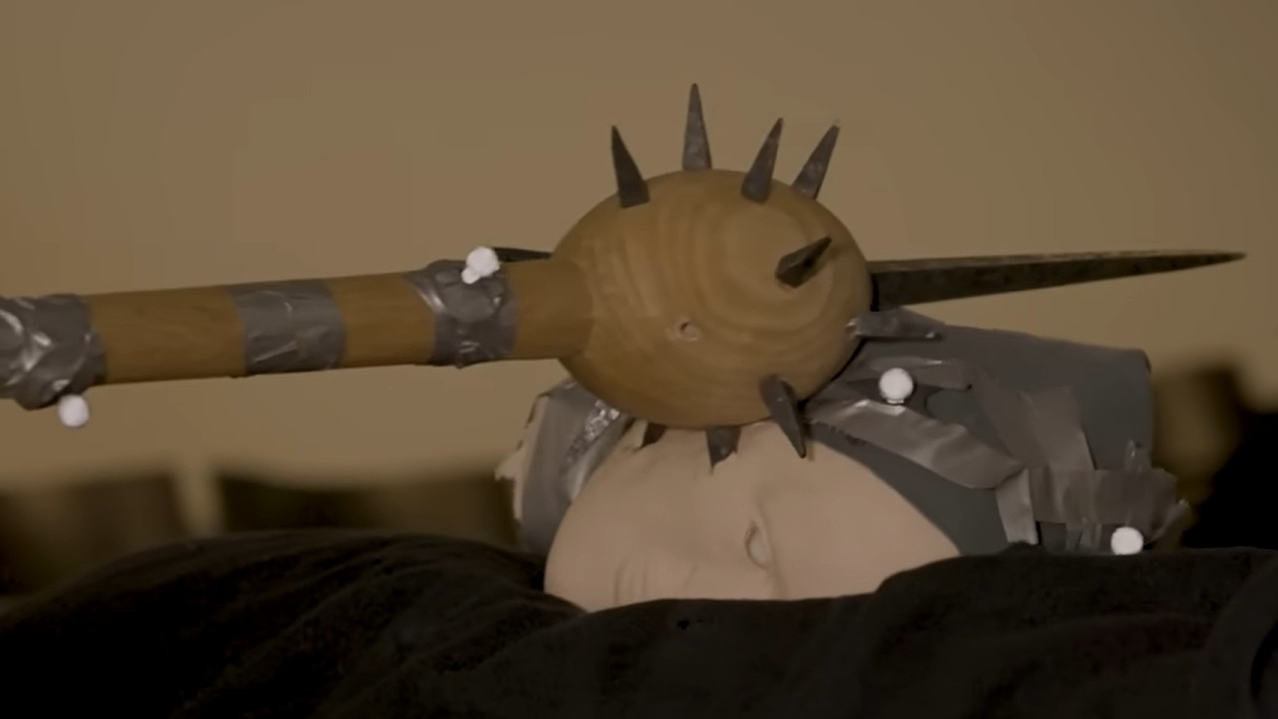
Researchers tested a replica spiked club to determine whether it could produce the square hole found in a Battle of Visby skull.
Image credit: Patrick Randolph-Quinney
The experiments showed that crossbows and axes did not create the same pattern of damage observed in the Visby remains. The replica spiked club, however, produced significant injuries that closely matched the square holes found in the medieval skulls.
Evidence of coordinated medieval combat
Several skeletons from the mass graves had multiple traumatic injuries. By examining the position, shape and overlap of the wounds, researchers were able to determine which strikes likely occurred first and which weapons were used.
One skull, for example, showed evidence of an axe injury followed by a distinct impact from a spiked club. This sequence suggests that more than one attacker may have targeted the same person.
“It’s a team of people working together. One person attacks from the front, two people attack from the back and sides, and they take out the legs with a big axe,” Randolph-Quinney explained.
After an opponent had been weakened or knocked down, another combatant may have delivered a final blow with a spiked club. This interpretation challenges the idea that medieval battles consisted primarily of isolated one-on-one fights.
Medieval militias may have been better trained than expected
The research also questions long-standing assumptions about the defenders of Visby. Traditional accounts often portray the Gotlandic militia as poorly equipped civilians, including older men and inexperienced young recruits who were unable to match the Danish army.
The injury patterns tell a more complicated story. The coordinated attacks and effective use of different weapons suggest that at least some of the defenders understood advanced battlefield tactics.
Joe Buckberry, a biological anthropologist at the University of Bradford in the United Kingdom who is collaborating on the project, said that soldiers did not need to belong to a permanent standing army to receive combat training.
“They may not have been in the standing army, but that doesn’t mean they weren’t trained,” Buckberry said.
The researchers emphasize that their conclusions remain preliminary because the study has not yet undergone peer review. Nevertheless, the combination of skeletal analysis, experimental archaeology and motion capture could help scientists reconstruct how medieval weapons were used and how combatants worked together.
“We need to understand the complexities of medieval combat. It’s not a simple process,” Randolph-Quinney said.
Can you identify these historical weapons and military objects? Test your knowledge with our World Weapons Quiz.
Source: www.livescience.com