


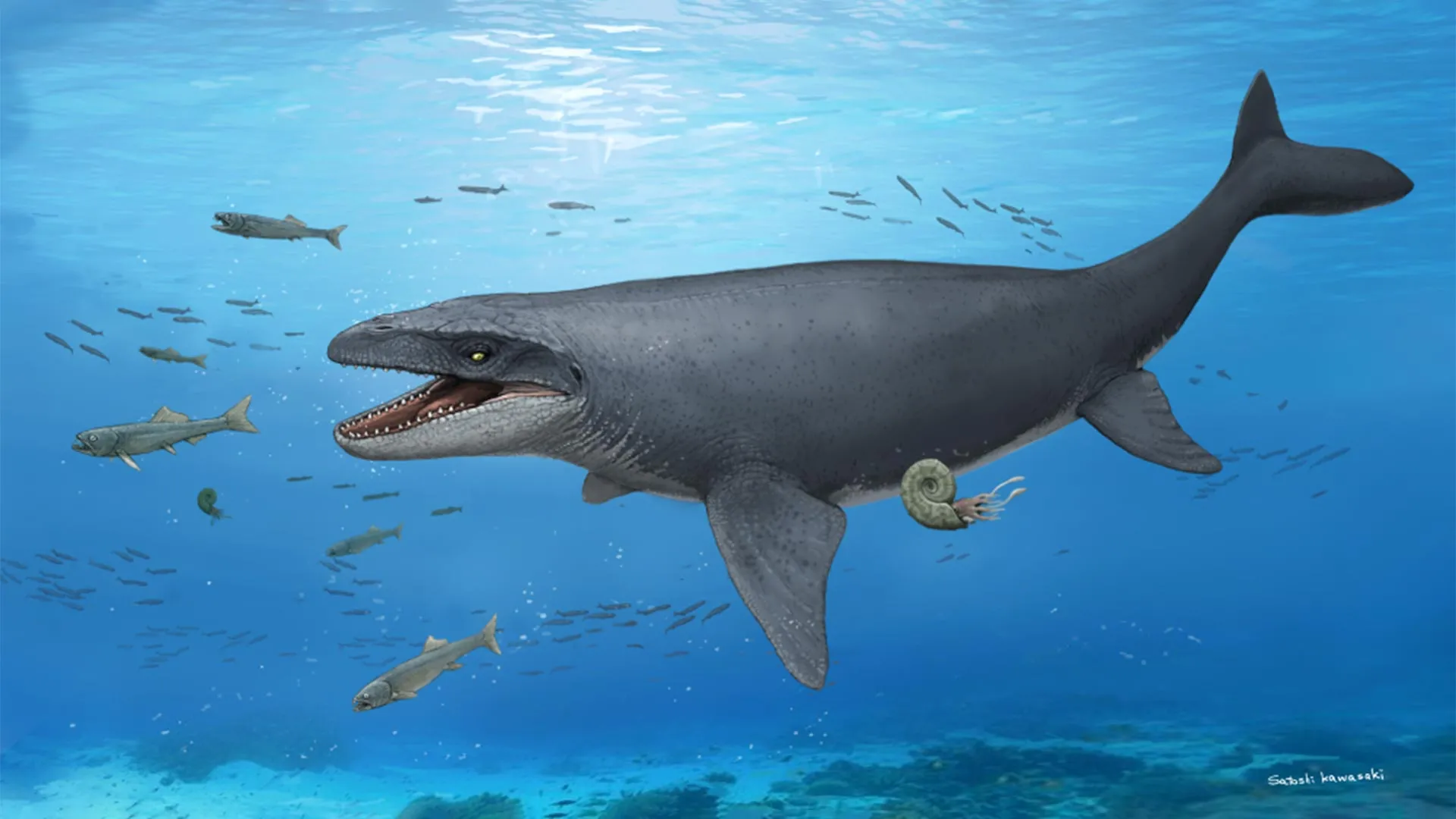
Researchers from Okayama University of Science, Tokyo City University, the Kishiwada City Museum of Natural History in Osaka Prefecture, and other institutions have identified four fossilized bones that remained overlooked for nearly 30 years. The fossils were discovered inside rock containing mosasaur remains collected in Kishiwada City, Osaka, and may belong to a previously unknown species of ancient marine reptile.
One of the most significant fossils is a premaxilla, the frontmost bone of the upper jaw. This marks the first confirmed discovery of a mosasaur premaxilla in Japan. Other unusual anatomical features found in the fossilized remains also differ from those documented in previously known mosasaurs, raising the possibility that the specimen represents a new species.
Ancient marine reptile fossils reexamined
Mosasaurs were large marine reptiles that inhabited oceans around the world during the Late Cretaceous Period, approximately 98 million to 66 million years ago. Their fossils provide important information about ancient marine ecosystems.
The fossil-bearing rock was discovered in Sobura, Kaizuka City, Osaka Prefecture, between 1990 and 1992. It was subsequently preserved at the Kishiwada City Museum of Natural History. When researchers recently reexamined the partially prepared rock fragment, they discovered four fossilized bones still embedded in the surrounding matrix.
The premaxilla is particularly important because it is the first skull bone of this type to be confirmed in a Japanese mosasaur fossil. Identifying the bone was difficult when the fossil was originally collected, as relatively few mosasaur specimens were available for comparison at the time.
Over the past several decades, researchers worldwide have assembled larger fossil collections and gained a more detailed understanding of mosasaur anatomy. This expanded knowledge enabled the research team to identify the previously unrecognized bone as a premaxilla.
Unusual skull features suggest a possible new mosasaur species
The researchers also examined the basal sphenoid, a bone located near the braincase, and identified several distinctive features.
The bone has short, horn-like processes that extend laterally and lacks a ventral median groove. These characteristics differ from those documented in other known mosasaurs. This unusual combination of features suggests that the fossil may belong to an undescribed species of mosasaur.
The discovery highlights the scientific value of reexamining unprepared fossils stored in museums and research collections. Specimens preserved for decades may still contain important bones and anatomical evidence that went unnoticed when they were first collected.
The fossil could also help scientists better understand the marine ecosystem of the Cretaceous northwest Pacific. Additional research will be necessary to determine whether the specimen represents a new species of mosasaur.
Research findings presented in Japan
The research results were announced at the 177th Annual Meeting of the Japanese Paleontological Society, held at Osaka Metropolitan University on June 27, 2026.
The research team included:
- Yasuaki Takano, Master’s Program, Graduate School of Okayama University of Science
- Shoji Hayashi, Associate Professor, Department of Dinosaur Paleontology, Okayama University of Science
- Yasuhisa Nakajima, Professor, Tokyo City University
- Satoshi Utsunomiya, Panasonic Electric Works Co., Ltd.
- Yuma Asai, Master’s Course, University of Tsukuba
- Miho Kazama, Curator, Kishiwada City Museum of Natural History
- Katsunori Watanabe, Advisor, Kishiwada City Museum of Natural History
Source: www.sciencedaily.com