


Can AI Harm Critical Thinking? Why Human Teachers Still Matter
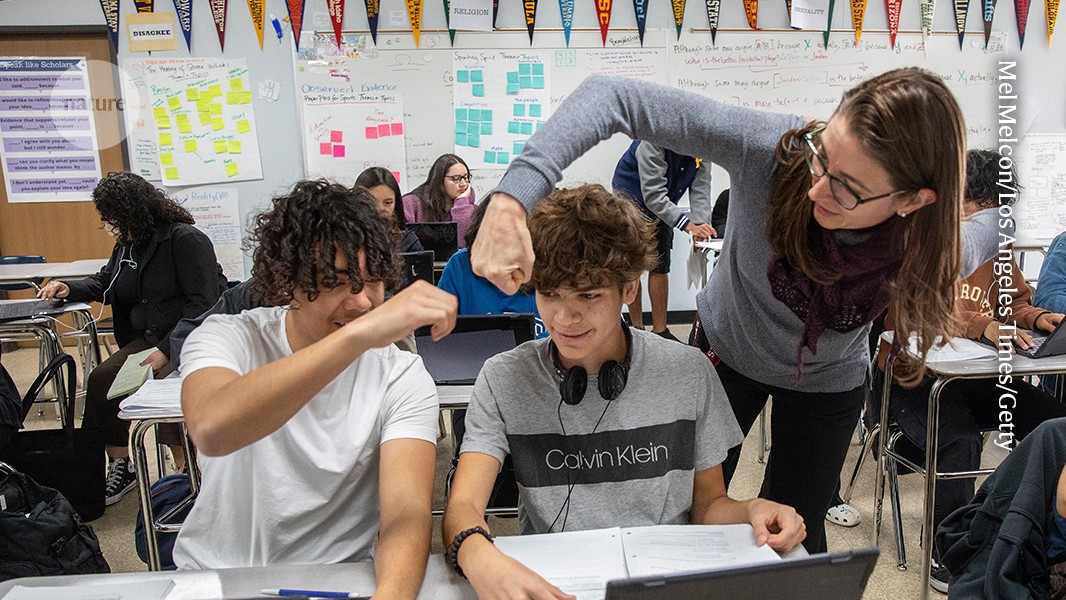
As students become accustomed to using AI tools, teachers remain essential for creating excitement about learning.
Credit: Mel Melcon/Los Angeles Times/Getty
Will artificial intelligence damage our ability to think critically? The question has become urgent for educators, from early-career teachers to experienced adult trainers. For universities, the issue is existential: teaching students how to think, and why that thinking matters, is central to the university’s mission.
Students, study leaders, prospective students, parents and carers are asking whether pursuing a qualification still makes sense when complex questions can be answered or essays written with a few chatbot prompts. They are also questioning what happens when AI tools grade assignments without teachers engaging directly with the content.
What the research says about AI and critical thinking
A news feature reviewing the literature on AI and critical thinking addresses these concerns. Because research is still in its early stages, it is too soon to draw final conclusions. However, AI use is already widespread, and teachers are reporting signs that chatbots may be reducing opportunities for thinking and reasoning.
Universities around the world are preparing for what could be a revolution in teaching, learning and assessment—possibly one greater than the introduction of personal computers, email and the Internet.
How universities are using AI in education
Last month, the Massachusetts Institute of Technology (MIT) in Cambridge published the results of a review of how its staff and students use AI. The report found that fear of missing deadlines was students’ greatest temptation to use AI. It also said that surviving encounters with AI without significant disruption would require “significant adaptation”. Read the MIT report.
Universities are incorporating AI tools into learning and teaching, including tasks traditionally performed by people. Chatbots can answer questions that students might otherwise ask administrative staff during their first week. Several universities are also experimenting with AI-generated lectures.
AI tools can provide feedback on coursework submissions. Thomas Corbin, a researcher who studies assessment and digital learning at Deakin University in Melbourne, Australia, said students report that one benefit is not having to wait for feedback. It is available immediately and 24 hours a day.
Why teachers remain essential in the age of AI
As this transition continues, the guiding role of human teachers will remain important. Teachers must help students learn how to think while using AI and stay on top of student progress, even when feedback is outsourced to AI tools.
There are no shortcuts to this, as Nobel Prize-winning economist Philippe Aghion said earlier this month at the Paris Nature Conference on AI in Healthcare: “We need schools where people learn to learn.”
What critical thinking means in education
Although the phrase “critical thinking” is widely used, researchers across disciplines define it in different ways. Cognitive scientists who study the relationship between cognition and education focus on high-level processes such as memory, reasoning, decision-making and problem-solving. Each process involves different but overlapping brain mechanisms.
For social scientists who study teaching and learning, critical thinking includes weighing evidence, considering trade-offs when making decisions and taking other people’s opinions into account during discussions.
Learning to apply these skills successfully requires deep subject knowledge and hours of practice with tasks and exercises. It also requires learning from mistakes—what teachers call “teachable moments”. Feedback within the student–teacher relationship, including the “light bulb moment” when students realize they have achieved something after sustained effort, is invaluable.
AI, calculators and the history of educational technology
The history of education is full of concerns about declining standards. Educators worried when pocket calculators replaced logarithm tables and when word processors replaced handwritten or typewritten compositions. Some also feared that word processors would affect how students think while completing assignments.
One argument was that computers could correct errors, meaning students would spend less time thinking about what to write. These technologies have not eliminated critical thinking, although some might argue that they have weakened it. If AI is properly managed, there may likewise be less risk to this skill.
However, AI differs from many earlier technologies. Thinking requires concentration, and there is evidence that smartphones and social media make students more easily distracted than previous generations, contributing to lower standards (see the OECD report).
Students using calculators and spreadsheets can generally be confident that their calculations are correct. Human error can still occur, but the device and software themselves can be trusted for the task. AI outputs require a different approach: users must examine the results carefully and verify the sources and evidence. Doing that requires knowledge and practice in thinking.
How schools can protect critical thinking while using AI
AI is the next major classroom revolution. Students and teachers need time to learn how to use it—and how to think critically about its results. Just as important is teaching in ways that are exciting and engaging.
This is where teachers can be at their best: at the centre of the learning process, guiding students every step of the way and helping them develop the knowledge, reasoning and confidence they need to learn effectively with AI.
Source: www.nature.com