


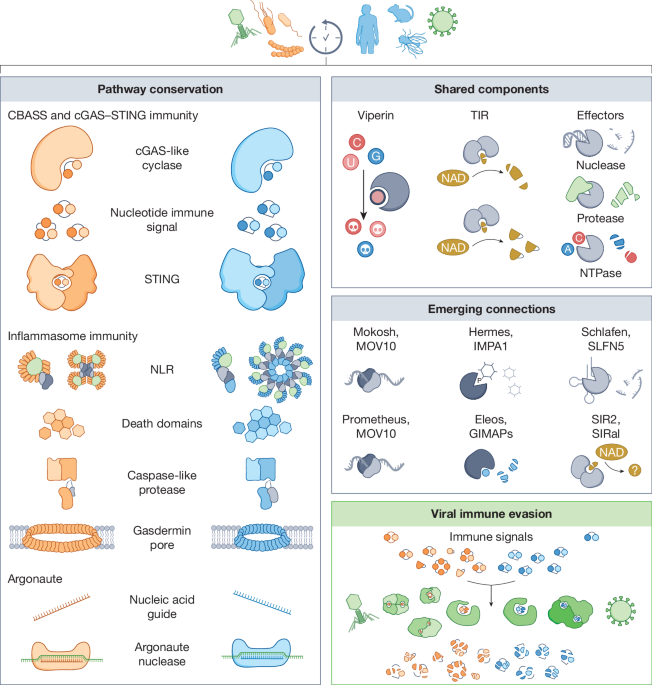
The supplied content is a bibliography/reference list rather than an article body. Bibliographic citations should not be paraphrased for SEO because changing author names, titles, journals, volumes, pages, or publication years can make the references inaccurate.
Below is an SEO-friendly, accessible HTML structure that preserves the citation content and existing classes while improving semantics, link security, and usability:
References
Explore the scientific research supporting this article, including studies on
bacterial immunity, antiviral defence systems, bacteriophages, innate immunity,
CRISPR–Cas systems and viral evolution.
<li class="c-article-references__item js-c-reading-companion-references-item"
data-counter="1."
itemprop="itemListElement"
itemscope
itemtype="https://schema.org/ScholarlyArticle">
<p class="c-article-references__text" id="ref-CR1" itemprop="citation">
Iuliano, A. D. et al. Estimates of global seasonal influenza-associated
respiratory mortality: a modelling study.
<i itemprop="isPartOf">Lancet</i>
<b>391</b>, 1285–1300 (2018).
</p>
<p class="c-article-references__links u-hide-print">
<a href="https://doi.org/10.1016/S0140-6736(17)33293-2"
rel="nofollow noopener"
target="_blank"
aria-label="Read the article: Estimates of global seasonal influenza-associated respiratory mortality">
Article
</a>
<a href="https://pubmed.ncbi.nlm.nih.gov/29248255/"
rel="nofollow noopener"
target="_blank"
aria-label="View PubMed record for reference 1">
PubMed
</a>
<a href="https://scholar.google.com/scholar_lookup?title=Estimates%20of%20global%20seasonal%20influenza-associated%20respiratory%20mortality%3A%20a%20modelling%20study"
rel="nofollow noopener"
target="_blank"
aria-label="Search reference 1 in Google Scholar">
Google Scholar
</a>
</p>
</li>
<li class="c-article-references__item js-c-reading-companion-references-item"
data-counter="2."
itemprop="itemListElement"
itemscope
itemtype="https://schema.org/ScholarlyArticle">
<p class="c-article-references__text" id="ref-CR2" itemprop="citation">
Mazur, N. I., Caballero, M. T. & Nunes, M. C. Severe respiratory
syncytial virus infection in children: burden, management, and emerging
therapies.
<i itemprop="isPartOf">Lancet</i>
<b>404</b>, 1143–1156 (2024).
</p>
<p class="c-article-references__links u-hide-print">
<a href="https://doi.org/10.1016/S0140-6736(24)01716-1"
rel="nofollow noopener"
target="_blank"
aria-label="Read the article: Severe respiratory syncytial virus infection in children">
Article
</a>
<a href="https://pubmed.ncbi.nlm.nih.gov/39265587/"
rel="nofollow noopener"
target="_blank"
aria-label="View PubMed record for reference 2">
PubMed
</a>
<a href="https://scholar.google.com/scholar_lookup?title=Severe%20respiratory%20syncytial%20virus%20infection%20in%20children"
rel="nofollow noopener"
target="_blank"
aria-label="Search reference 2 in Google Scholar">
Google Scholar
</a>
</p>
</li>
<li class="c-article-references__item js-c-reading-companion-references-item"
data-counter="3."
itemprop="itemListElement"
itemscope
itemtype="https://schema.org/ScholarlyArticle">
<p class="c-article-references__text" id="ref-CR3" itemprop="citation">
He, W. T. et al. Virome characterization of game animals in China reveals
a spectrum of emerging pathogens.
<i itemprop="isPartOf">Cell</i>
<b>185</b>, 1117–1129.e8 (2022).
</p>
<p class="c-article-references__links u-hide-print">
<a href="https://doi.org/10.1016/j.cell.2022.02.014"
rel="nofollow noopener"
target="_blank"
aria-label="Read the article: Virome characterization of game animals in China">
Article
</a>
<a href="https://pubmed.ncbi.nlm.nih.gov/35298912/"
rel="nofollow noopener"
target="_blank"
aria-label="View PubMed record for reference 3">
PubMed
</a>
<a href="https://www.ncbi.nlm.nih.gov/pmc/articles/PMC9942426/"
rel="nofollow noopener"
target="_blank"
aria-label="View PubMed Central record for reference 3">
PubMed Central
</a>
<a href="https://scholar.google.com/scholar_lookup?title=Virome%20characterization%20of%20game%20animals%20in%20China%20reveals%20a%20spectrum%20of%20emerging%20pathogens"
rel="nofollow noopener"
target="_blank"
aria-label="Search reference 3 in Google Scholar">
Google Scholar
</a>
</p>
</li>
<!-- Continue the same structure for references 4–280.
Preserve each citation exactly as published. -->Recommended SEO improvements:
- Use
<section>and a descriptive<h2>. - Use
<ol>because the references are sequential. - Preserve the original citation wording for accuracy.
- Use
https://links instead of outdatedhttp://links. - Add
target="_blank"withrel="nofollow noopener"to external sources. - Add descriptive
aria-labelattributes for accessibility. - Use
ScholarlyArticlestructured-data attributes where appropriate. - Remove unnecessary tracking attributes such as
data-track,data-track-value, anddata-track-actionif they are not required by your analytics system.
Source: www.nature.com