


70 years ago, physicists Clyde Cowan and Frederick Reines built a custom 10-ton detector, surrounded it with thick lead walls and wet sandbags, and placed it near a powerful nuclear reactor at the Savannah River Plant in South Carolina. They called the experiment Project Poltergeist, and its goal was to capture elusive particles that behaved like ghosts: neutrinos.
More than a quarter of a century earlier, physicists had been puzzled by missing energy in a radioactive process known as beta decay. Something appeared to be carrying energy away, but existing physics offered no explanation. In 1930, Austrian physicist Wolfgang Pauli proposed a radical solution: virtually undetectable particles were silently transporting the missing energy. “I did something terrible,” Pauli reportedly told a friend. “I hypothesized a particle that cannot be detected.” The particle eventually became known as the neutrino. With almost no mass or electric charge, neutrinos can pass through the Earth and nearly everything on it, including the human body.
The massive detector introduced by Cowan and Reines in early 1956 was designed to find what Pauli had considered nearly impossible to observe. That June, the two physicists sent a telegram to Pauli: “We are pleased to announce that we have definitely detected a neutrino.”
The discovery soon led to broader questions. If nuclear reactions produce neutrinos, could scientists use them to observe the nuclear processes taking place inside stars, including the Sun? Detecting neutrinos from distant stars would be extremely difficult. Because these particles rarely interact with matter, scientists needed enormous quantities of material to increase the chances of a collision. They also had to shield their detectors from other sources of radiation. The solution was to build some of the largest, deepest, and most unusual scientific instruments ever created—and then wait.
In the 1960s, Raymond Davis Jr. of Brookhaven National Laboratory and his colleagues installed a detector 1.5 kilometers underground at the Homestake Mine in South Dakota. The tank contained approximately 400,000 liters of perchloroethylene, a chlorine-based cleaning fluid. In rare cases, when a solar neutrino struck a chlorine nucleus, the nucleus transformed into a radioactive form of argon that scientists could identify and count. After operating for 25 years, the experiment detected only about one-third as many solar neutrinos as theoretical models predicted. The discrepancy became known as the solar neutrino problem.
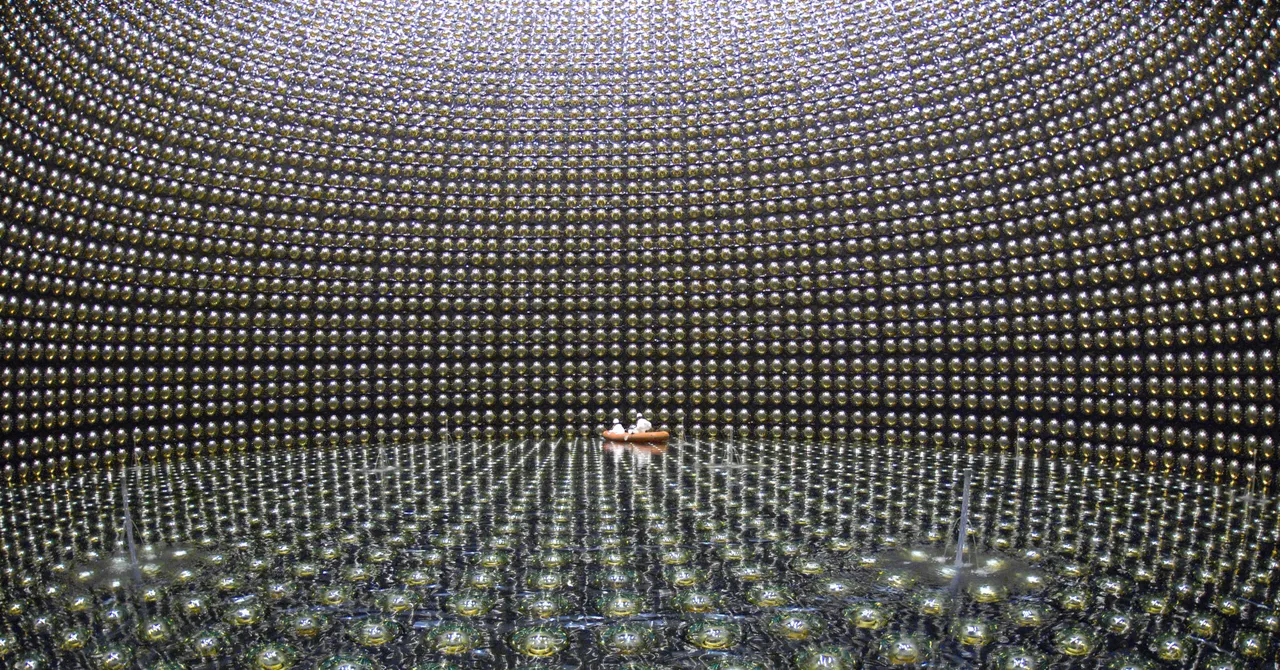
Decades passed before larger and more advanced neutrino experiments solved the mystery. Deep inside Japan’s Kamioka Mine, Masatoshi Koshiba developed Kamiokande, a detector containing 3 million liters of ultrapure water. When a neutrino occasionally interacted with a water molecule, it produced a fast-moving electron. That electron generated faint flashes of Cherenkov light, which were recorded by sensitive photodetectors.
Kamiokande and Koshiba confirmed Davis’s results. Later, the even larger Super-Kamiokande detector in Japan and Canada’s Sudbury Neutrino Observatory explained the missing-neutrino mystery. Neutrinos exist in three “flavors”—electron, muon, and tau—and can oscillate, or change from one flavor into another. This behavior requires neutrinos to have mass, a property that was not predicted by the Standard Model of particle physics.
Modern neutrino observatories continue this tradition of ambitious experiments and unexpected discoveries. At the IceCube Neutrino Observatory, beneath the Amundsen-Scott South Pole Station, Antarctic ice serves as a giant particle detector. Researchers have used IceCube data to create a map of the Milky Way based entirely on neutrinos, tracing high-energy cosmic particles to active galaxies powered by supermassive black holes. Meanwhile, at the bottom of the Mediterranean Sea, the Cubic Kilometre Neutrino Telescope, known as KM3NeT, has detected one of the highest-energy cosmic neutrinos ever recorded. Its source remains unknown.
Source: www.wired.com