


Close Menu
HitechubHitechub
    What's Hot
    Technology

    How AI Can Help Close Breast Cancer’s Deadliest Gap

    Science

    Net-Zero Emissions Won’t Reverse Climate Change as Countries Pursue Net-Negative Targets

    Science

    New Scientist Highlights Steve Brusatte’s Insights on Bird Evolution

    Important Pages:
    • About Us
    • Privacy Policy
    • Terms & Conditions
    Facebook X (Twitter) Instagram Pinterest
    Facebook X (Twitter) Instagram
    HitechubHitechub
    Saturday, November 28
    • Shop
      • Fashion
        • Mens
        • Womens
        • Accessories
          • Handbags
          • Keychain
          • Masks
          • Money clicps
          • Neck Pillow
          • Rings
          • Towels
          • Wallets
        • Jewelry
        • Watches
        • T-shirts
        • Hawaiian shirts
        • Vests
        • Swim trunks
        • Swimsuits
      • Fun
        • Magic cubes
        • Magnifiers
        • Misc
        • Photo books
        • Puzzles
        • Toys
      • Home
        • Cleaning/Care
        • Mailbox covers
        • Mugs
        • Pot Holders
        • Spoon
      • Office and Electronics
        • Chairs
        • Office Supplies
        • IPad cases
        • Laptop stickers
        • Mouse pads
        • Notebooks
        • Pencil bags
        • Pens
        • Phone cases
      • Personalized
      • Pets
      • Sports
        • Cycling
          • Balaclava Mask
          • Bike Bell
          • Bike Computer
          • Bike Fender
          • Bike Grips
          • Bike Kickstand
          • Bike Light
          • Bike Locks
          • Bike Mitts
          • Bike Pumps
          • Bike Repair Stand
          • Bike Seat
          • Bike Trainer
          • Bike Wheels
          • BIKES
            • Folding Bikes
            • Road Bikes
          • Carbon Fiber Bike Products
          • Cycling Mask
          • Kid’ Bike Helmets
          • Inner Tube
          • Motorcycle Bag
          • Nylon Pedals
          • Adult Helmets
          • Photochromic Sunglasses
          • Soft Coolers
          • Suction Cup Bike Rack
          • Tool accessories
          • Winter Cloth
          • Heart Rate Monitor
        • Outdoors/Camping
          • Outdoor Bags
        • Sweatband
    • Technology
      1. AI
      2. Gadgets
      3. View All

      This is the most popular CEO in the world

      Sectors in which “Chat-GPT” is most often used

      Artificial intelligence has begun to “swallow” professions

      The unusual robot conductor of a concert in Seoul

      Here’s how you can tell if your phone is being tapped

      PlayStation 5 becomes a completely silent console and gets more space

      This is the first phone that can be used to park a car

      Best Gaming Laptops 2023: Powerful Portables for PC Games

      Why Firewalls Aren’t Enough: Hidden Security Risks of Unmanaged Virtual Machines (VMs)

      Boston Scientific Data Breach Exposes Patients’ Personal Medical Information

      pCloud Confirms Password Manager Hack Following Suspicious Login Alert

      How Advanced Prosthetics Help Us Explore the Human Mind

    • Science
      1. Space
      2. Wheels
      3. View All

      Space Perspective: A Journey to the Edge of Space

      5 Fascinating Facts About Space

      Space Exploration: Unveiling the Wonders of the Universe

      Toyota wants to make a new generation battery with a range of up to 1,200 km

      Meet Toyota’s lunar “baby” that could make exploring the Moon easier

      What does a night drive look like with one of the most beautiful cars in the world: the Rolls-Royce Ghost

      Ancient Protein Links Chinese Fossil Remains to Denisovans

      DARPA Evaluates Microsoft’s Majorana 2 Quantum Computing Technology: What If It’s Proven Legitimate?

      Scientists Identify Two Ages When Children Are Most Vulnerable to Screen Time Effects

      WATCH: Why Are We the Last Humans Left on Earth?

    HitechubHitechub
    Home » Inside the Experimental Trap Designed to Capture Elusive Ghost Neutrinos
    Technology

    Inside the Experimental Trap Designed to Capture Elusive Ghost Neutrinos

    Share Facebook Twitter Pinterest WhatsApp
    Share
    Facebook Twitter LinkedIn Pinterest WhatsApp

    70 years ago, physicists Clyde Cowan and Frederick Reines built a custom 10-ton detector, surrounded it with thick lead walls and wet sandbags, and placed it near a powerful nuclear reactor at the Savannah River Plant in South Carolina. They called the experiment Project Poltergeist, and its goal was to capture elusive particles that behaved like ghosts: neutrinos.

    More than a quarter of a century earlier, physicists had been puzzled by missing energy in a radioactive process known as beta decay. Something appeared to be carrying energy away, but existing physics offered no explanation. In 1930, Austrian physicist Wolfgang Pauli proposed a radical solution: virtually undetectable particles were silently transporting the missing energy. “I did something terrible,” Pauli reportedly told a friend. “I hypothesized a particle that cannot be detected.” The particle eventually became known as the neutrino. With almost no mass or electric charge, neutrinos can pass through the Earth and nearly everything on it, including the human body.

    The massive detector introduced by Cowan and Reines in early 1956 was designed to find what Pauli had considered nearly impossible to observe. That June, the two physicists sent a telegram to Pauli: “We are pleased to announce that we have definitely detected a neutrino.”

    The discovery soon led to broader questions. If nuclear reactions produce neutrinos, could scientists use them to observe the nuclear processes taking place inside stars, including the Sun? Detecting neutrinos from distant stars would be extremely difficult. Because these particles rarely interact with matter, scientists needed enormous quantities of material to increase the chances of a collision. They also had to shield their detectors from other sources of radiation. The solution was to build some of the largest, deepest, and most unusual scientific instruments ever created—and then wait.

    In the 1960s, Raymond Davis Jr. of Brookhaven National Laboratory and his colleagues installed a detector 1.5 kilometers underground at the Homestake Mine in South Dakota. The tank contained approximately 400,000 liters of perchloroethylene, a chlorine-based cleaning fluid. In rare cases, when a solar neutrino struck a chlorine nucleus, the nucleus transformed into a radioactive form of argon that scientists could identify and count. After operating for 25 years, the experiment detected only about one-third as many solar neutrinos as theoretical models predicted. The discrepancy became known as the solar neutrino problem.

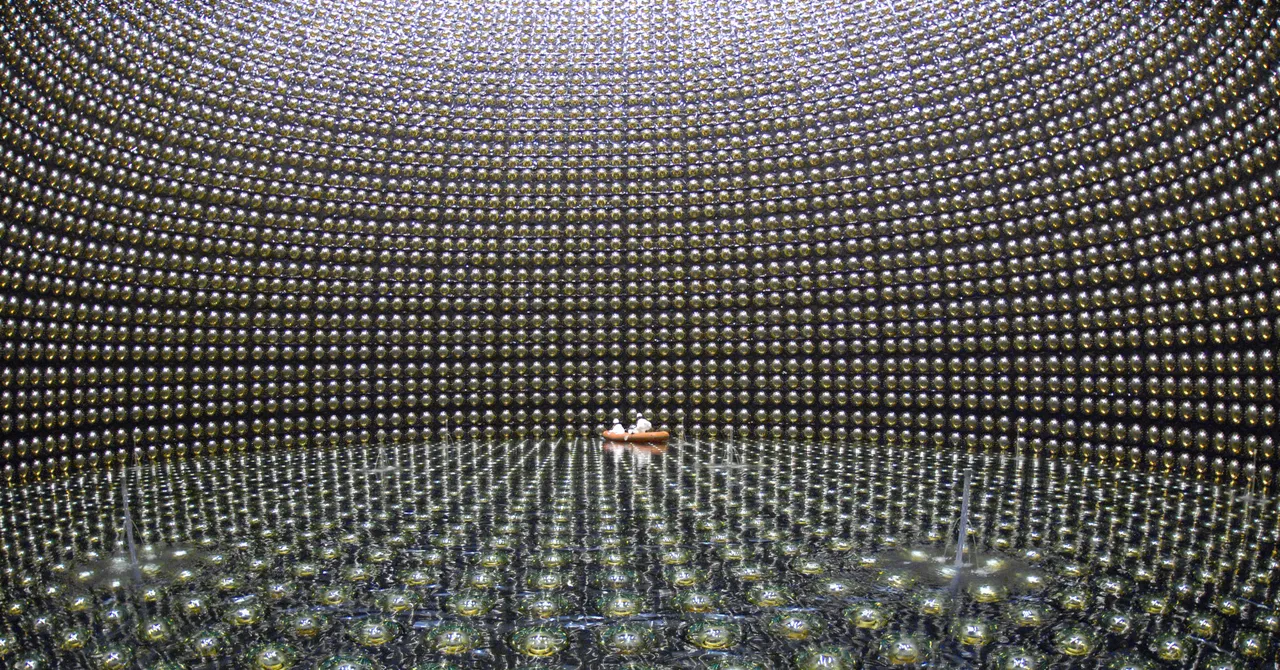
    Decades passed before larger and more advanced neutrino experiments solved the mystery. Deep inside Japan’s Kamioka Mine, Masatoshi Koshiba developed Kamiokande, a detector containing 3 million liters of ultrapure water. When a neutrino occasionally interacted with a water molecule, it produced a fast-moving electron. That electron generated faint flashes of Cherenkov light, which were recorded by sensitive photodetectors.

    Kamiokande and Koshiba confirmed Davis’s results. Later, the even larger Super-Kamiokande detector in Japan and Canada’s Sudbury Neutrino Observatory explained the missing-neutrino mystery. Neutrinos exist in three “flavors”—electron, muon, and tau—and can oscillate, or change from one flavor into another. This behavior requires neutrinos to have mass, a property that was not predicted by the Standard Model of particle physics.

    Modern neutrino observatories continue this tradition of ambitious experiments and unexpected discoveries. At the IceCube Neutrino Observatory, beneath the Amundsen-Scott South Pole Station, Antarctic ice serves as a giant particle detector. Researchers have used IceCube data to create a map of the Milky Way based entirely on neutrinos, tracing high-energy cosmic particles to active galaxies powered by supermassive black holes. Meanwhile, at the bottom of the Mediterranean Sea, the Cubic Kilometre Neutrino Telescope, known as KM3NeT, has detected one of the highest-energy cosmic neutrinos ever recorded. Its source remains unknown.

    Source: www.wired.com

    Share. Facebook Twitter Pinterest LinkedIn WhatsApp
    Previous ArticleAstronomers Discover Water Near the Milky Way’s Black Hole in a Harsh Environment | Space Photo of the Week
    Next Article TerraMow V1000 Review: Features, Performance, and Lawn Care Results

    Related Posts

    Technology

    Why Firewalls Aren’t Enough: Hidden Security Risks of Unmanaged Virtual Machines (VMs)

    Technology

    Boston Scientific Data Breach Exposes Patients’ Personal Medical Information

    Technology

    pCloud Confirms Password Manager Hack Following Suspicious Login Alert

    Technology

    How Advanced Prosthetics Help Us Explore the Human Mind

    Technology

    Unpatched Cacti Zero-Day Exploit With Public PoC Enables Remote Code Execution

    Technology

    Best Black Friday Deals and Discounts Handpicked by Ars Technica

    Technology

    Download: Bionic Windows to the Mind as Nominations Open for Innovators Under 35

    Technology

    U.S. Air Force Cloud Platform Reportedly Hacked in Latest Federal Data Breach

    Add A Comment
    Leave A Reply Cancel Reply

    Stay In Touch
    • Facebook
    • Twitter
    • Instagram
    • Pinterest
    Top Picks
    Science

    Clay Minerals Reveal Evidence of Mars’ Warm, Wet Past – Sciworthy Insights

    While many envision Mars as merely a dusty red ball, recent research has unveiled mineral…

    I Set Up the UK Government’s Metascience Department: What Countries Need to Know

    NASA’s Hubble and Webb Telescopes Discover Ancient World Preserving Clues to the Past

    Study Finds Obesity in 4-Year-Olds Is a Stronger Warning Sign Than Being Overweight

    Unveiling the Secret Food Source of Deep Sea Creatures: What Scientists Never Expected

    Most Popular
    Science

    Nuneaton Farmer Misses Out on Wildlife Funding by Just Minutes

    Science

    New Scientist’s Top Insights on the Future of Work: Transformative Ideas and Trends

    Categories
    • AI (9)
    • Gadgets (6)
    • Science (3,623)
    • Space (3)
    • Technology (3,054)
    • Wheels (3)
    Our Picks
    Science

    UK Summer 2026 Predicted to Be the Hottest on Record

    Science

    Essar to Pay £873,000 for Stanlow Refinery Wastewater Leak

    © 2026 Hitechub.
    • Home
    • About Us
    • Privacy Policy
    • Terms & Conditions

    Type above and press Enter to search. Press Esc to cancel.

    GDPR Cookie Banner

    We are using cookies to give you the best experience on our website.

    You can find out more about which cookies we are using or switch them off in .

    Ad Blocker Enabled!
    Ad Blocker Enabled!
    Our website is made possible by displaying online advertisements to our visitors. Please support us by disabling your Ad Blocker.