


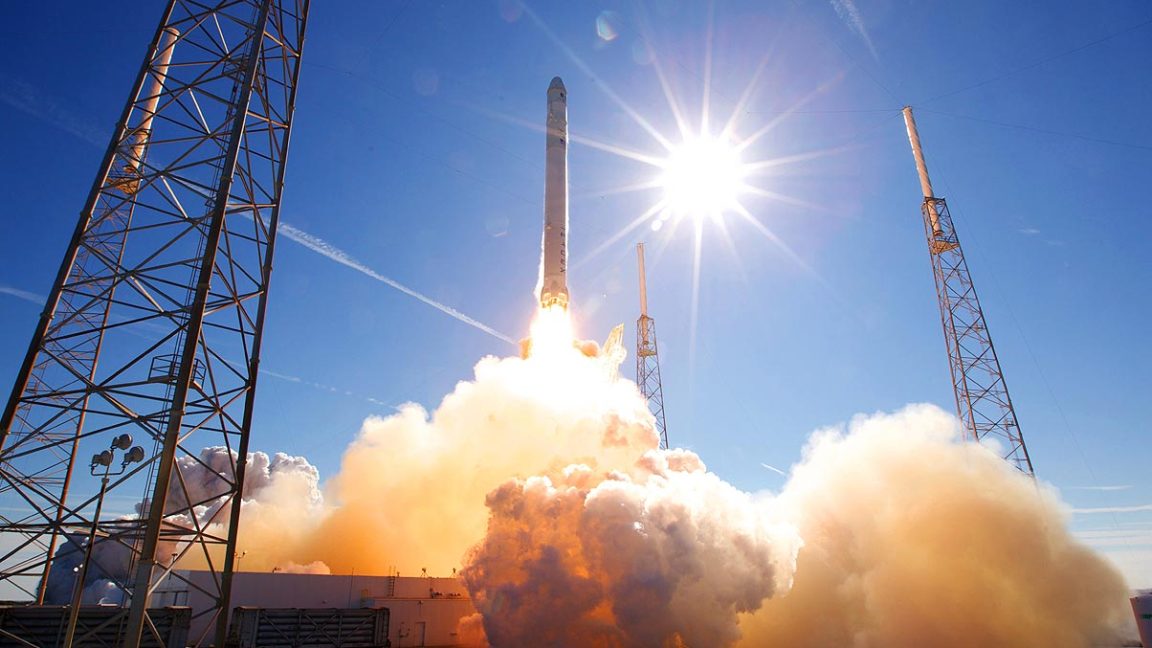
Despite decades of innovation, the Western commercial launch market has changed relatively little. Ariane 6 has introduced important changes in Europe, but across the broader industry, SpaceX’s Falcon 9 remains the dominant force shaping launch prices, schedules, and customer expectations.
What’s next for the new generation of launch vehicles?
Vulcan and New Glenn are powerful heavy-lift rockets, but they are not the only next-generation launch vehicles in development. Several American aerospace companies are also working on medium-lift rockets designed to compete in the growing commercial space launch market.
The smallest of these is Stoke Space’s Nova rocket. The company is designing Nova to be fully reusable, with the ability to deliver up to 7 metric tons to low Earth orbit. Stoke Space CEO Andy Lapsa has avoided announcing a firm launch date publicly. However, during a recent visit to the company’s factory in Kent, Washington, officials told Ars that they hope to ship a flight-ready version of the first stage to Florida for testing this fall. If development remains on schedule, Nova could make its debut during the first half of 2027.
Rocket Lab’s Neutron is another reusable medium-lift rocket under development. It is expected to carry up to 13 metric tons to low Earth orbit in reusable configuration and as much as 15 metric tons when operated in expendable mode. Neutron was originally scheduled to launch in 2024, but that target has been delayed several times. According to Rocket Lab’s latest guidance, the company plans to move the rocket to its Virginia launch site by the end of this year. A first launch in 2027 appears possible, although it is not guaranteed.
Relativity Space is also developing Terran R, a heavy-lift rocket designed to carry 23.5 metric tons to orbit in reusable mode and 33.5 metric tons in expendable mode. Since billionaire Eric Schmidt acquired the company, development of Terran R has continued to advance. Based on the rocket’s recent progress, a debut launch could take place within the next 12 months. However, because Terran R is a large and complex vehicle, additional delays remain possible.
This rendering shows Rocket Lab’s Neutron rocket carrying a stack of satellites into orbit.
Credit: Rocket Lab
Firefly Aerospace and Northrop Grumman are also working on Eclipse, a launch vehicle reportedly designed to deliver up to 16 metric tons to orbit. Few details are currently available about the rocket’s development or launch schedule. As a result, Eclipse is likely to enter service after the other next-generation rockets discussed here.
Together, these vehicles could reshape the commercial launch industry by expanding competition beyond Falcon 9. Their success will depend on reliable operations, competitive pricing, and the ability to deliver reusable rockets at scale.
Source: arstechnica.com