


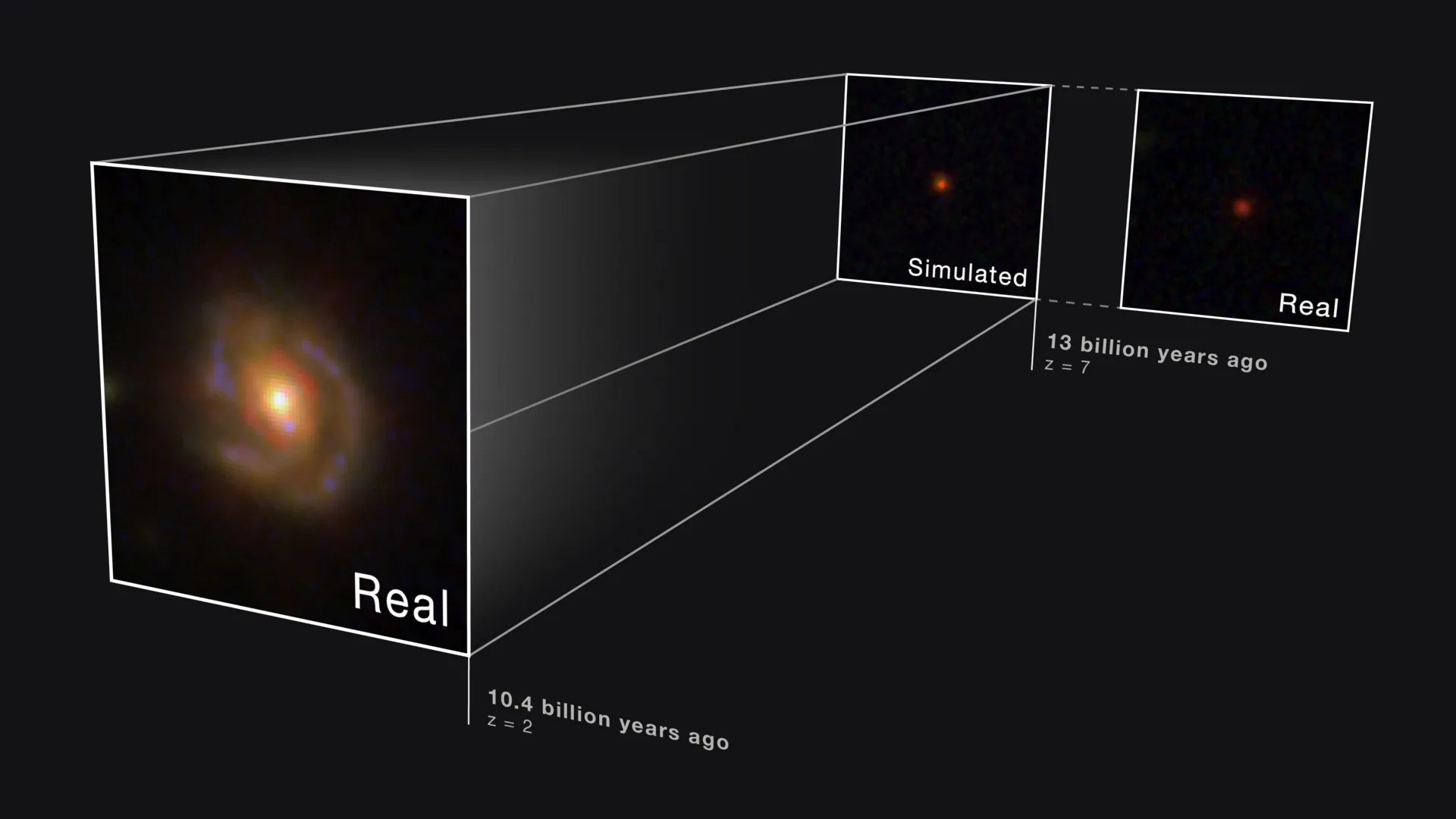
Since NASA’s James Webb Space Telescope (JWST) discovered the first “little red dots” (LRDs) in 2022, astronomers have worked to understand these mysterious objects. The extremely distant, compact red sources appear throughout the early universe, yet their true nature and evolution remain uncertain.
One leading explanation is that little red dots are supermassive black holes surrounded by rapidly accreting matter—a phenomenon known as an active galactic nucleus (AGN). However, LRDs do not behave exactly like AGNs in the nearby universe. They are common at high redshifts but become increasingly rare at lower redshifts. Because greater redshift generally indicates that light has traveled farther and originated earlier in cosmic history, this pattern raises important questions about how LRDs evolve as the universe ages.
A possible evolutionary path for little red dots
A research team led by Pierluigi Rinaldi of the University of Arizona’s Steward Observatory, now affiliated with the Space Telescope Science Institute (STScI) in Baltimore, may have uncovered part of the answer. Building on earlier research, the team published a new study on July 29 in The Astrophysical Journal.
The study suggests that little red dots may not represent a completely separate population of galaxies. Instead, their unusual appearance could be partly caused by observational bias. At extreme distances, the faint structures surrounding these objects become too dim for current telescopes to detect, leaving only the bright central source visible.
The researchers reached this conclusion by studying a low-redshift spiral galaxy known as WISEA J123635.56+621424.2. They nicknamed the galaxy “Saguaro” because its prominent spiral arms resemble the cacti found in the Sonoran Desert of the southwestern United States. Located at a redshift of about 2, Saguaro formed roughly 3.3 billion years after the Big Bang. Its center contains a compact red source that closely resembles a little red dot and evokes the ruby-red berries of a desert cactus.
“Everything created in the early universe should have evolved into something around us. Little was known about what LRDs would look like, but our results show us how to eventually find their descendants,” said co-author George Rieke of the University of Arizona.
Earlier observations from NASA’s retired Spitzer Space Telescope had already offered a glimpse of the compact, dusty galaxy system surrounding Saguaro. Those findings helped pave the way for more detailed observations with NASA’s Hubble Space Telescope and the James Webb Space Telescope.
“Saguaro is important because it is a typical little red dot and one of the few examples found at a lower redshift. That makes it possible to study how these objects may evolve over cosmic time,” said Fabio Pacucci of the Harvard-Smithsonian Center for Astrophysics in Cambridge, Massachusetts, a co-author of the study.
Webb and Hubble reveal Saguaro’s hidden details
Rinaldi examined thousands of sources across multiple astronomical surveys, but Saguaro stood out because unusually valuable observations were available. One of Webb’s microshutter arrays was positioned directly over the galaxy’s center, allowing the telescope to collect spectroscopic data from its core. Saguaro’s relatively low redshift also enabled astronomers to study its larger galactic structure in greater detail.
To examine the spiral galaxy across a broad range of wavelengths, the team combined archival observations from Hubble and Webb. Hubble provided ultraviolet imaging, while Webb contributed infrared images and spectroscopic data.
“Because Saguaro is at a lower redshift, Webb and Hubble allow us to see its bright, beautiful host galaxy in high resolution and detail,” said Zhihao Wu of the Harvard-Smithsonian Center for Astrophysics, a co-author of the study. “Webb’s observations help us understand how galaxies and their little red dot-like nuclei are connected.”
The researchers used several techniques to determine whether Saguaro’s compact red center shared the characteristics of a typical LRD. Observations from Hubble and Webb showed that the galaxy’s central nucleus emits stronger radiation at ultraviolet and infrared wavelengths than at visible wavelengths—a signature that can make distant galactic nuclei appear as little red dots.
The team also separated the light emitted by the galaxy from the radiation produced by its central source to determine whether Saguaro was emitting X-rays.
Most high-redshift little red dots have not been detected in X-rays. Saguaro, however, produces weak X-ray emission that was observed by NASA’s Chandra X-ray Observatory.
“The X-ray observations show that this galaxy contains an active galactic nucleus and that it is heavily obscured,” said study co-author Carys Gilbert, a master’s student at the University of Cape Town in South Africa. “Not only is the nucleus hidden, but its X-ray emission is also weak. That combination could explain why X-rays have not been detected from many other little red dots. It fits neatly into the little red dot puzzle.”
What would Saguaro look like in the early universe?
The researchers then conducted another revealing test. After confirming that Saguaro’s compact red core matched the characteristics of a little red dot, they digitally shifted the galaxy to a higher redshift. This simulation showed how Saguaro might have appeared to astronomers observing it much earlier in cosmic history.
The results were striking. As Saguaro was placed at increasingly greater simulated distances, its surrounding galaxy became so faint that it disappeared from view. The spiral structure also vanished, while the bright, LRD-like source at the center remained visible.
These findings support the idea that at least some distant little red dots appear isolated simply because their fainter host galaxies and surrounding structures are too difficult to detect.
“Our theory is that most of these distant sources are affected by this cosmological effect, creating observational biases,” Rinaldi said. “At high redshifts, we cannot study the immediate environment of little red dots because their surroundings are too faint to be observed, even by Webb. Little red dots are much more complex than simple points of light. They are the visible tip of the iceberg: a supermassive black hole interacting with its surrounding environment.”
A hidden stage of supermassive black hole growth
Based on the Saguaro case study, the researchers suggest that little red dots may not form a unique class of galaxies. Instead, they could represent a temporary phase in the evolution of galaxies, when a supermassive black hole is especially active and heavily obscured.
If this interpretation is correct, Saguaro could provide an important link between the large population of little red dots observed by Webb at high redshifts and galaxies in the more recent universe.
The researchers caution that Saguaro may not represent all LRDs. Rather, it may illustrate one possible stage in the evolution of these compact red cosmic sources.
Additional observations will be necessary to test this explanation. The research team plans to continue studying the Saguaro galaxy and search for more Saguaro-like galaxies at lower redshifts. They also intend to examine Webb’s extensive archives to build a larger census of little red dots and investigate how their surrounding environments influence their evolution.
Together, these efforts could help astronomers reconstruct the evolutionary history of little red dots and determine how these mysterious early-universe sources changed over cosmic time.
Webb and Hubble continue to explore the history of the universe
The James Webb Space Telescope is the world’s leading space science observatory. Webb investigates the mysteries of our solar system, studies distant worlds orbiting other stars, and explores the structure, origins, and evolution of the universe. Webb is an international program led by NASA in partnership with the European Space Agency (ESA) and the Canadian Space Agency (CSA).
The Hubble Space Telescope has operated for more than 30 years and continues to make groundbreaking discoveries that shape our understanding of the universe. Hubble is an international collaboration between NASA and ESA. NASA’s Goddard Space Flight Center in Greenbelt, Maryland, manages telescope and mission operations. Lockheed Martin Space in Denver supports mission operations at Goddard. The Space Telescope Science Institute in Baltimore, operated by the Association of Universities for Research in Astronomy, conducts Hubble science operations for NASA.
Source: www.sciencedaily.com