


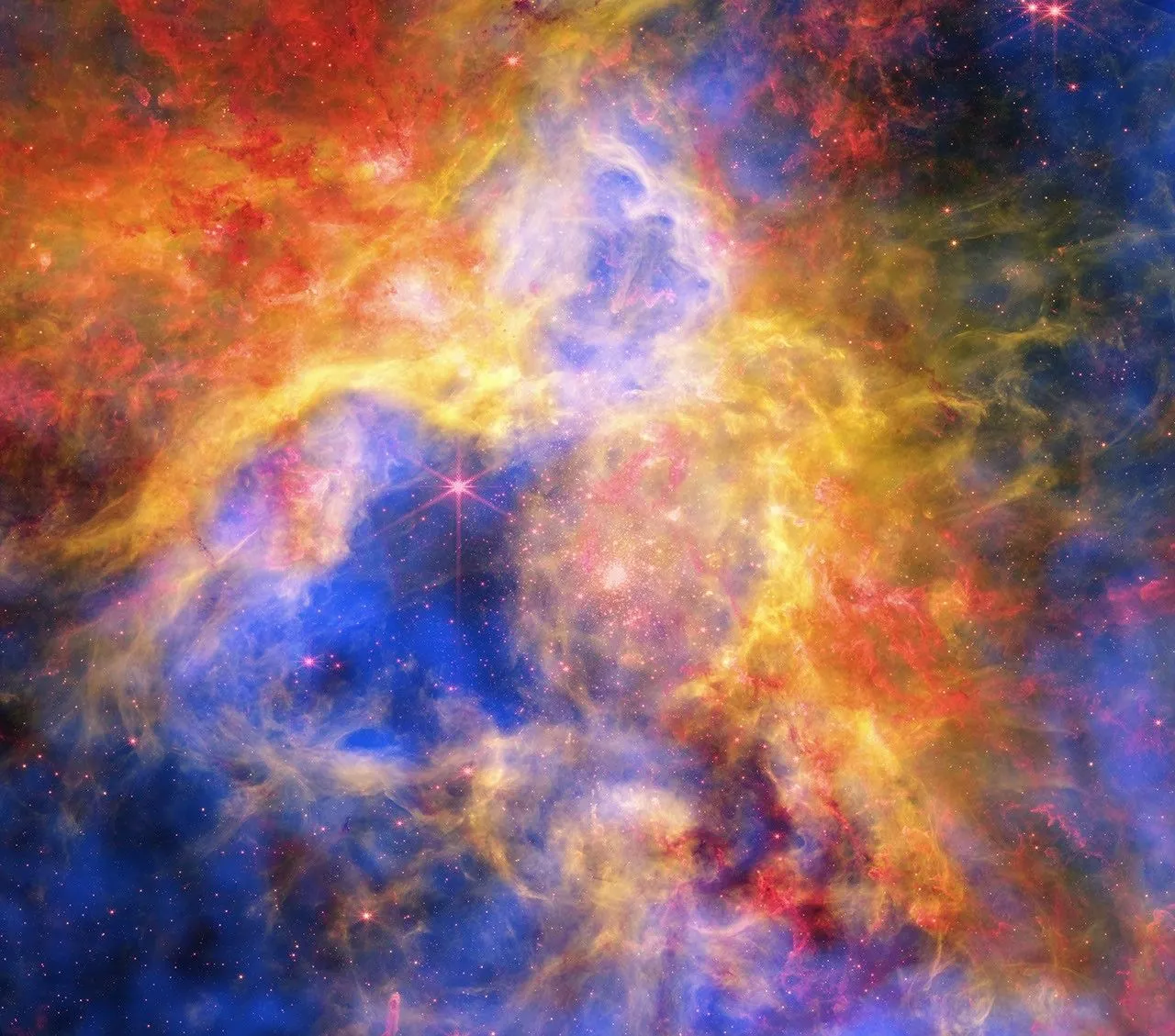
This stunning multiwavelength image of 30 Doradus, also known as the Tarantula Nebula, combines observations from NASA’s Chandra X-ray Observatory, NASA’s James Webb Space Telescope, and NASA’s Hubble Space Telescope. Released on August 11, 2026, the image showcases one of the most active star-forming regions near the Milky Way.
Located in the Large Magellanic Cloud— a small neighboring galaxy approximately 160,000 light-years from Earth—the Tarantula Nebula contains thousands of young, massive stars. These stars are surrounded by a dramatic honeycomb-like network of glowing gas and cosmic dust, creating a spectacular view across X-ray, infrared, and optical wavelengths.
By combining data from Chandra, Webb, Hubble, and NASA’s retired Spitzer Space Telescope, astronomers found that 30 Doradus may be losing energy through several processes, including the escape of extremely hot gas from the nebula. These observations provide valuable insight into how massive stars shape their surrounding environment and influence the evolution of galaxies.
Learn more about this stunning Tarantula Nebula image from NASA.
Image credit: X-ray: NASA/CXC/Ohio State University/J. Rodriguez et al. Infrared: NASA/ESA/CSA/STScI; Optical: NASA/ESA/STScI; Image processing: NASA/CXC/SAO/P. Edmonds
Source: www.nasa.gov