


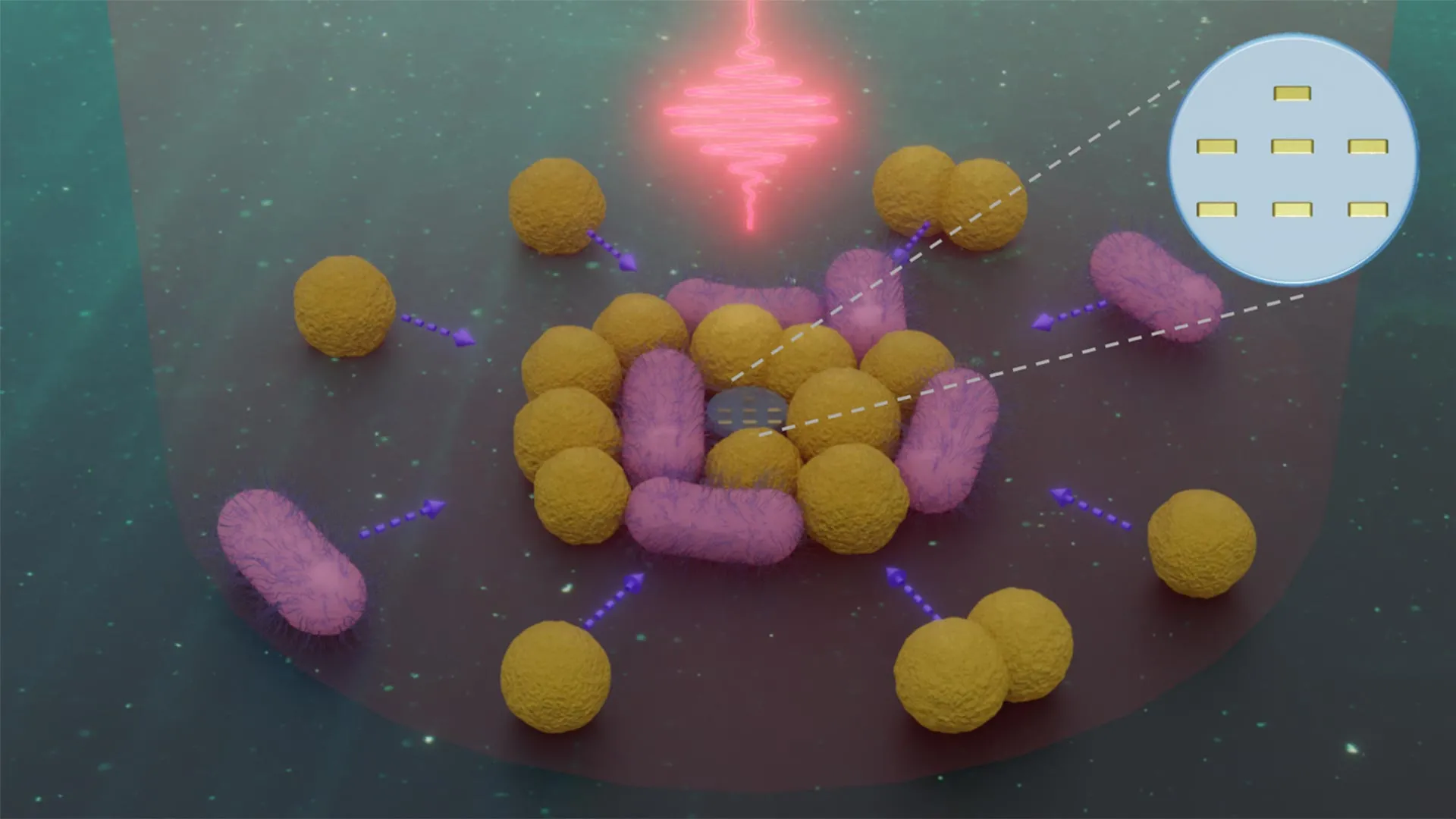
Light-powered nanorobots smaller than one-fiftieth the diameter of a human hair could give scientists unprecedented control over the microbial world. These microscopic machines are designed to manipulate objects that are too small to handle by hand, including individual cells and bacteria suspended in water.
The technology could transform research involving biological materials in liquid environments. Precisely moving and controlling microscopic objects has been a major scientific challenge, but newly developed nanorobots have demonstrated the ability to capture, transport and release bacteria at precisely selected locations.
Light powers and steers microscopic robots
One of the greatest challenges in building nanorobots is developing an effective propulsion and control system. Researchers at Julius-Maximilians-Universität Würzburg (JMU), led by Professor Bert Hecht, are addressing this challenge with light-powered devices known as microdrones.
Each microdrone contains up to four plasmonic nanoantennas. These tiny antennas absorb light of a specific color and helicity before emitting it in a particular direction. Redirecting individual photons produces a small recoil force, similar in principle to the recoil generated when a bullet is fired. Because microdrones have extremely low mass, even these minute forces can create substantial acceleration and speed.
In their latest study, the researchers reduced the size of the light-powered robot to less than 1 micrometer. Achieving this compact design while preserving photon-recoil propulsion required a simpler and more efficient steering mechanism.
The new steering system uses nanoscale antenna wires integrated into the robot. These wires naturally align with the polarization direction of incoming light. By changing the polarization of the light, researchers can control the direction in which the nanorobot faces. Photon recoil continues to push the robot forward, producing directional control similar to the steering systems used in larger vehicles.
Nanorobots act as “microscopic vacuum cleaners”
“Essentially, we built a light-driven nanorobot that can track and collect bacteria,” says Jin Qing, the study’s lead experimental scientist. “By simplifying the design, we have reached a size that allows these robots to operate directly in the microbial world, almost like microscopic cleaning devices.”
The nanorobots are also highly mobile. Their ability to rotate 90 degrees at extremely high speeds allows them to scan large sample areas in an organized and efficient way. The robots can selectively capture, transport and release substantial numbers of bacteria.
Under controlled laboratory conditions, this capability enables the nanorobots to “clean” microscopic environments by collecting bacteria from one area and depositing them at a specific target location.
“This is a striking example of how light can be used not only to observe the microscopic world, but also to actively shape it,” adds Bert Hecht. “The idea of a small robotic vacuum cleaner may sound futuristic, but we have already demonstrated the physical principles that make it possible.”
The robots retain their maneuverability even when carrying larger groups of bacteria, although their speed decreases slightly under the additional load. The ability to transport bacterial clusters while remaining functional could support future applications in microbiology, biomedical research and the precision manipulation of materials at the microscopic scale.
Source: www.sciencedaily.com