


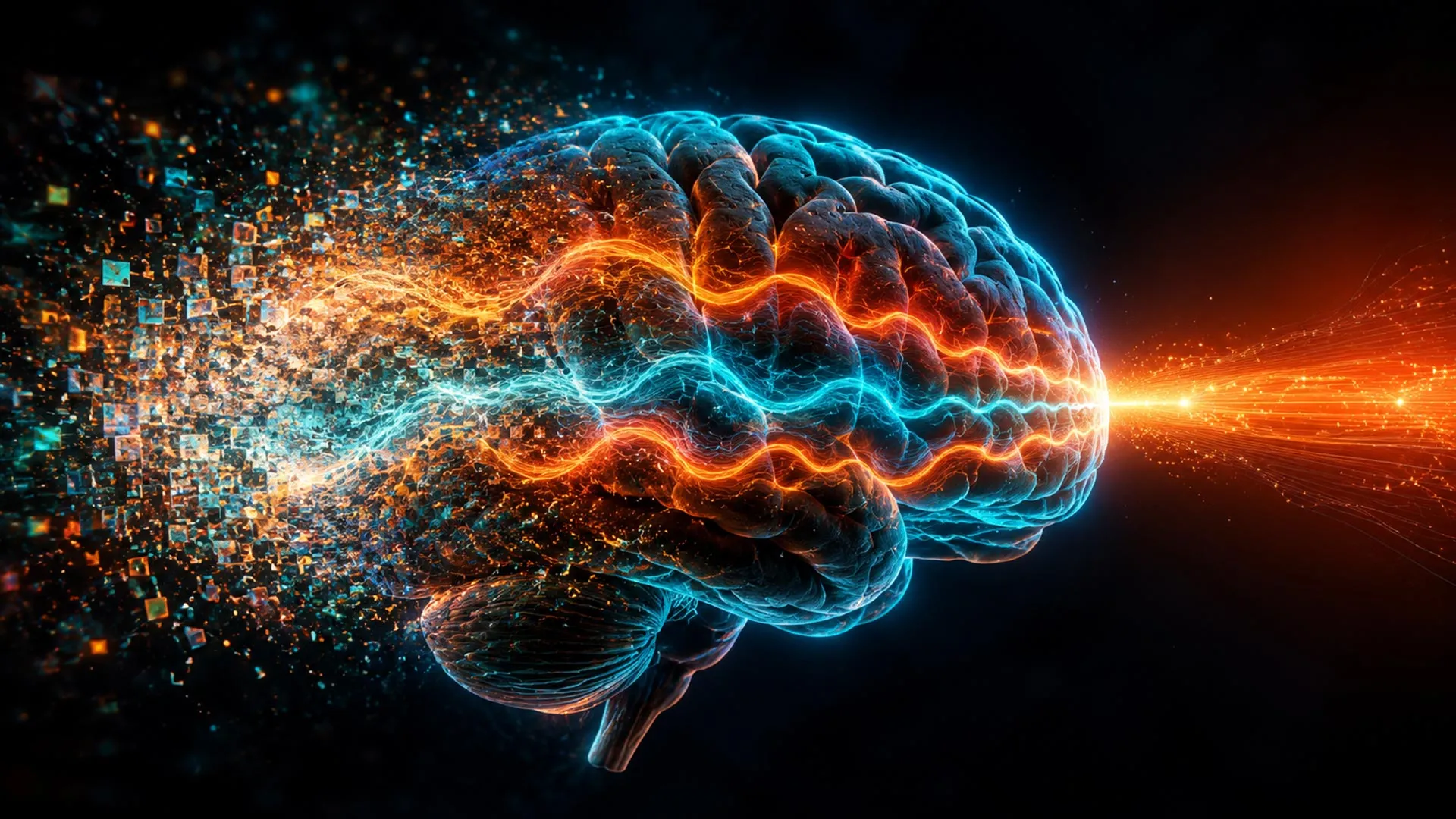
Your brain and the ocean share an unexpected feature: waves. Electrical activity can move across the brain’s surface in organized patterns called traveling brain waves, or neural traveling waves. Like ocean waves, these patterns can arise from multiple sources, including activity generated inside the brain and signals from the environment. Research suggests that neural traveling waves may influence attention, perception, and behavior from one moment to the next.
Neuroscientists at the Salk Institute are combining physiological experiments with computational research to develop a broader explanation of how neural traveling waves work. Their conclusion is that these waves may function as a computational engine for the visual cortex. By moving through neural circuits, neural traveling waves may help the visual cortex—and possibly other brain regions—build internal representations of the outside world. This process could support perception, the reconstruction of recent information, and predictions about what will happen next.
The review was published in Neuron on July 21, 2026.
Why neural traveling waves matter
Salk Institute neuroscientist Dr. John Reynolds was the first to identify brain waves traveling through the visual system of an awake animal in 2020. His laboratory has also found that these waves are directly linked to how effectively animals detect objects in front of them.
This discovery may help explain the familiar experience of repeatedly searching for something—such as a pair of keys—only to realize that it has been visible the entire time. The object was present, but the brain did not register it clearly in that moment.
After Reynolds and his colleagues demonstrated that neural traveling waves occur in awake animals and can influence whether visual stimuli are perceived, a larger question emerged: Why does the brain generate these waves in the first place?
“This paper reveals for the first time in a single integrated framework what the brain can actually compute thanks to this repetitive wave-generation circuit,” said Reynolds, the study’s senior author and co-corresponding author.
Neural traveling waves may power perception and prediction
By focusing on the visual cortex, the researchers identified four potential functions of neural traveling waves. The waves may adjust perception from moment to moment, transform recent sensory information into internal representations, generate short-term predictions about the surrounding world, and store and reproduce patterns linked to memories of events that unfold over time.
Together, these functions suggest that neural traveling waves are more than background electrical activity. They may play a central role in how the brain processes sensory information, interprets the environment, and forms predictions.
Brain waves may be more than electrical noise
Under this framework, neural traveling waves are not simply electrical signals passing through the nervous system. The connections that generate these waves do more than transmit information. They can change their physiology, including their “synaptic weights,” in response to information learned from the outside world.
Every sight, smell, sound, and action an animal experiences can modify the neural connections involved in producing traveling waves. Over time, these changes help shape the circuits the brain uses to create internal representations of its surroundings.
“This is similar in some meaningful ways to what large language models like ChatGPT do,” Reynolds explains. “They learn statistical structure from language and use that knowledge to generate meaningful, well-structured text that reflects language patterns. The brain may be doing something functionally similar: building a biologically generative model from the ground up through experience.”
How neural traveling waves help the brain model the world
When sensory information reaches the brain, it must answer a fundamental question: What am I most likely experiencing right now?
Although the environment is highly complex, it also follows predictable rules. Objects occupy three-dimensional space, while the image projected onto the retina changes continuously as the eyes and body move. These changing signals are also shaped by the laws of physics and the limits of human physiology.
The new framework proposes that the brain learns these recurring patterns and stores them within networks of synapses. These networks generate neural traveling waves that help the brain determine the most likely causes of incoming sensory signals and construct an internal model of the world.
From this perspective, neural traveling waves may explain how the brain transforms a constant stream of complex sensory information into coherent perceptions, predictions, actions, and experiences. Understanding this process could bring scientists closer to explaining how the brain makes sense of the busy and often confusing world around us.
Study authors and funding
Other study authors include Lyle Muller of UT Dallas and the Fields Institute; Alexandra Bush of the Fields Institute and Western University; and Zachary Davis of the University of Utah.
This research was funded by the National Institutes of Health (R01 EY028723, U01 NS131914, U01 NS139877, and EY014800), Blindness Prevention Research, the Natural Sciences and Engineering Research Council of Canada, Western University, Compute Ontario, and the Canadian Digital Research Alliance.
Source: www.sciencedaily.com