


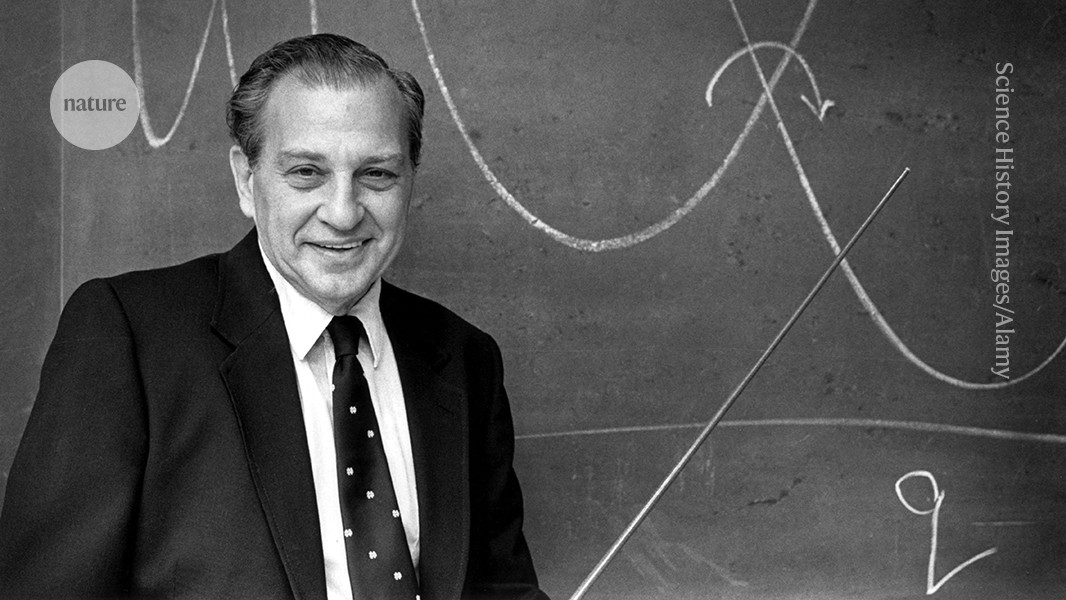
Credit: Science History Images/Alamy
In the 1950s, Rudolph (Rudy) Marcus developed the groundbreaking theory of electron transfer that would establish his place in the history of chemistry. Marcus theory explains how quickly electrons move from one molecule to another. Electron-transfer reactions underpin molecular chemistry, biological processes such as respiration and photosynthesis, and technologies including batteries and solar cells. Marcus was awarded the 1992 Nobel Prize in Chemistry for this work.
Marcus was renowned for creating simple equations and models that captured the essential features of complex molecular processes. He described research as a “wonderful way of life” and continued working with enthusiasm well into his 100s. Marcus, who reached the age of 102, has now passed away.
Marcus was born on July 21, 1923, in Montreal, Canada, to a family of Lithuanian Jewish descent. He enjoyed school and was encouraged to pursue intellectual interests by his mother, a talented pianist and singer. His father was a businessman with a passion for sports, a love that Marcus also shared.
He studied chemistry at McGill University in Montreal, which at the time operated a “Jewish quota” for students. Marcus also developed a strong interest in mathematics and enrolled in advanced courses in the subject.
Marcus began his scientific career as an experimental chemist. After completing a PhD based on wartime research into the chemical behaviour of explosives, he joined the National Research Council of Canada in Ottawa. While breaking glassware and cleaning up spilled mercury — an experience he later credited with strengthening his ability to tackle theoretical chemistry problems — he taught himself the fundamentals of chemical theory. The experience convinced him that his future lay in applying mathematics to chemical phenomena.
When theoretical chemist Oscar Rice offered him a research position at the University of North Carolina at Chapel Hill, Marcus moved to the United States with great excitement. The relocation marked the beginning of a new scientific life and, soon afterwards, he met his future wife, Laura.
Marcus began developing his theory of electron transfer in the 1950s at the Brooklyn Institute of Technology in New York. At the time, researchers were working to understand what determined the rates of reactions involving the transfer of individual electrons between molecules.
Marcus recognized that the atoms surrounding the reacting molecules must rearrange into a configuration that enables an electron to move while conserving energy. He used this insight to develop a simple equation for predicting electron-transfer reaction rates (RA Marcus J. Chem. Phys. 24, 966–978; 1956).
Conversations with experimental chemists, including Norman Sutin, helped Marcus test his ideas against laboratory data. The close agreement between the predicted and measured electron-transfer rates soon demonstrated the power of his theory, which quickly attracted widespread recognition.
Today, the Marcus equation is a foundational tool for modelling electron-transfer reactions in fields ranging from energy and medicine to manufacturing and environmental science. The theory also made a counterintuitive prediction: beyond a particular energy threshold, adding more energy can cause a reaction to slow down rather than accelerate.
This “inverted region” was demonstrated experimentally in 1984 through carefully controlled studies led by Gerhard Closs. The phenomenon is important in natural photosynthesis and artificial solar-energy systems, where slower electron-transfer reactions can keep charges separated long enough to perform useful work.
Marcus maintained broad scientific interests throughout his career. In later years, he explored problems at the intersection of theory and experiment, including ozone formation, molecular fluorescence and the machinery of biomolecules. Even as scientific research became increasingly dependent on complex calculations, he continued searching for elegant, paper-and-pencil theories that experimentalists could use to guide discovery. Reflecting on his approach, he once said: “You have to be willing to struggle. I’ve struggled a lot over the years.”
Source: www.nature.com