


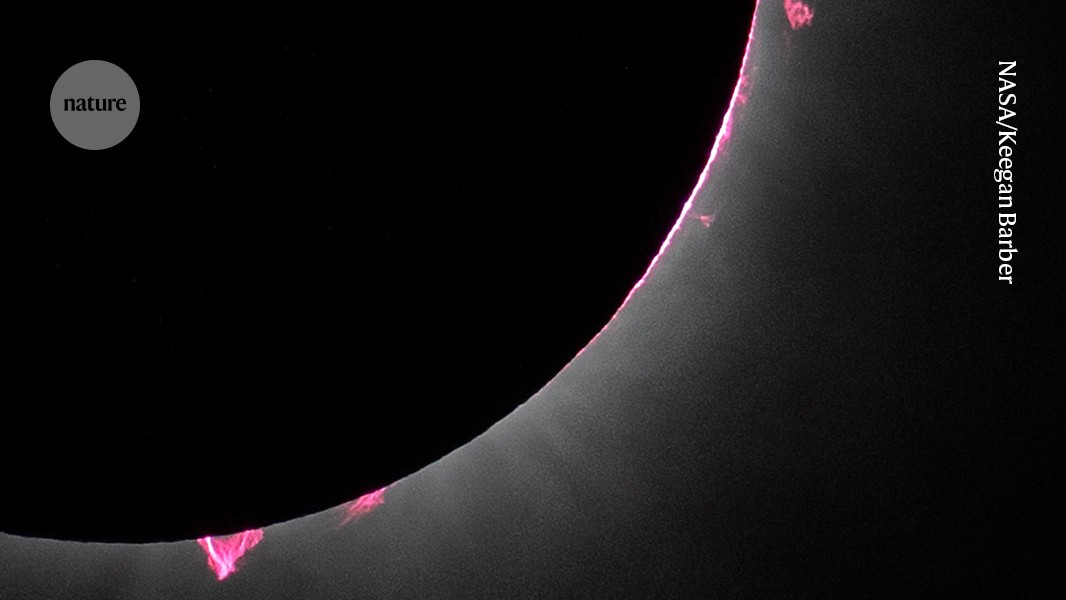
Solar prominences extending from the Sun’s corona during the 2024 total solar eclipse in Dallas.
Credit: NASA/Keegan Barber
When the Moon passes directly in front of the Sun over Greenland, Iceland and Spain on 12 August 2026, researchers will have about two minutes to study the solar corona. This outer layer of the Sun is normally hidden from view and can be seen with the naked eye only during a total solar eclipse.
Although scientists have observed the corona for centuries, they still do not fully understand why it reaches temperatures hundreds of times higher than the Sun’s visible surface. Several research teams will travel to Spain and Iceland for the 2026 total solar eclipse, collecting detailed observations that complement data from space-based instruments. The event is also the first of two total solar eclipses occurring in successive years; the next will take place on 2 August 2027. Researchers hope that improved knowledge of the solar corona will lead to more accurate space-weather forecasts and help protect satellites, communications networks and electrical grids on Earth.
“We want to address this age-old question: where does the [Sun’s magnetic] energy come from and how does it get transported to get the corona to be a thousand times hotter than the surface underneath?” says Amir Caspi, an astrophysicist at Southwest Research Institute in Boulder, Colorado, and leader of one of the eclipse expeditions.

Path of totality for the 12 August 2026 total solar eclipse.
Source: ESA
A rare window into the solar corona
The solar corona, the Sun’s outer atmosphere, consists of extremely hot plasma — a mixture of free electrons and charged atoms — that can reach temperatures of around 1,000,000 °C. Despite its heat, the corona is much dimmer than the Sun’s surface and cannot normally be seen. During totality, however, the Moon blocks the bright solar surface and reveals the corona. “The eclipse basically lets us see the Sun at night,” explains Caspi.
Scientists can create artificial eclipses by blocking sunlight with instruments in space or on the ground, but a natural total solar eclipse offers exceptional observing conditions. It produces sharp, continuous views close to the Sun while reducing the effects of scattered light and diffraction. “There’s nothing else that gives you this continuous coverage, so close to the Sun and so far away,” says Shadia Habbal, an astronomer at the University of Hawaii in Manoa who will also travel to Europe to observe the eclipse.
Staring at the Sun — close-up images from space rewrite solar science
For Habbal, the 2026 eclipse will mark her 20th expedition to observe a total solar eclipse since 1995. Her team plans to establish five observing locations — two in Iceland and three in Spain — to improve the chances of collecting useful data if clouds obscure some sites. Using spectrometers and high-resolution cameras fitted with specialized filters, the researchers will measure light emitted by the corona at specific wavelengths. These measurements reveal which chemical elements are present and show their ionization states. The team is especially interested in ionized iron, which can provide clues about the corona’s temperature, density and structure.
Observations from the eclipse could also improve forecasts of geomagnetic storms and other forms of space weather. These events can disrupt satellite operations and generate electrical currents that damage power infrastructure. In 1989, for example, a geomagnetic storm caused a power-grid failure that left six million people in Canada without electricity.
At present, scientists can often determine several days in advance whether plasma released by a coronal mass ejection is travelling towards Earth. However, they may not know whether the material poses a serious threat until it reaches a monitoring satellite, which measures its magnetic field only tens of minutes before the plasma arrives. A better understanding of the physical processes in the solar corona could allow researchers to estimate the magnetic properties of this plasma earlier and improve space-weather warning systems.
Source: www.nature.com