


Mississippian Pottery in Tampa Bay Reveals Ancient Migration of Skilled Potters
About a century ago, archaeologists excavating pottery fragments around Tampa Bay discovered something puzzling. Some sherds featured decorations strikingly similar to pottery found hundreds of miles to the north, suggesting a connection to the Mississippian culture that emerged more than 1,000 years ago and transformed social, economic, and political life across much of the southeastern United States.
For decades, however, archaeological interpretations of the Mississippian world rarely included the Florida peninsula. Tampa Bay pottery suggested that the relationship between Florida communities and Mississippian culture may have been far more complex than previously believed.
“This open discussion has been going on for a century,” said Neil Wallis, curator of the Florida Institute of Archeology, Bioarchaeology, and Ceramic Technology at the Florida Museum of Natural History. “The Tampa Bay site had some Mississippian features, such as platform mounds, village complexes, and iconography. But other features, such as corn farming and shell-tempered pottery, were missing. Mississippian-looking pottery has always raised the question: How did this end up in Tampa Bay?”
Pottery appeared to offer some of the strongest evidence linking Tampa Bay communities to the broader Mississippian cultural system. Yet decorative similarities alone could not reveal where the vessels were made. Without the technology to analyze their materials and manufacturing methods, museum curators stored the fragments while competing explanations remained unresolved.
Researchers at the Florida Museum are now investigating where the pottery came from and who made it.
“We were interested in knowing whether these vessels were imported from the central region by trade, were local imitations of Mississippian motifs, or, as we eventually discovered, were built by immigrants who moved into Tampa Bay communities and began working and living there,” said Trevor Duke, who began the research for his doctoral dissertation at the University of Florida. Duke and his colleagues later expanded the project to examine a larger collection of pottery samples.
By studying manufacturing details that are barely visible on the surface, the researchers determined that the decorated vessels were made by a small community of skilled potters who traveled hundreds of miles from the Mississippian heartland before settling in Tampa Bay.
The decorated vessels differed from the plain earthenware commonly used in the region. They were made with different clay recipes, tempering materials, and construction methods, suggesting that immigrant potters brought specialized knowledge and access to resources that were not widely available among local residents.
How Mississippian Culture Reached the Southeast
Around 1000 A.D., a new cultural system developed in the Mississippi River Valley and spread across large parts of what is now the Midwest and eastern United States. In its core regions, Indigenous communities were organized into political hierarchies, while powerful chiefdoms influenced surrounding settlements.
These societies planted large amounts of corn and moved vast quantities of earth to build platform mounds. Temples and elite residences were often placed on top of these monumental structures.
Tampa Bay was far outside the major northern centers of Mississippian culture.
The regional culture that occupied Tampa Bay during this period is known as Safety Harbor. Like Mississippian societies, Safety Harbor communities formed small chiefdoms and built flat-topped mounds. The region’s largest settlement was home to the Tocobaga people, while smaller Mokoso, Pohoi, and Ujita chiefdoms were located nearby.
Important differences remained, however. None of these Tampa Bay groups accumulated the same degree of political power found at major Mississippian centers farther north. They also did not adopt the large-scale corn farming associated with Mississippian societies, relying instead on fishing and other marine resources.
This combination of similarities and differences has made it difficult for archaeologists to determine how closely Tampa Bay communities were connected to the Mississippian heartland. The discovery of pottery decorated in the Mississippian style added another layer to the mystery.
Analyzing 58 Tampa Bay Pottery Fragments
For the study, Duke and other Florida Museum archaeologists collected 58 pieces of plain and decorated pottery from Tampa Bay. Both types of vessels were probably used to prepare and serve food, although the decorated pieces may have been reserved for special events.
Mississippian potters commonly mixed crushed freshwater shells and fragments of older pottery, known as grog, into their clay. They also built vessels by stacking coils of clay rather than molding them.
These details gave researchers a way to distinguish authentic Mississippian pottery traditions from local imitations. If the decorated Tampa Bay vessels had been imported or made by potters trained in Mississippian techniques, the fragments should preserve evidence of those methods. If local potters had merely copied the designs, the vessels would likely retain familiar Tampa Bay practices, such as sand tempering.
Local Tampa Bay Clay, Far-Flung Pottery Traditions
The researchers first measured the chemical composition of the pottery using neutron activation analysis. They compared the results with raw clay deposits from the Tampa Bay area.
The chemistry matched, indicating that the vessels were manufactured locally. This ruled out the possibility that finished pots were made in the Mississippian center and transported south through trade. It did not, however, rule out the possibility that local potters had imitated northern designs.
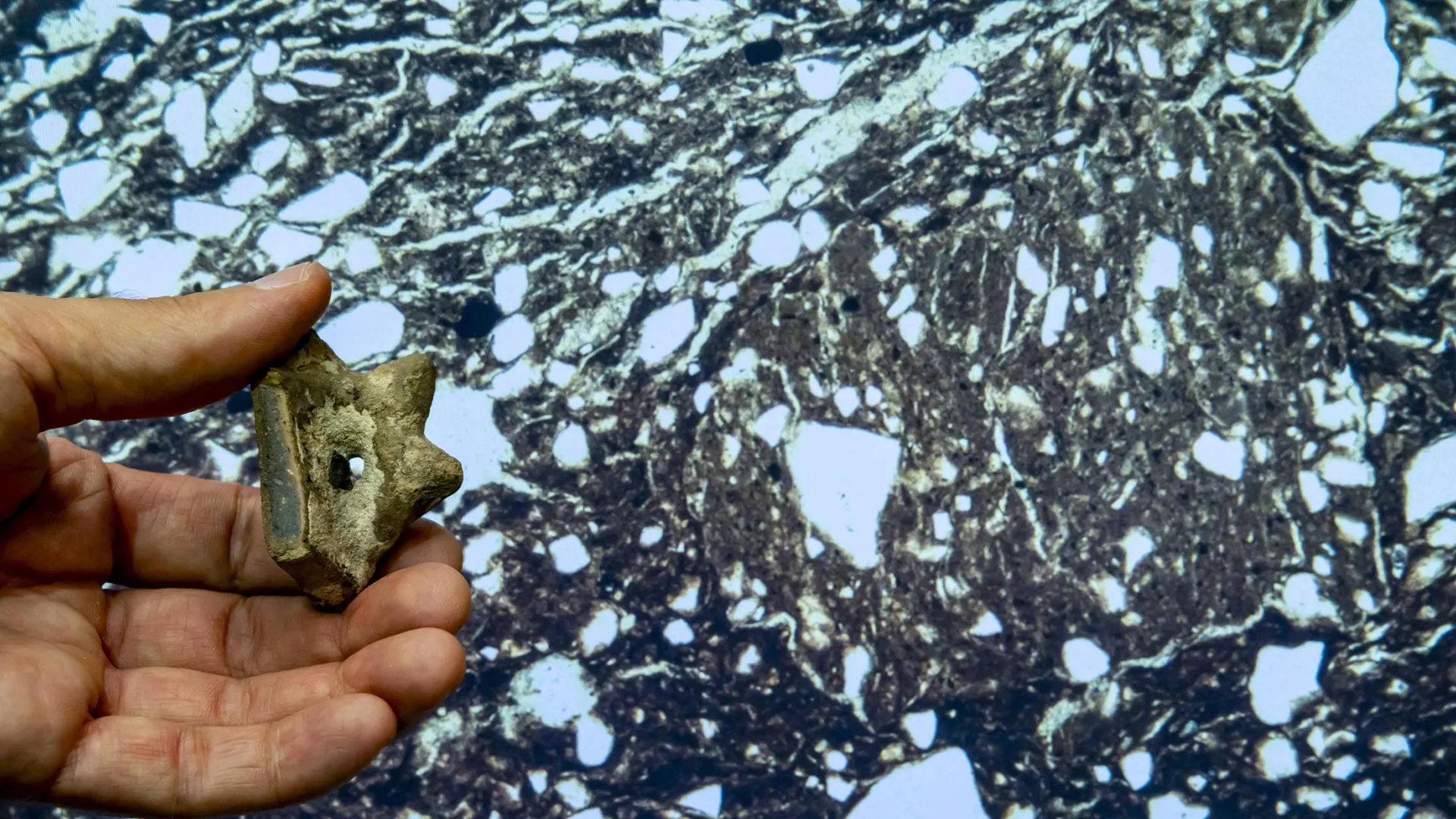
The team then examined thin slices of the pottery under a microscope using a technique called petrography. Researchers polish a piece of ceramic until it is roughly half the width of a human hair and examine it under polarized light. Tiny particles, cracks, and empty spaces reveal how the clay was prepared and which materials were added.
“If you look at that section under a microscope, you can identify the minerals in it based on its color and shape. From there, you can tell what was added. It’s a kind of fingerprint of the people who made it,” Wallis said.
The microscopic examination produced some of the clearest evidence in the study.
Some decorated sherds contained grog, or crushed pottery, a tempering material associated with Mississippian traditions. Adding grog increases the durability of a vessel and helps it withstand the intense heat of baking and cooking.
“This grog tempering is unlike anything we’ve seen before or in typical samples from Tampa Bay,” Duke said. “But in the Tallahassee Hills, where the closest giant Mississippian mound center is located, it’s common on all vessels. There, this is a plain-jane tempering technique.”
The connection extended beyond manufacturing technology. Tallahassee Hills is approximately 320 miles north of Tampa Bay. Inside the grog used in the decorated vessels, researchers found mica, a reflective silicate mineral common in the Florida Panhandle but rare on the Florida peninsula.
The clay surrounding the pottery came from Tampa Bay, but some of the crushed material mixed into it likely originated farther north in central Mississippi.
Grog appeared in 80% of the decorated pottery analyzed, while none was found in some of the plain pottery. Most plain vessels instead contained dried clay shards or sand, materials that had been used in the local pottery tradition for approximately 3,000 years.
Other differences supported the distinction between the two pottery traditions. Decorated vessels were constructed using the Mississippian technique of coiling clay and followed a more consistent recipe, suggesting a higher level of expertise. Plain vessels, by contrast, were molded. This simpler technique became increasingly common as the regional population grew and could be learned quickly by people without advanced pottery skills.
Immigrant Potters May Have Carried Pieces of Their Homeland
Taken together, the evidence indicates that potters migrated from the Mississippian center and brought technical knowledge and raw materials with them.
As these artisans traveled south from northern Florida, they may have carried older pottery fragments made from clay found in their homelands. After settling in Tampa Bay, the fragments could have been broken, ground into small pieces, and mixed into newly collected local clay.
This practice may have had cultural significance as well as practical benefits.
The immigrants appear to have selected specially decorated pottery from their homeland for use as grog. Every grog-tempered vessel examined by the researchers contained what is known as multigenerational grog: one fragment of crushed pottery contained an even older grog fragment. In effect, pottery made by one generation was incorporated into vessels made by the next.
“It’s like a Russian nesting doll, because there’s a grog within a grog. This can be traced back to several generations of pots,” Wallis said. “And they’re not just using vessels they got from anywhere; they’re crushing identically decorated vessels, including shards of earlier decorated pottery.”
These embedded fragments represented small physical pieces of the immigrants’ homeland that continued to be incorporated into pottery made in Tampa Bay for generations.
The newcomers’ pottery expertise and ties to Mississippian traditions may also have helped them establish valuable roles within their adopted communities. Skills that were common in their homeland may have become highly specialized and desirable after the potters moved south.
“Immigrant communities often had to find their niche in new places,” said Andrea Tovinen, collections manager for the Florida Museum’s Institute of Ceramic Technology and Florida Archaeology. “What made these immigrants stand out? How did they establish a role in this new region? Bringing expertise in pottery production seems to have been one way they did so.”
The evidence suggests that these skills were highly valued. Although advanced technology appeared almost exclusively in decorated pottery, everyday plain vessels continued to be made using simpler local methods. Decorated pots were also made from high-quality clay, indicating that migrant potters had access to rare and superior materials.
Why Did the Specialized Pottery Techniques Remain Limited?
The divide between decorated and ordinary pottery lasted for centuries, raising another question: Why did local residents not simply learn the immigrants’ more advanced techniques?
Researchers suggest that the knowledge remained concentrated within a small group of artisans who worked closely together. Whether the methods were deliberately kept private or simply passed down through close-knit social networks, the techniques were never widely adopted.
“Even if it wasn’t secret in the sense that no one knew about it, the group of potters who were making the decorated vessels may have had some kind of special status that they maintained through this secret practice,” Wallis said. “In fact, with secrets like this, some of the details need to be aired to let people know there’s a secret.”
High-quality decorated vessels were widely distributed and appear to have been prized throughout the community. Yet many of their defining characteristics—including grog tempering, coiled construction, and carefully standardized clay preparation—were hidden inside the finished pottery and difficult to imitate.
Without direct access to the small circle of immigrant potters who understood the techniques, Tampa Bay residents would have had little opportunity to learn them.
“People with specialized skills have a direct relationship with the people who are learning from them. We think that’s how knowledge is passed on. If that’s how leaders have always done it, you’re going to do it too,” Tovinen said. “And in this case, there may have been a more meaningful reason behind it. By linking the pottery of our homeland to this chain, we are bringing that pottery into the next generation.”
This research was published in Ancient America.
Source: www.sciencedaily.com