


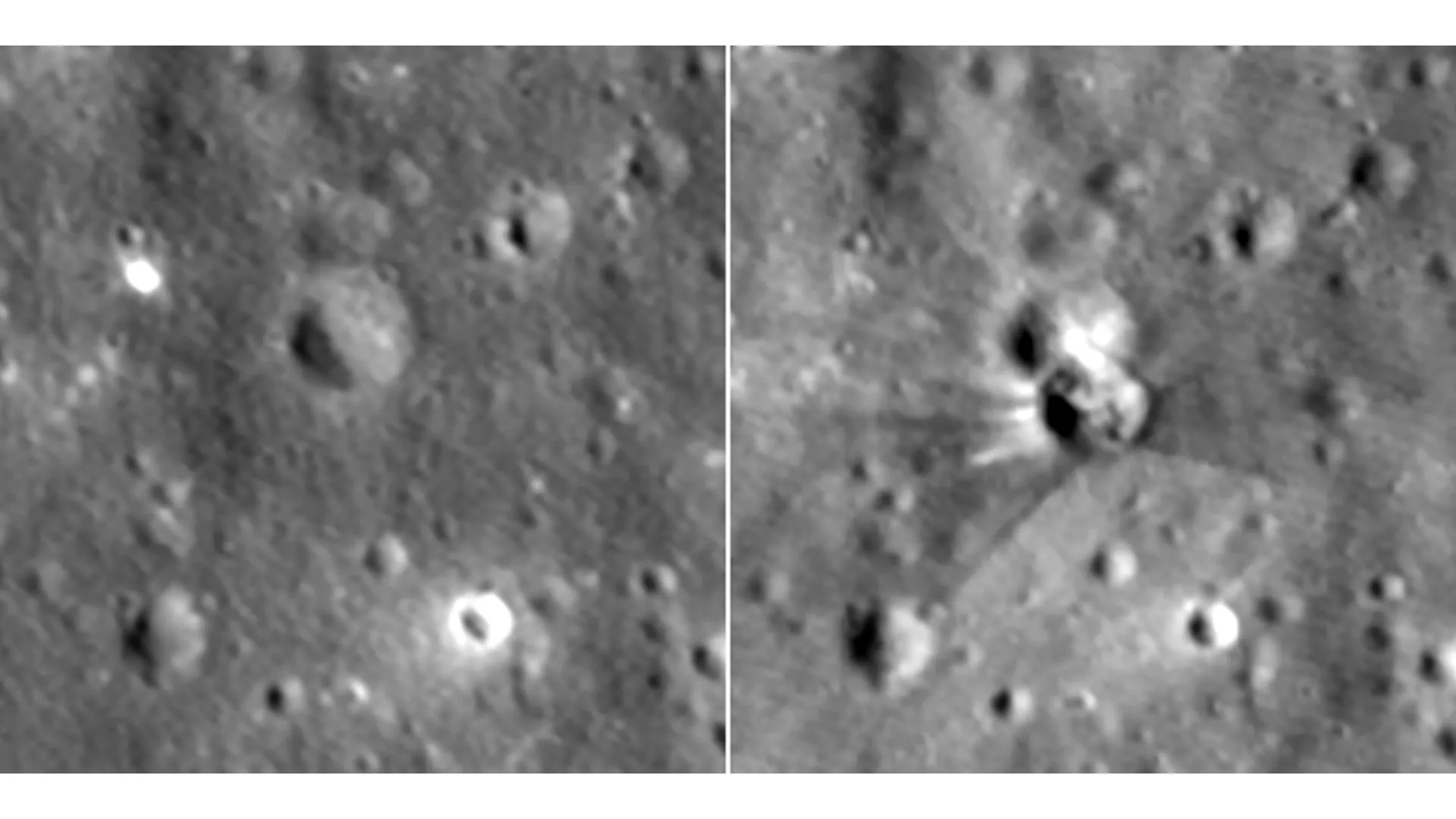
NASA’s Lunar Reconnaissance Orbiter (LRO) has photographed a newly formed impact crater on the Moon created when a SpaceX Falcon 9 upper stage struck the lunar surface on August 5. The rocket stage was launched in January 2025 as part of Firefly’s Blue Ghost 1 mission. LRO captured images of the impact site between August 11 and 12.
Capturing the new lunar crater required precise spacecraft maneuvering. Engineers tilted NASA’s LRO so its camera could face the impact site as the orbiter passed approximately 90 miles above the Moon’s surface at nearly 1 mile per second.
LRO travels from pole to pole every two hours while the Moon slowly rotates beneath it. Because of this orbital pattern, the spacecraft had to wait until the impact site moved into an observable position. In this case, six days passed before LRO had an ideal opportunity to photograph the newly formed crater.
Accurate timing was also essential. If LRO had taken the image just 10 seconds too early or too late, the target would have appeared roughly 10 miles away from the center of the photograph.
Scientists observed the impact crater from multiple angles and under varying lighting conditions, allowing different features to become visible. Images that clearly revealed the crater’s rim showed that it measures approximately 60 feet wide. By analyzing the crater’s shadow, researchers determined that it is less than 10 feet deep.
These observations were made with LRO’s narrow-angle camera, which can identify lunar surface features as small as 3 feet across.
Fresh lunar material revealed by the impact
The LRO images show bright and dark rays spreading outward from the newly formed Moon crater. The darker streaks contain dust and rocks that had been exposed on the lunar surface and altered over time by solar wind, galactic cosmic rays, and micrometeorite impacts.
The collision excavated this weathered material from depths of up to 1.5 feet below the lunar surface. Closer to the crater’s rim, brighter streaks reveal fresher lunar material that had remained buried beneath the surface.
International investigation pinpoints the lunar impact site
Finding the crater required cooperation among professional scientists and amateur astronomers around the world. Independent observers initially calculated the rocket stage’s trajectory using publicly available data.
NASA’s Near Earth Object Research Center, which monitors natural objects that could pose a threat to Earth through NASA’s Planetary Defense Program, used the event to test and validate techniques for predicting impact locations.
Based at NASA’s Jet Propulsion Laboratory in Southern California, the center refined its calculations until it identified the rocket stage’s most likely impact site. Researchers then shared their predictions with South Korea and the team operating the Korean Pathfinder Lunar Orbiter, known as Danuri.
Several hours later, Danuri’s team used the spacecraft’s high-resolution Lunar Terrain Imager (LUTI) camera to photograph the crater. The images confirmed that NASA’s predicted impact location was accurate to within approximately 0.6 miles.
After imaging the site, the Danuri mission provided the crater’s coordinates to NASA’s LRO team, helping researchers precisely target their follow-up observations.
The LRO team compared the new photographs with images taken before the Falcon 9 upper-stage impact. Based on these comparisons, researchers determined that the crater’s center is located at 19.4759 degrees north latitude, 266.7138 degrees east longitude, and 511 meters above sea level.
Source: www.sciencedaily.com