


Lignin is a key component of plant cell walls, providing structural strength and representing the largest renewable source of aromatic chemicals in nature. Agricultural and forestry waste can account for up to 35% of available biomass, making lignin an important resource for sustainable chemical production. However, its complex molecular structure and strong chemical bonds make lignin difficult to break down efficiently, limiting its use in renewable manufacturing.
In a study published in ACS Catalysis, an international research team, including Dr. Christopher Parlett, Xinyue Zhou, and Yongtao Jiang from the School of Chemical Engineering, developed a highly efficient single-atom catalyst for lignin conversion. The researchers also identified, at the molecular level, how the catalyst breaks the strong bonds that hold lignin together.
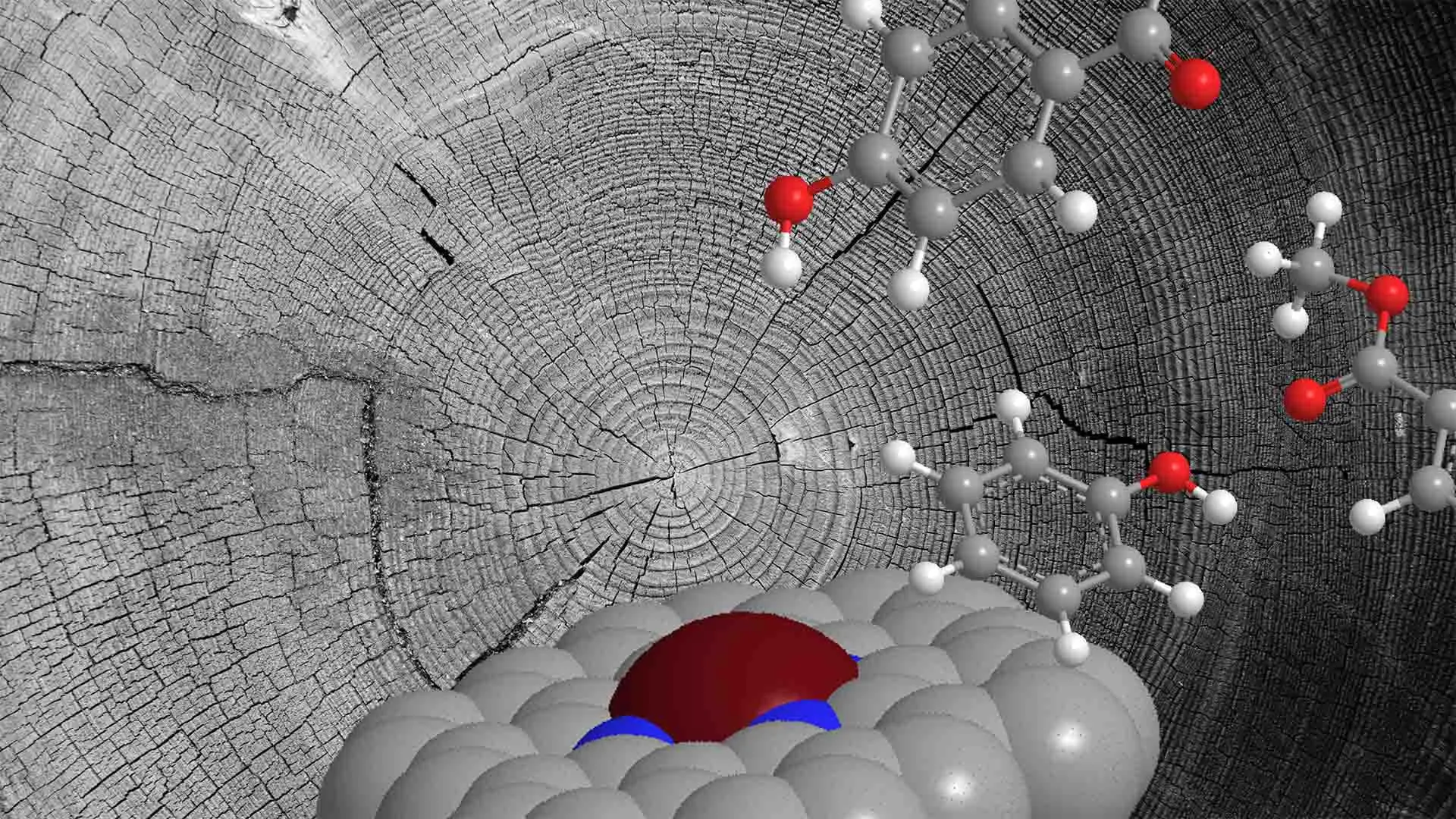
The catalyst consists of individual ruthenium atoms embedded in a nitrogen-doped carbon material. Isolating the ruthenium atoms enables strong catalytic activity while using only a small amount of metal, improving efficiency compared with conventional catalyst systems.
Revealing how single-atom catalysts break down lignin
A major challenge in lignin research is determining which components of a catalyst are responsible for breaking its unusually strong chemical bonds. Without a clear understanding of the reaction mechanism, it is difficult to design more effective catalysts for biomass conversion.
The research team identified a specific atomic structure known as a Ru-N4 site. These active sites help activate oxygen molecules, triggering the cleavage of both carbon-oxygen and carbon-carbon bonds within lignin.
By combining laboratory experiments with computational modeling, the researchers reconstructed the lignin degradation process in detail. The catalyst first activates oxygen to generate highly reactive species. These species then attack the lignin structure, breaking it into smaller, valuable aromatic molecules.
High lignin conversion under mild reaction conditions
Under optimized conditions, the single-atom catalyst converted nearly all of the tested model lignin compounds and produced valuable chemical products, including phenol, in high yields.
The lignin conversion process operates under relatively mild conditions and does not require harsh chemicals. This combination could help support the development of more sustainable methods for producing chemicals from renewable biomass.
The researchers also tested the catalyst on real lignin obtained from several biomass sources rather than relying solely on simplified model compounds. The catalyst converted these samples into useful aromatic compounds that could serve as building blocks for fuels, plastics, and other advanced materials.
Advancing biomass-based chemical production
This discovery offers a clearer understanding of how single-atom catalysts operate during lignin depolymerization and biomass conversion. The findings could guide the design of more efficient catalyst systems for turning agricultural and forestry waste into higher-value products.
“Understanding exactly how these catalysts work at the atomic level will allow us to design better materials for converting renewable resources into valuable chemicals,” said Dr. Christopher Parlett, Lecturer in Chemical Engineering.
By enabling the efficient upgrading of lignin into useful aromatic chemicals, this research could help accelerate the shift away from traditional petroleum-based manufacturing toward a more circular, sustainable, and biomass-based chemical economy.
Source: www.sciencedaily.com