


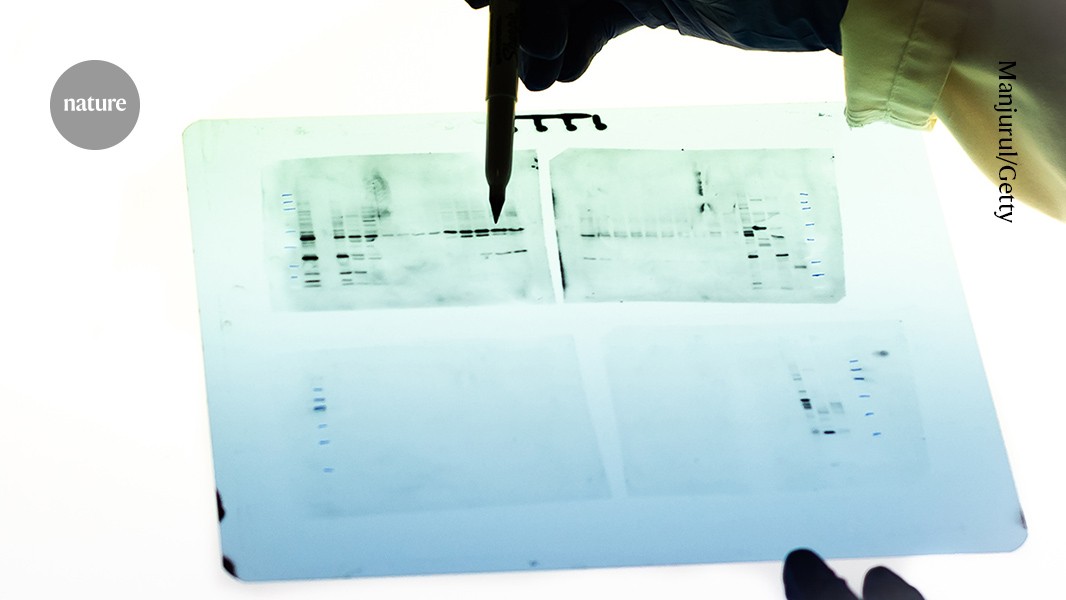
Companies use Western blot images in antibody catalogs to demonstrate that products perform as expected.
Credit: Manjurul/Getty
Scientific-integrity experts say that thousands of antibodies sold by multiple research suppliers are linked to catalog images that appear to have been digitally altered.
The findings follow an investigation in May, when scientific detectives identified more than 100 questionable images in the antibody catalog of Thermo Fisher Scientific. Image manipulation does not necessarily mean that an antibody product is defective. However, the large number of flagged images has raised fresh concerns about quality-control practices among commercial antibody suppliers as researchers continue to question the reliability of these widely used laboratory tools.
Scientific detectives identify more than 100 suspicious images in a Thermo Fisher antibody catalog
The latest investigation into potentially manipulated antibody-catalog images was conducted by metascientist Reece Richardson of Northwestern University in Evanston, Illinois. Richardson also led the May investigation. On August 25, he reported finding more than 18,000 additional suspicious images associated with antibodies sold by 15 companies. The image databases have been published online. Richardson said that many of the “verification images” included in product listings to demonstrate antibody performance showed signs of extensive editing.
Antibodies are Y-shaped biomolecules that bind to specific proteins, making them essential tools for laboratory research and medical diagnostics. Yet their reliability remains a major concern. A 2023 survey1 tested 614 commercially available antibodies and found that more than half did not perform as advertised. The annual cost of ineffective antibodies is estimated to exceed US$1 billion.
Researchers working to improve antibody validation say they are frustrated but not surprised by Richardson’s findings. “It’s disappointing, but I’m not really surprised because I’ve been burned many times by buying commercially available antibodies that don’t work,” said Simona Colantonio, director of the Antibody Characterization Laboratory at the Frederick National Cancer Institute in Maryland.
Most of the suppliers listed in Richardson’s database were associated with hundreds of potentially problematic images. Four companies were linked to thousands of flagged antibody-verification images: G-Biosciences of St. Louis, Missouri, with 6,388 images; Thermo Fisher of Waltham, Massachusetts, with 5,580; LSBio of Newark, California, with 2,695; and OriGene of Rockville, Maryland, with 2,236.
A Thermo Fisher spokesperson said in a statement that the company’s ongoing product review had so far “found no evidence of an impact on antibody performance or the underlying scientific data.” The company added that it remains “confident in the quality of the products in our antibody catalog.” An LSBio spokesperson said the flagged entries represented “less than 0.04% of the total products offered on our platform,” but added that the company takes image-related concerns seriously and would investigate them with its partners. G-Biosciences and OriGene did not respond to requests for comment.
The scale of the suspicious-image report alarmed researchers. “What we’re really looking at is a system-wide problem that requires a system-wide solution,” said Harvinder Burke, a pulmonologist and co-founder of Only Good Antibodies in Leicester, England. The initiative uses open-science methods to characterize and validate commercially available antibodies.
Problems in antibody catalogs
Researchers shopping for antibodies often search through extensive online catalogs before choosing a product. Some suppliers list hundreds of thousands of antibodies. Product pages typically include experimental data, such as Western blot images, showing how an antibody detects specific proteins in a sample. A reliable antibody should produce a clear band, while a poorly performing antibody may generate several fuzzy bands because it binds to unintended targets.
Sholto David, a molecular biologist at the University of Oxford in the United Kingdom who specializes in research-integrity issues, said these images are “one of the few things you really have to consider” when deciding whether an antibody is worth buying.
How scientific journals are responding to the rise of questionable research images
When David and Richardson identified more than 100 suspicious images in Thermo Fisher’s catalog in May, the company said it “fully stands by the data and the underlying science.” It also noted that some image data may have been “edited, optimized, or otherwise adjusted” for display purposes.
To expand the investigation, Richardson analyzed Thermo Fisher’s catalog in greater detail and examined catalogs from other suppliers. He developed a computer program that automatically adjusted the black-and-white levels of more than 270,000 images to increase contrast and reveal possible inconsistencies. Richardson then reviewed the images manually.
Not all of the more than 18,000 images flagged by Richardson have been independently verified. Nature asked researchers to review documentation related to the findings and reported that his methods appeared adequate. “Some of them are really outrageous, because you can tell there’s some kind of manipulation even without increasing the contrast,” Colantonio said. “The sad thing is that some antibodies are likely to actually be very good, but these changes could cast doubt on their performance.”
Signs of obvious image manipulation
One of the most common issues Richardson identified was the repeated use of identical backgrounds. Western blot backgrounds are typically random, resembling static on a television screen. Richardson found that approximately 13,800 images contained one of seven recurring background patterns, with some patterns appearing across catalogs from multiple suppliers.
“That particular type of image tampering and manipulation suggests that these antibodies were never tested in the lab,” said Elizabeth Bick, a leading expert in research-image integrity based in San Francisco, California.

Richardson created this GIF from 102 Western blot images in Thermo Fisher’s antibody catalog, showing that they shared the same background pattern. The pattern appears in 845 images flagged by scientific detectives across the five company catalogs.
Credit: Reece Richardson from Thermo Fisher Scientific
Source: www.nature.com