


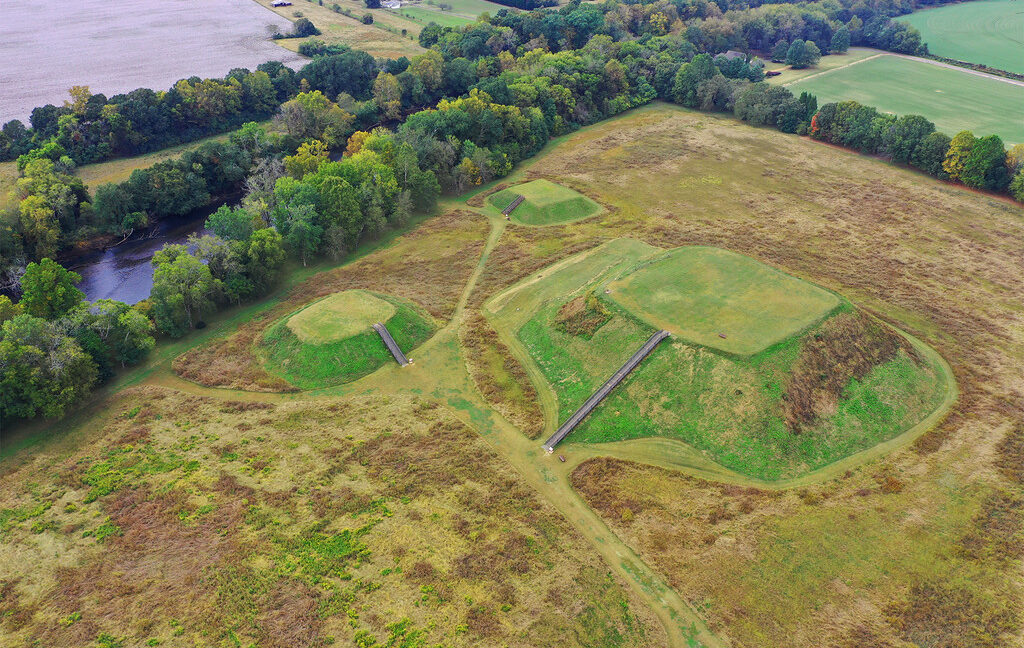
Archaeologists already know that Chaco Canyon maintained an extensive trade network reaching through Mexico and into Central and South America. However, it remains unclear how Etowah acquired cocoa. The substance may have traveled north through Mexico, reached Etowah through connections with Chaco Canyon, or arrived through both routes.
“These results warrant a closer look at the evidence for relationships linking the Mississippian world with the Hohokam and ancestral Pueblo peoples of the Southwest,” King and his colleagues wrote.
From approximately 800 to 1600 CE, Ancestral Pueblo-related cultures in the Southwest were connected to the Caddoan peoples, who lived west of Etowah across parts of present-day Arkansas, Louisiana, Oklahoma, and Texas. Archaeological sites associated with these cultures contain turquoise, Southwestern-style pottery, and obsidian transported hundreds of kilometers from the west.
Together, these discoveries point to far-reaching Indigenous trade networks that connected societies across much of North America before European colonization. As King and his colleagues noted, these networks moved “goods, people, and ideas,” creating a complex web of cultural relationships spanning the continent.
Determining precisely which communities traded with one another—and how these connections operated—remains a more complicated mystery. Solving it will require additional archaeological evidence from Etowah, Chaco Canyon, the Mississippian world, and Indigenous sites throughout the Southwest and Central America.
“Early in the history of Mississippi studies, it was common to attribute the complexity of Mississippi’s way of life to its connections to Central America,” King and his colleagues wrote. “This set of explanations was ultimately abandoned due to a lack of supporting evidence and the implication that the Eastern Woodland Indians were not capable of building a complex civilization.”
The researchers emphasized that future discoveries may reveal previously unknown connections between these societies. At the same time, they stressed that recognizing long-distance cultural exchange should not diminish the achievements of Mississippian communities, which developed complex societies and trade systems of their own.
PLOS ONE, 2026. DOI: 10.1371/journal.pone.0353607. (About DOI).
Source: arstechnica.com