


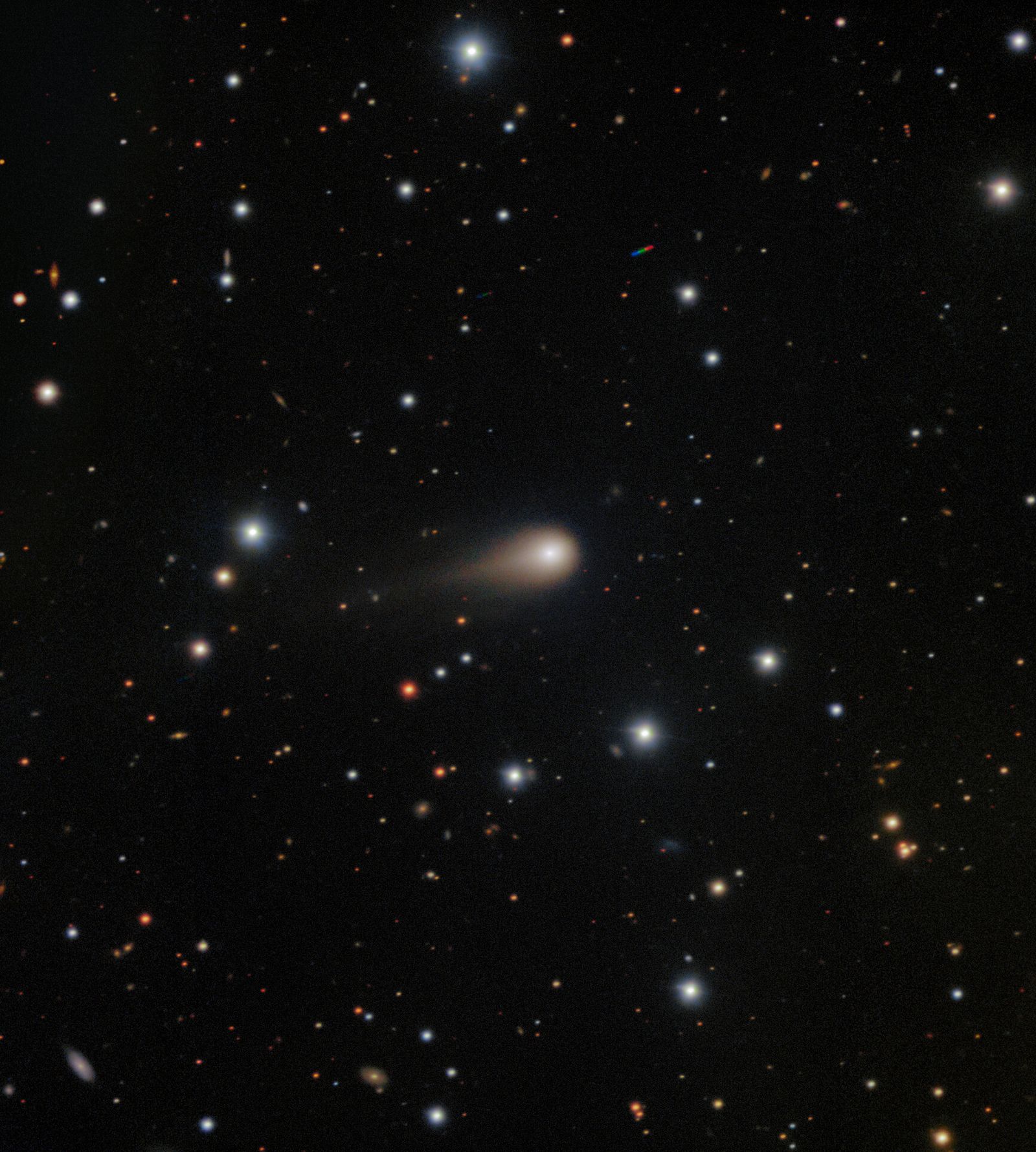
Recent research explores the chemical structure of 3I/ATLAS through telescope observations, suggesting its formation in the serene outskirts of a planetary system.
:focal(866x965:867x966)/https://tf-cmsv2-smithsonianmag-media.s3.amazonaws.com/filer_public/b2/0d/b20db74d-3a38-49aa-b8c2-26e38cfd4944/noirlab2525b.jpg)
International Gemini Observatory / NOIRLab / NSF / AURA / Shadow the Scientist Image processing: J. Miller & M. Rodriguez (International Gemini Observatory / NSF NOIRLab), TA Rector (University of Alaska Anchorage / NSF NOIRLab), M. Zamani (NSF NOIRLab)
3I/ATLAS, the third interstellar object detected, is on its way out of our solar system. Unlike its predecessors orbiting the Sun, this icy body is currently navigating through Jupiter’s orbit, destined to return to the interstellar void, never to be observed by humans again.
This comet-like object, enveloped in gas and dust, was born from a disk of debris surrounding a distant star, offering researchers a rare chance to study materials from another planetary system. Following its discovery on July 1, 2025, astronomers globally have focused their telescopes on this celestial visitor, examining its composition both before and after its closest approach to the Sun, during which the Sun’s heat caused surface material to evaporate.
Key Background: Three Interstellar Objects
3I/ATLAS is the third interstellar object found in our solar system, following 1I/Oumuamua, the cigar-shaped object discovered in 2017, and 2I/Borisov, identified in 2019 as the first confirmed interstellar comet.
After a year of research and observation, scientists now believe 3I originated in the cold outer regions of its parent star’s protoplanetary disk, a ring of debris that eventually formed planets, moons, and asteroids.
The latest research findings will be published on Sunday on arxiv.org as a preprint awaiting peer review. The team utilized the James Webb Space Telescope to observe dust from 3I. The analysis of cometary silicate structures suggests that 3I formed far from the inner regions of the protoplanetary disk. Coupled with chemical evidence from hydrogen and carbon isotopes, these observations indicate that 3I originates from the outskirts of ancient star systems.
“This is proof that unusual objects can form far from their star, producing captivating imagery,” states Karen Meech, an astronomer from the University of Hawaii. “As far as I know, no such entities have been sighted in our solar system.”
Clear Clues to Distant Origins
/https://tf-cmsv2-smithsonianmag-media.s3.amazonaws.com/filer_public/ca/2f/ca2fd380-9000-4f3a-98be-a371a86fc51a/ezgif-68c82026e62acdca.jpg)
Most of the mass of rocky celestial bodies, such as terrestrial planets, asteroids, and comets, consists of silicates—minerals made of silicon and oxygen. These compounds can be crystalline (with a regular atomic structure) or amorphous (having a disordered atomic arrangement).
Planets, moons, and minor rocky bodies originate from protoplanetary disks around a central star. Modeling this formation process indicates that crystalline silicates form more readily in the inner disk, closer to the star. In our solar system, these crystalline silicates were pushed to the outer regions by substantial gas and dust flows originating from the Sun.
“In the early stages, before the gas and dust dissipated, significant turbulence and large-scale flows occurred within the solar system,” claims Matthew Belyakov, a Caltech astronomer involved in 3I’s dust analysis. “The solar system’s turbulence was powerful enough to mix material from the interior to outer regions.”
Consequently, comets formed in the outer solar system may still possess crystalline silicates. “I don’t interpret it that way,” says Belyakov.
Belyakov and his team employed Webb’s mid-infrared instrument to analyze light signatures emitted from 3I’s surrounding dust. By dispersing the light into spectra, they determined which parts of the 3I silicate were structurally crystalline.
The finding showed almost no crystalline material. “We didn’t detect any material formed close to the host star,” remarked Belyakov. “It likely originated from outside dust.”
“This was an unexpected finding,” stated Meech, who did not participate in the study. “The crystalline silicates appeared unaffected and thus didn’t mix extensively.”
There remains a possibility that some crystalline silicates were hidden from the telescope’s view due to the bright glow from larger dust particles. However, 3I’s amorphous structure suggests its environment was quieter and significantly less turbulent compared to our solar system, hinting that other planetary systems might differ profoundly from ours.
Deep Freeze
/https://tf-cmsv2-smithsonianmag-media.s3.amazonaws.com/filer_public/b0/1e/b01eeeb3-3c53-4f03-bad3-576105a492bd/stsci-h-atlas-b-f-3437x2598.jpg)
Further insights into 3I’s origins stem from its chemical composition, including heightened levels of carbon monoxide, carbon dioxide, and methane. These compounds quickly degrade under high temperatures, suggesting a formation environment characterized by low temperatures.
The Webb Telescope and Chile’s Atacama Large Millimeter Array (ALMA) successfully detected water molecules within the 3I coma. Researchers uncovered significant quantities of heavy water.
While a standard water molecule consists of one oxygen atom and two hydrogen atoms, water can also contain heavy hydrogen, known as deuterium. Findings from ALMA, as reported in an April paper, indicate that the ratio of heavy water to standard water in 3I is approximately 30 times higher than what is found in solar system comets, further reinforcing evidence of frigid formation conditions with temperatures plummeting to minus 405 degrees Fahrenheit.
“At low temperatures, reactions favor the production of deuterium,” states Luis Manzano, an astronomer from the University of Michigan involved in the ALMA observations. “We predict that 3I/ATLAS formed outside the protoplanetary disk, as the farther from the protostar, the lower the temperature.”
Another significant ratio, the carbon-12 to carbon-13 levels, sheds light on 3I’s distinctive properties. According to Web observations, the comet’s carbon-13 content is low in comparison to solar system objects, nearby interstellar clouds, and protoplanetary disks, suggesting it may have formed roughly 12 billion years ago around stars on the outskirts of the Milky Way, where heavy elements were likely scarcer.
“Outflows from massive stars generate more carbon-13, gradually enriching the galaxy with it,” says Belyakov. “3I’s low carbon-13 content implies it formed early in the galaxy’s history. While this isn’t conclusive evidence, it’s as solid as it gets.”
Follow-up observations estimate 3I traversed interstellar space for billions of years. Before reaching Earth, this approximately 2.5-mile-wide fragment of rock and ice became the oldest planetary body ever observed.
Track Down Space Invaders
/https://tf-cmsv2-smithsonianmag-media.s3.amazonaws.com/filer_public/59/2b/592bdee9-15c6-4ab2-a1da-1e7686590926/noirlab2532a.jpg)
Ground-based and space telescopes have unveiled surprising characteristics of 3I/ATLAS, yet many variables remain unknown that could further illuminate its origins.
“Measurements of oxygen isotopes, nitrogen isotopes, and noble gases can yield distinct signatures of processes occurring within the disk,” notes Meech. “The study of isotopes provides valuable insights into formation locations and the physical phenomena involved, yet some of these measurements will be challenging to obtain from Earth.”
For future interstellar objects, some scientists propose deploying an Interceptor spacecraft for a flyby. Though challenging, it’s not impossible. The European Space Agency is planning to launch a Comet Interceptor mission, set to position itself in space and monitor for uncharted long-period comets. If fortunate, another interstellar object may make its way past while the interceptor awaits. “Deploying a mass spectrometer through the dust to obtain detailed measurements would be invaluable,” states Meech.
While the frequency of interstellar objects visiting our solar system remains uncertain, telescopes like the recently inaugurated Vera C. Rubin Observatory, which released its first images last year, are well-equipped to detect the next arrivals.
“We may be on the brink of a golden age for interstellar astronomy in the coming years,” remarks Belyakov.
Source: www.smithsonianmag.com