


How Surf Conservation Could Protect West Africa’s Coastal Ecosystems
A new mapping study identifies surf breaks in West Africa and the Atlantic Maghreb that overlap with important biodiversity sites, creating opportunities to protect recreation, marine ecosystems and local economies.
:focal(2671x1833:2672x1834)/https://tf-cmsv2-smithsonianmag-media.s3.amazonaws.com/filer_public/9f/90/9f9029db-fc9c-46d3-92b9-6559bc6c5ae8/d98c8b.jpg)
Barry Lewis via Alamy
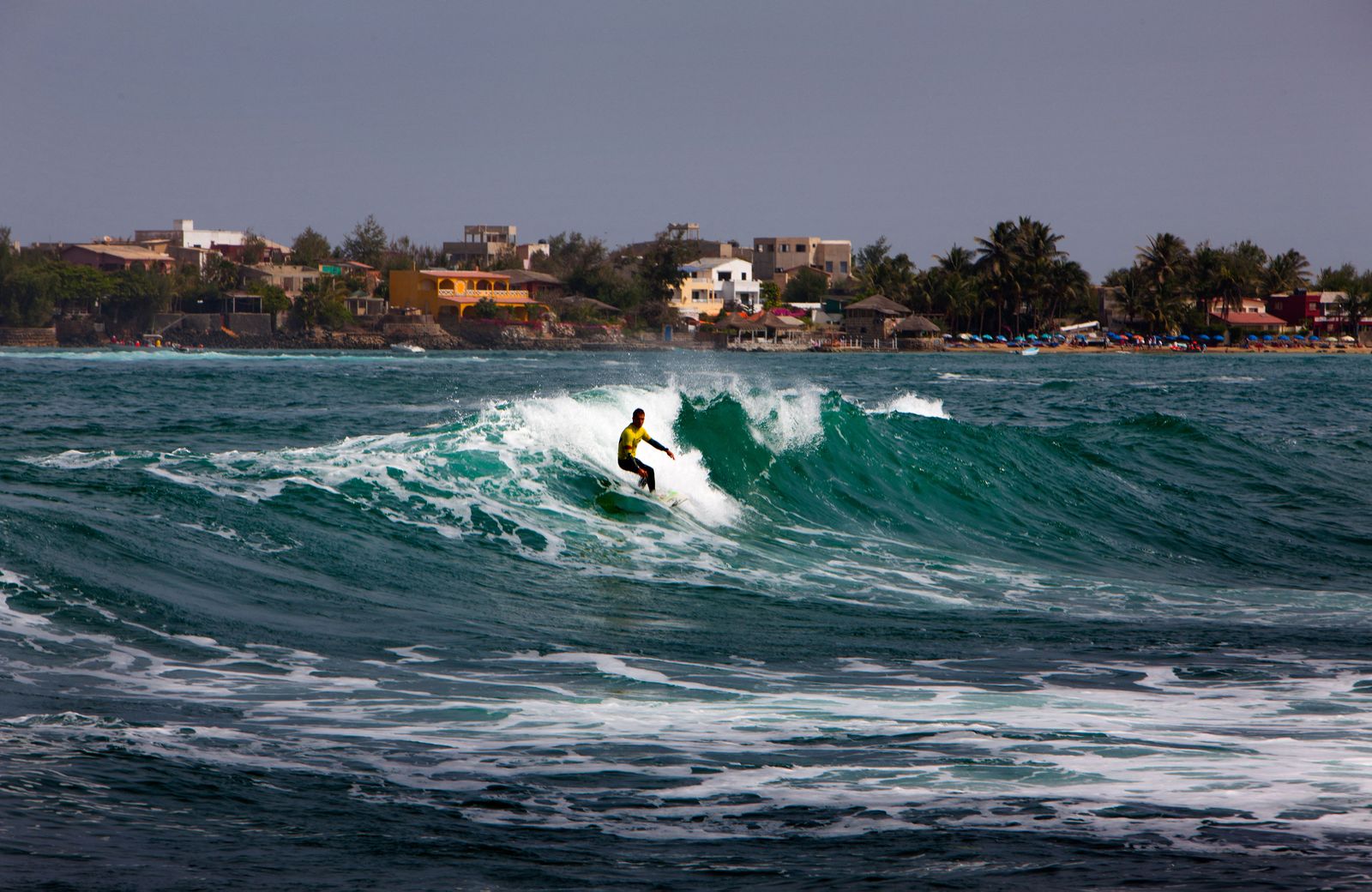
Hundreds of miles of undeveloped coastline with long, rolling waves are becoming increasingly difficult to find. For conservation ecologist Grégoire Touron-Gardic, however, the beaches of West Africa remain among the world’s most promising surf destinations.
Many coastlines that were once considered surfing paradises have been transformed by mass tourism, luxury development and pollution. Construction along the shore can also change the currents and underwater features that create quality waves. In countries such as Senegal and Liberia, Touron-Gardic sees an opportunity to protect relatively intact coastal landscapes while supporting local communities.
“Protecting the waves might have cascading benefits for the whole coastal area,” says Touron-Gardic, who is also a surfer. He describes surf conservation as “a new angle for marine conservation.”
Touron-Gardic began exploring the concept of wave conservation after watching a French documentary about wave reserves, or protected areas established to preserve surfing conditions. The idea reminded him of marine protected areas, which he had studied while researching northwestern Africa’s marine ecosystems. He wondered whether protecting important surf breaks could also help conserve biodiversity.
In 2022, while completing his PhD at the University of Portsmouth in the United Kingdom, Touron-Gardic and a colleague published a paper examining the conservation value of wave reserves.
Waves help exchange gases between the ocean and atmosphere, transport sediment to beaches and create habitat for marine species. Yet surfable waves can be affected by pollution, coastal construction and other human activities. The best surf breaks form where reefs, sandbars or artificial structures interrupt incoming waves, forcing water upward and creating the curling shape surfers seek.
/https://tf-cmsv2-smithsonianmag-media.s3.amazonaws.com/filer_public/5e/3f/5e3f4d30-35db-47c9-a978-48bc30db8600/ffgkf3.jpg)
Adam Goodwin via Alamy
Surf breaks can face “threats that compromise, even eliminate their ability to produce surfable waves,” says Michael Blum, executive director of Sea of Clouds, a nonprofit that helps protect landscapes, including surfing areas.
In his master’s thesis on surf-break protection, Blum identified poor water quality and industrial development as major threats. Kelp harvesting, offshore wind projects and changes in the amount of sediment flowing from rivers can also reshape or destroy a break. Erosion, pollution and construction may damage the reefs and sandbars responsible for producing the waves.
Research has also found that many surf breaks are located close to areas already recognized for their biodiversity. This overlap suggests that protecting surf locations could conserve both recreational resources and marine species, according to a 2021 paper.
Mapping surf breaks and biodiversity hotspots
After completing his PhD, Touron-Gardic and his colleagues published a study in Conservation Letters. The researchers used geospatial mapping to identify surf beaches in 15 African countries that overlap with biodiverse coastlines or nearby marine ecosystems.
The team examined 146 surf spots in West Africa and the Atlantic Maghreb, a region of North Africa. They found that 96 locations—nearly two-thirds of the total—were in or near an area considered important for biodiversity. Fifty-nine of those surf spots were located in or near a marine protected area, where conservation rules can be legally enforced. The remaining locations had no comparable protection.
Expanding existing protected areas to include surf breaks—or establishing new protected areas around them—could benefit surfers, coastal communities and wildlife. Legal protection may support environmental monitoring, limit harmful development, improve enforcement against pollution and illegal activities, and fund projects such as mangrove restoration or coral reef recovery.
“Surfing in West Africa and Atlantic Maghreb can represent much more than just a recreational activity; it can act as a catalyst for conserving coastal and marine ecosystems,” the study’s authors write.
To complete the analysis, the researchers compiled information about internationally important wetlands—including marshes, mangroves, coral reefs and rivers—recognized under the 1971 United Nations Ramsar Convention. They also mapped marine protected areas and Key Biodiversity Areas across the region.
Next, they assembled a database of established surfing locations, including well-known breaks and sites listed in Stormrider surf guides, a widely used resource for traveling surfers.
By comparing the locations, Touron-Gardic’s team identified places where high-quality surf conditions overlap with important ecological areas. The resulting map highlighted southern Morocco, Dakar in Senegal, Ghana’s Gold Coast and Robertsport in Liberia. At some of these locations, Touron-Gardic says, “you have pristine coastal rainforest areas with world-class surf spots.”
Liberia may offer a particularly promising opportunity. The country has powerful waves, but political instability has limited international surf tourism. Liberia’s civil wars ended in 2003, and Touron-Gardic believes the country could become a more popular surf destination as it stabilizes. Robertsport already has a vibrant surfing community and is attracting more visitors.
/https://tf-cmsv2-smithsonianmag-media.s3.amazonaws.com/filer_public/5b/ef/5beffc7e-f2cf-4059-b60d-abce0339c932/apmfft.jpg)
JS Callahan / tropicalpix via Alamy
Touron-Gardic says locations such as Robertsport could become strong candidates for surf conservation projects before mass tourism and large-scale development arrive. Establishing a conservation framework early could help ensure that future growth remains sustainable.
“There is not a lot of that [mass tourism] infrastructure in West Africa,” says Nik Strong-Cvetich, CEO of the Save the Waves Coalition. Developing these destinations responsibly could create opportunities for local residents to benefit from tourism, he adds.
/https://tf-cmsv2-smithsonianmag-media.s3.amazonaws.com/filer_public/f1/a6/f1a63047-03e0-493c-9ec0-1a200d14a9a2/gettyimages-2277070149.jpg)
Cem Ozdel / Anadolu via Getty Images
Balancing surfing, tourism and conservation
Surfers and conservationists have not always agreed about how to manage coastal areas. A well-known dispute unfolded in Malibu during the 1990s and 2000s, when runoff from development flowed through Malibu Creek and polluted the Surfrider point break.
Ecologists supported restoring wetlands, which can filter polluted water while providing habitat for marsh wildlife. Local surfers and other Malibu residents opposed the plan because they feared changes to Malibu Creek’s outflow would alter the underwater conditions that shape the waves. The restoration eventually went forward and reportedly improved water quality, according to the state’s Resource Conservation District tracker. However, local surfers say the waves were affected for years.
For Touron-Gardic, the Malibu example shows how local resistance can sometimes place surfing at odds with environmental protection. Still, he cautions against treating surfers as a single group. “There is a spectrum of attitudes within surfing communities, ranging from highly engaged environmental stewards to full exclusionary and self-centered persons,” he says.
Surfing itself can also place pressure on coastal ecosystems when visitor numbers grow beyond sustainable levels. At Australia’s Gold Coast, surfers may be crowded nearly shoulder to shoulder, potentially disturbing marine environments, Strong-Cvetich says. In Bali, Indonesia, large crowds and unchecked development around popular breaks such as Kuta Beach have contributed to pollution. The destination, he says, “runs the risk of being a victim of its own success.”
Surfers may accidentally damage coral reefs, while surfboard wax, broken equipment and other waste can add pollutants to the ocean. Long-distance travel to remote surf destinations also produces carbon emissions. As tourism increases, communities must manage both the benefits and environmental costs.
“Surfing has the power to create these new incentives for conservation, but it also has the power to be a destructive force for coastal ecosystems,” Strong-Cvetich says.
Wave reserves and other protected surf areas can help address these risks by setting rules for development, visitor numbers and resource use. “It’s about management and carrying capacity,” Strong-Cvetich says. “It’s an interesting and intriguing challenge and opportunity.”
/https://tf-cmsv2-smithsonianmag-media.s3.amazonaws.com/filer_public/4b/63/4b6356e6-789a-4cb7-9270-055f2f7d95b3/sanmiguel_mexico_surf_nachofelix.jpg)
© Nacho Félix
Examples of successful surf protection
Strong-Cvetich, who was not involved in Touron-Gardic’s study but contributed to the 2021 research on surfing and conservation, points to several successful projects led by Save the Waves.
In northern Baja California, Mexico, the creation of Arroyo San Miguel State Park protected a popular surf break. In 2017, the organization helped safeguard Punta de Lobos in Chile, an iconic surfing destination that also contains important coastal habitat and threatened species, including the Leucostele bolligeriana cactus. Malibu became the organization’s first World Surfing Reserve in 2009.
Other organizations, including Conservation International, are working to create protected surf areas. In Indonesia, one program has established 22 protected surfing areas. The first wave reserve dates to the early 1970s, when Bells Beach in Australia received protection.
For Touron-Gardic, protecting surf breaks can benefit more than surfers and wildlife. Carefully planned surf tourism can strengthen coastal economies, particularly when conservation begins before a destination becomes internationally famous.
When local residents and community leaders participate in planning, environmental rules can help small businesses benefit from tourism without encouraging large-scale development. Potential beneficiaries include locally owned hotels, surf shops, instructors and small fishing fleets that supply restaurants. “You can make livelihoods from surfing,” Touron-Gardic says.
Whenever possible, he favors ICCAs, or Indigenous and community conserved areas, over conventional marine protected areas. These community-led arrangements can give local residents greater control over coastal resources they depend on for fishing, surfing and other activities.
Building community-led wave reserves in Africa
Touron-Gardic hopes to apply these ideas in southern Ghana, Senegal and other priority locations. Publishing the mapping study was only the beginning, he says. Pilot projects that bring together surfers, residents and government authorities could establish local environmental stewardship and eventually lead to legally protected national networks of wave reserves.
For Strong-Cvetich, connecting surf conservation with ecosystem protection addresses a longstanding gap in coastal policy. Many countries protect beaches and inland areas while paying less attention to offshore habitats and the ocean conditions that connect them.
“The ocean and waves aren’t seen necessarily as a resource to be managed,” Strong-Cvetich says. Waves are essential to marine ecosystems, but they also support the physical and mental well-being of people who surf and participate in other water sports. “There’s a human component to that ecosystem,” he says.
Source: www.smithsonianmag.com