


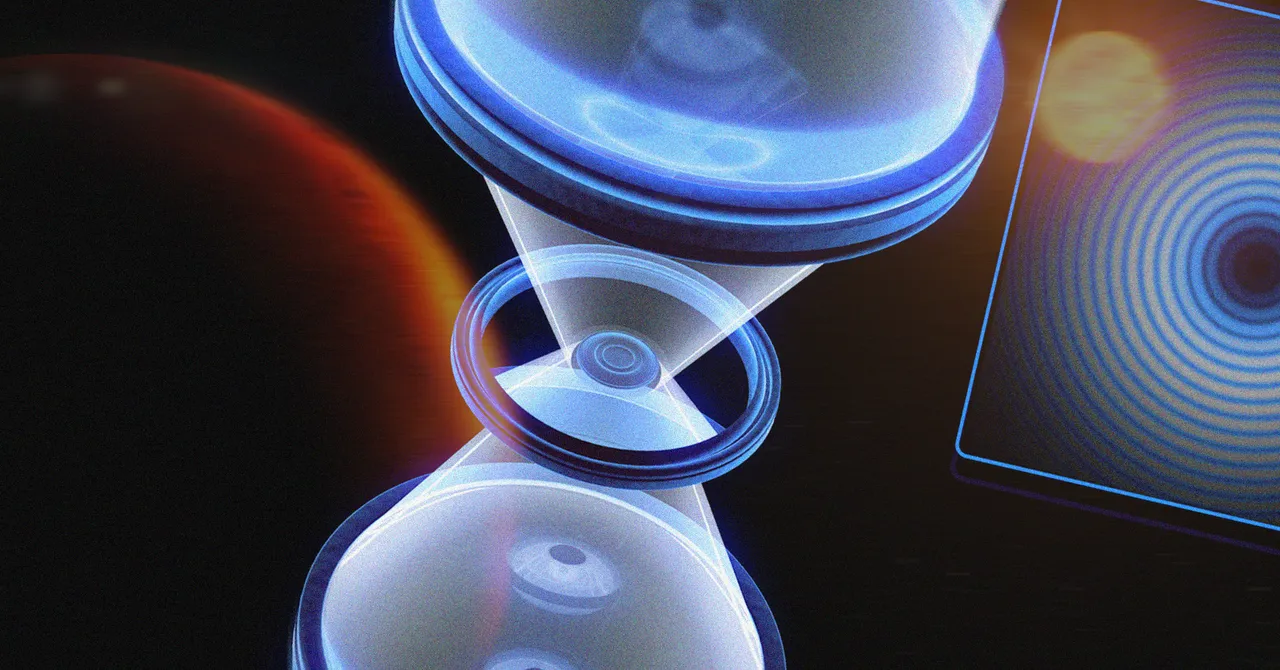
2 mirrors each This palm-sized technology could transform how scientists study exoplanets and deepen our understanding of the universe.
NASA’s Nancy Grace Roman Space Telescope is preparing for launch, and its primary instruments are designed to advance research across nearly every area of astrophysics. The telescope will also carry an experimental coronagraph, an instrument designed to block bright starlight and directly capture the faint light reflected from a planet’s surface. This groundbreaking technology could help NASA develop future space telescopes capable of imaging Earth-like planets orbiting Sun-like stars.
Directly imaging these distant worlds is far beyond the capabilities of today’s engineering. Roman’s coronagraph will therefore serve as a critical technology demonstration. “This will be the first time we’ve tested it in space, and we’ll see what work remains to be done,” said Vanessa Bailey, an astrophysicist at NASA’s Jet Propulsion Laboratory and the instrument scientist for the Roman Coronagraph.
A coronagraph functions like a precision sunshade, blocking intense starlight so astronomers can detect faint objects hidden in the glare. The Hubble Space Telescope and James Webb Space Telescope also use coronagraphs, but Roman’s system is significantly more advanced. It combines coronagraphic imaging with adaptive optics, which precisely adjusts the telescope’s mirrors to correct tiny distortions in the light. Even so, the challenge remains enormous. NASA compares the task to photographing a firefly next to a floodlight from thousands of miles away.
“If a bit of starlight hits the wrong place, it can destroy the entire image,” said Margaret Turnbull, an exoplanet scientist at the SETI Institute in California and leader of the Roman Coronagraph Science Team.
Adaptive optics is already standard on advanced ground-based observatories, including the Very Large Telescope in Chile and the twin Keck Observatories in Hawaii. These systems monitor turbulence in Earth’s atmosphere and adjust the telescope’s mirrors in real time, producing sharper images. Space telescopes do not face atmospheric turbulence, but Roman will use adaptive optics for a different reason: to search for cold, mature planets illuminated only by reflected starlight.
Roman’s coronagraph relies on two palm-sized deformable mirrors. Each mirror contains approximately 2,300 tiny actuators that expand in response to small electrical signals, subtly reshaping the mirror to correct unwanted distortions. It will be NASA’s first mission to operate an active deformable mirror in space.
The mirrors are only one part of the system. Roman also needs an ultrasensitive detector capable of measuring signals made up of just a few photons, because planets reflect an extraordinarily small amount of light. The coronagraph’s specially engineered masks are equally important. These masks block the star’s light and create the dark conditions needed to reveal a nearby planet. Astronomer Bruce Macintosh, who leads the University of California Observatory and the Roman Coronagraph Science Team, describes the masks as a “beautifully complex shape” unlike anything used in previous space telescopes. “Hubble’s stuff is completely brute force, literally just a little piece of metal that gets in the way of the star,” he said.
Source: www.wired.com