


Inside an unassuming warehouse in an industrial park in Oakville, Canada, a driverless forklift is helping test the future of nuclear waste disposal. When controlled remotely, the compact vehicle moves toward a stack of enormous bentonite-clay blocks. Each block weighs around 8,000 kilograms and is transported into a narrow rock tunnel, where another specialized machine fills the gaps with crushed clay.
Every block is designed to surround a copper-coated steel canister containing spent nuclear fuel. In Canada’s planned deep geological repository, these containers will be sealed behind layers of clay and concrete in tunnels hundreds of metres underground. The radioactive material will then be isolated while it gradually decays over thousands of years.
Nature Outlook: Nuclear power
The warehouse contains no actual nuclear waste. It is a full-scale testing facility operated by the Nuclear Waste Management Organization (NWMO), the Toronto-based group responsible for Canada’s long-term nuclear waste management strategy. The mock-up includes simulated tunnels and rock surfaces, allowing Peter Keech, the NWMO’s manager of engineered barrier science, and his colleagues to test equipment, assess storage technologies and explain the planned disposal process to the public.
The metal canisters are engineered to withstand immense pressure, including the weight of a glacier up to 3 kilometres thick if another ice age occurs before the fuel’s radioactivity has sufficiently declined. NWMO researchers have subjected several containers to even greater forces, equivalent to pressures more than 6 kilometres beneath the ocean.
The tested canisters were visibly deformed, resembling toothpaste tubes squeezed in the middle, but they remained completely sealed.
“These are much higher forces than they will ever experience in the repository, but we take the containers to failure so that we can understand how the materials behave,” says Keech. “Even after failure, the container still provides containment.”
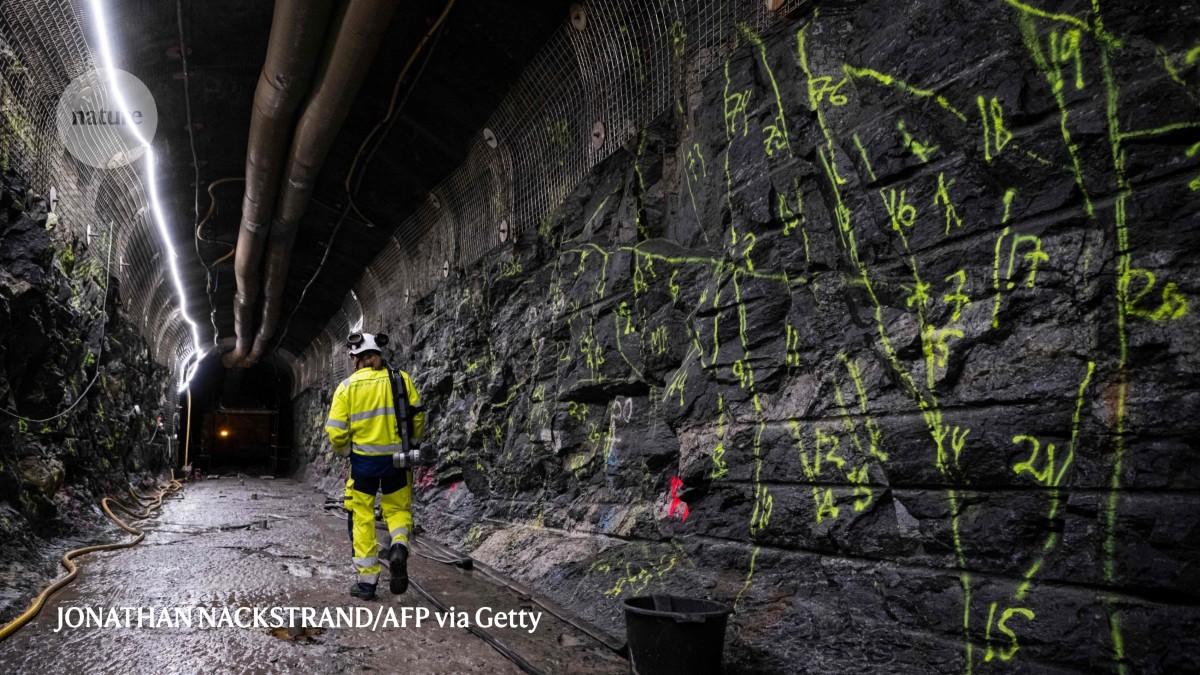
Canada’s permanent nuclear waste repository will be built approximately 1,600 kilometres northwest of the Oakville test facility. The site, selected in partnership with the Wabigoon Lake Ojibway Nation and the town of Ignace, will be located about 750 metres below ground in the hard rock of the Canadian Shield.
When the facility is expected to open around 2040, its network of 80–100 kilometres of underground tunnels will be capable of storing almost 6 million bundles of spent nuclear fuel generated by Canada’s four nuclear power stations during their operating lifetimes. The goal is to isolate the waste from people and the environment until its radiation levels eventually fall to those of naturally occurring uranium.
Deep geological repositories under development worldwide
Almost every country with a nuclear power industry is developing some form of deep geological repository for high-level radioactive waste. Finland is closest to operating a permanent facility: its Onkalo repository on the country’s western coast is expected to begin operations later this year.
Onkalo is being constructed approximately 430 metres underground in hard crystalline bedrock. The completed facility is expected to include about 50 kilometres of tunnels and hold roughly 6,500 tonnes of spent uranium fuel, says Linda Kumpula, a nuclear safety engineer at Finland’s Ministry of Economic Affairs and Employment in Espoo.
Sweden is also building a repository in crystalline rock and expects to begin accepting radioactive waste during the 2030s. France and Switzerland have selected sites in natural clay formations and are seeking regulatory approval. In December 2025, China completed the first stage of construction on an underground laboratory in the Gobi Desert, where researchers will assess the region’s suitability for long-term nuclear waste storage.
In the United States, plans for a spent-fuel repository at Yucca Mountain in Nevada have remained politically stalled for decades. The country does have one permanent underground facility: the Waste Isolation Pilot Plant, which stores radioactive waste from the US nuclear weapons programme in salt caverns beneath New Mexico.
The Waste Isolation Pilot Plant has provided valuable lessons for other nations, says Keech. These include how to transport radioactive waste safely, how to work with communities along transportation routes and how to minimize the amount of time spent fuel remains above ground after arriving at a repository.

A mock-up of a storage container demonstrates Canada’s nuclear waste disposal plans.Credit: Nuclear Waste Management Organization
Most of the major technical questions surrounding deep geological disposal have now been addressed, including how to construct underground repositories and how to engineer multiple protective barriers.
“We have been working on this for a long time, and it is no longer a major technical or scientific challenge,” says Stefan Mayer, team leader of radioactive waste disposal at the International Atomic Energy Agency in Vienna.
The more difficult challenge is securing political support and community consent. “You need to identify a site that is technically suitable, but you also need a community that is willing to host the facility,” says Allison Macfarlane, a geologist at the University of British Columbia in Vancouver and former chair of the US Nuclear Regulatory Commission. “It turns out that the second problem is harder than the first.”
What are the different types of nuclear waste?
Radioactive waste from nuclear power plants is generally divided into four categories: very-low-level, low-level, intermediate-level and high-level waste.
Very-low-level and low-level materials account for approximately 95% of all radioactive waste by volume. Very-low-level waste includes soil, concrete and rubble produced when a nuclear facility is dismantled. Low-level waste includes used protective clothing, tools and other lightly contaminated materials.
These materials can generally be placed in secure near-surface disposal facilities. They need to be isolated from people and the environment for several hundred years.
Intermediate-level waste includes reactor components and metal parts that have become contaminated with radioactive materials. Because some of the radioactive isotopes are highly concentrated and long-lived, this waste remains hazardous for thousands of years and must be stored underground rather than in near-surface facilities.
The most challenging category is high-level radioactive waste. It includes spent nuclear fuel, the containers used to store it and waste produced when some countries reprocess used fuel to recover additional energy resources.
High-level waste represents only about 3% of the radioactive waste produced by a nuclear power plant by volume, but it accounts for approximately 95% of the radioactivity. Some of this material will remain radioactive for hundreds of thousands or even millions of years — longer than any human civilization has existed.
Because of this extreme longevity, spent nuclear fuel must be isolated deep underground in a stable geological formation. A properly designed repository is intended to prevent radioactive materials from reaching groundwater, ecosystems or future generations.
The total volume of high-level nuclear waste is smaller than many people assume. An average 1-gigawatt nuclear power plant produces approximately 30 tonnes of spent fuel each year. Including the waste and its storage container, each tonne occupies about 2 square metres, says Haruko Wainwright, a nuclear engineer at the Massachusetts Institute of Technology in Cambridge.
Wainwright notes that the volume becomes more manageable when compared with other long-lasting pollutants. An average coal-fired power plant produces roughly 500,000 tonnes of coal ash and 6 million tonnes of carbon dioxide annually.
By comparison, the United States has accumulated just under 100,000 tonnes of spent nuclear fuel during approximately six decades of commercial nuclear power generation, according to the US Nuclear Waste Technical Review Board.
When spent fuel is first removed from a reactor, it is both intensely radioactive and extremely hot. It must remain in cooling pools of water for at least five years before it can be transferred to large steel storage canisters. These casks are filled with inert gas and placed inside concrete silos, where the fuel continues to cool gradually.
Nearly every nuclear power plant currently stores its spent fuel in concrete casks or pools on-site. This interim storage is a major source of public concern.
“When people say we do not know what to do with nuclear waste, they are usually referring to spent nuclear fuel that is still stored on the surface,” says Mayer. “The next step is clear: it needs to be placed underground.”
However, no deep geological repository for high-level radioactive waste is currently operating at full scale.
Why nuclear waste disposal has become a political issue
The United States was once expected to lead the world in developing a permanent repository for spent nuclear fuel. The country began searching for a disposal site in the early 1980s.
“The Yucca Mountain geological disposal programme was the first in the world to submit a licence application. It was ahead of Finland and Sweden in science, engineering and safety research,” says Mayer.
But the proposed repository in northern Nevada, near areas where the United States conducted nuclear weapons tests, has made little progress for more than 16 years. Congress has provided no funding for the project since 2010, and there is currently no clear indication that construction will resume.

Plans for a US nuclear waste repository at Yucca Mountain in Nevada remain stalled.Credit: Cavan Images/Alamy
Macfarlane says the Yucca Mountain proposal also faces technical concerns. A nearby volcano is considered potentially active, which could pose a long-term safety risk. The proposed repository would also be located above the water table, raising concerns that radioactive particles known as radionuclides could eventually enter the environment.
Although those technical questions are significant, Macfarlane says the central problem is political. Nevada and nearby communities had limited involvement in the site-selection decision, creating strong and sustained opposition.
The original US plan was to evaluate three potential sites in Nevada, Texas and Washington before selecting the most suitable location. However, the cost of the programme and opposition from influential politicians in Texas and the Pacific Northwest contributed to legislation passed in 1987 that designated Yucca Mountain as the only site to be studied.
After Nevada senator Harry Reid became majority leader of the US Senate in 2007, the project was effectively placed on indefinite hold.
The site “was politically chosen, and then politically killed”, says Wainwright.
Finland and Canada have made greater progress partly because they involved local communities from the beginning. Finland initially considered 100 candidate sites during the 1980s before selecting Onkalo in the early 2000s.
Throughout the process, transparent communication with communities near potential sites was a priority, says Kumpula. “Trust was the key.”
Canada also began with a nationwide public consultation, says Lisa Frizzell, the NWMO’s vice-president of communications. “An important step was opening a dialogue across the country about how people wanted nuclear waste to be managed over the long term,” she says.
The Canadian site-selection process began in 2010, when communities were invited to express interest in hosting a repository. Twenty-two communities in Ontario and Saskatchewan volunteered, with the understanding that they could withdraw at any stage.
“We only want to put the repository in a place that is safe and where the communities have given their consent,” says Frizzell.
In 2024, Ignace and the Wabigoon Lake Ojibway Nation were selected as the preferred host communities. Canada’s regulatory approval process is now under way, although opposition remains. Some local residents plan to hire legal representation so that their concerns can be raised during the final environmental impact assessment.
Macfarlane says the United States could learn from the consent-based approaches used in Finland, Canada and other countries.
“The way the NWMO proceeded was excellent. They were not in a rush, they invited communities to volunteer, carried out technical studies and allowed communities to make the decision,” she says. “The US approach has been to decide, announce and defend.”
Macfarlane also believes the United States should reconsider which organization is responsible for nuclear waste disposal. Rather than placing responsibility with the Department of Energy, she suggests creating an independent organization — either a government body similar to a port authority or an industry-led group modelled on Canada’s NWMO.
“You need more of a corporate structure, with leadership that will remain in place for a long time, because this is a slow process,” Macfarlane says. “It takes decades to do properly.”
That approach was among the main recommendations made in 2012 by the Blue Ribbon Commission on America’s Nuclear Future, on which Macfarlane served. So far, however, the recommendation has not led to significant changes.
Macfarlane says the United States should be willing to abandon the Yucca Mountain approach and restart the search using a consent-based process.
“I think the US has failed and needs to acknowledge that — then decide to try again,” she says.
The timescales involved in managing spent nuclear fuel make it easy for governments to postpone decisions and leave the problem to future generations. But Macfarlane says the responsibility lies with people today to begin developing permanent solutions.
“It is imperative that we do something sooner rather than later,” she says. “I can tell you one thing with 100% certainty: if we do nothing, this material will eventually enter the environment and harm people in the future.”
Source: www.nature.com