


Hello Nature readers. Would you like to receive the Nature Briefing free in your inbox every day? Sign up here.
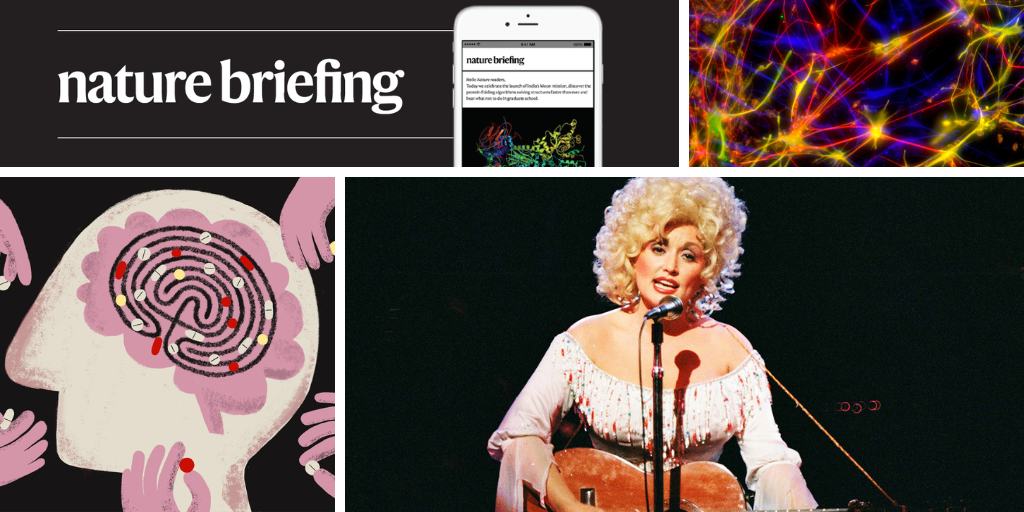
Dolly Parton performs at the Dominion Theatre in London, England, in 1983.
Credit: Pete Still/Redferns via Getty
Dolly Parton has died at the age of 80, leaving a lasting legacy in music, philanthropy, science and public health. She helped fund Moderna’s early-stage vaccine research and publicly documented her vaccination to encourage confidence in COVID-19 vaccines. Her Imagination Library program sends more than 3 million books each month to children worldwide. World Health Organization Director-General Tedros Adhanom Ghebreyesus described Parton as “an extraordinary artist, a champion of true kindness and an ambassador for science and public health.”
Nature | 9 min read
China has delayed the launch of Chang’e 7, the next mission in its lunar-probe program, until 2027. The mission will target the Moon’s south polar region, an area filled with steep rocks and craters, to search for water ice and study moonquakes. The China Manned Space Administration did not explain the reason for the last-minute change, which was announced in a brief statement on Sunday.
Reference: China Manned Space Agency notice
AI detection, sleep and research careers
AI detection tools such as Pangram and GPTZero claim to identify text generated by large language models. Platforms that use these tools, including alphaXiv, an alternative interface for the arXiv preprint server, are making them available to more researchers. However, detecting AI involvement does not prove how a tool was used or whether that use was ethical. Researchers warn that even highly advanced AI-detection systems may have unavoidable limitations.
Nature | 20 min read
Sleep deprivation can harm health, reduce productivity and increase workplace-safety risks. These concerns could encourage employers to monitor how much their staff sleep, write bioethicists Brian Earp, Sebastian Porthdam Mann and Effie Viena. As more products promise to improve sleep, they ask when institutional support for healthy sleep could become an expectation. Researchers, ethicists and policymakers should examine these issues before sleep-tracking and sleep-enhancement technologies become more widespread.
Nature | 14 min read
Stefan Haulka and Christoph Salzmann, who run a successful research-fellowship program in the Department of Chemistry at University College London, share practical advice for strengthening applications and securing a first fellowship.
Nature | 10 min read
I’m enjoying the sunshine today while exploring how researchers reconstructed the sounds of a Jurassic forest. Calls and wing movements were recreated from fossilized wings, including what may be the earliest known example of ultrasonic communication in animals. Read the report and the research paper.
Let us know what you think about this newsletter as we explore the sounds of the Jurassic. Email us at [email protected].
Thank you for reading,
Flora Graham, Nature Briefing Editor-in-Chief
• Nature Briefing: Careers — practical insights, expert advice and award-winning journalism to help you develop your research career.
• Nature Briefing: Microbiology — news about microorganisms, the most abundant forms of life on Earth, and their roles in health, the environment and food systems.
• Nature Briefing: The Anthropocene — coverage of climate change, biodiversity, sustainability and geoengineering.
• Nature Briefing: AI and Robotics — human-written reporting on artificial intelligence and robotics.
• Nature Briefing: Cancer — a weekly newsletter created for cancer researchers and health professionals.
• Nature Briefing: Translational Research — the latest developments in biotechnology, drug discovery and pharmaceuticals.
Source: www.nature.com