


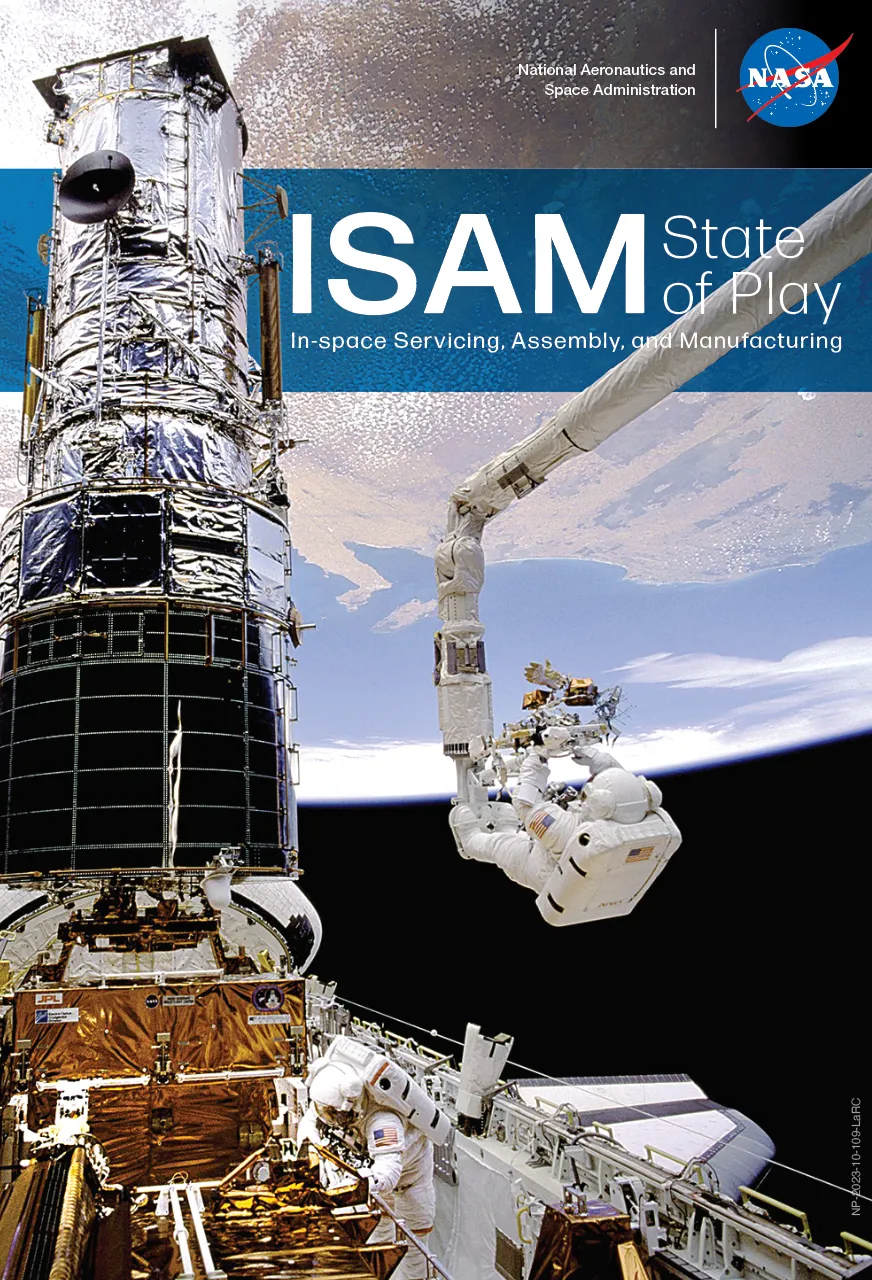
NASA Langley Research Center’s 2026 Space Services, Assembly, and Manufacturing (ISAM) State of Play has expanded into a 368-page reference covering the technologies needed to service, assemble, and manufacture spacecraft in orbit. Published since 2021, the document tracks capabilities across 11 functional areas and distinguishes demonstrated hardware from concepts that remain speculative, giving mission designers and companies a shared view of what exists today and what is under development.
A growing reference for an expanding industry
Companies began asking NASA Langley to participate in the ISAM State of Play to gain access to competitive intelligence, a sign that the field had passed an inflection point.
“We’ve had anonymous companies ask us if we have sensitive information,” said Dale Arney, senior team lead for NASA Langley’s ISAM technology portfolio. The answer is no, but that impartiality is part of what makes the State of Play valuable to an industry trying to understand a rapidly expanding field.
“The field itself has grown more than linearly since we started,” Ernie explains. What began as a tool for NASA centers to establish a common reference point has become an industry resource for understanding which technologies are possible and which remain conceptual.
Evidence-based participation
The State of Play teams maintain strict standards for including technologies. Hardware must be physically present, either as a ground prototype or an in-flight demonstration.
“We have people who give PowerPoint presentations of technology ideas,” Ernie says. “There’s still no real indication that they’ve done any work on the technology itself.” Such concepts will not be adopted until the following year’s review.
This rigor matters because ISAM capabilities could enable missions that are not possible through traditional single-launch approaches. Future missions may require telescopes larger than any launch-vehicle fairing, durable national security assets that are mobile and resilient, and commercial systems that can be upgraded to the latest technology in orbit instead of being completely replaced.
A collaborative document
The document is intentionally collaborative. “We call this a kind of crowdsourced document,” said team member John Mulvaney.
Each year, the team conducts more interviews with industry partners to improve the document’s accuracy and completeness. Contributions come from NASA centers including Ames, Glenn, Marshall, Kennedy, and Johnson, as well as from international developers whose work meets the hardware criteria.
The 2026 edition goes beyond a technical reference by including developer profiles and facility documentation. It shows mission designers not only what can be done, but also who is developing the relevant technologies and where the work is taking place. For companies entering the ISAM ecosystem or expanding their capabilities, the document outlines both a competitive environment and opportunities for collaboration.
Establishing a capability baseline
As the space industry moves toward more ambitious missions, including lunar infrastructure and on-orbit manufacturing, the ISAM State of Play provides the shared vocabulary and capability baseline needed by the emerging ecosystem.
It is not a speculation about the future. Instead, it documents what exists today and where the hardware is expected to go next. The 2026 ISAM State of Play can be downloaded from NASA.gov.
Source: www.nasa.gov