


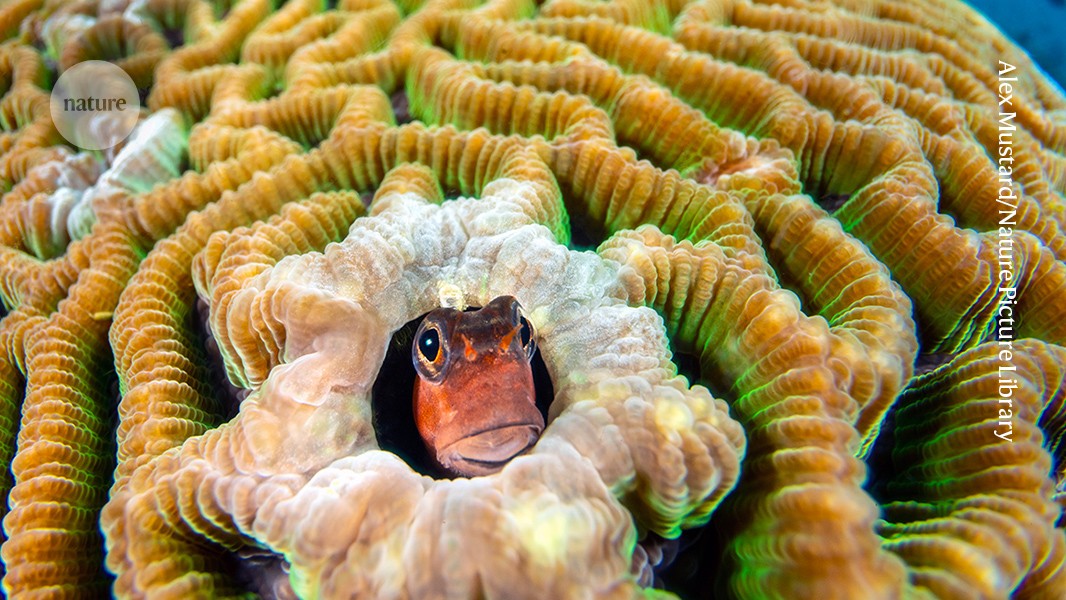
Can Underwater “Lullabies” Help Restore Coral Reefs?
Corals in the Caribbean are at peak spawning season, and something new is appearing in the water this year: underwater speakers. At several locations, the devices are playing recordings of vibrant coral reefs—including snapping shrimp and fish—to clouds of floating coral larvae searching for a place to settle.
This El Niño is expected to be the largest in recorded history with an “astonishing margin”
Researchers hope these underwater soundscapes will attract coral larvae to degraded reefs and help them recover. The project, conducted by scientists at Woods Hole Oceanographic Institution (WHOI) in Massachusetts, is based on the discovery that coral larvae can detect sound and use it as a cue to find a new home.1
“A healthy coral reef naturally transmits sound everywhere,” says WHOI marine bioacoustician Alan Mooney, who is leading the project. He is part of a growing group of researchers working to save endangered corals. Alongside playing recordings of healthy reefs to restore damaged habitats, scientists are moving corals from shallow areas to deeper, cooler waters and inoculating reefs with protective microorganisms.
Earth’s corals need all the help they can get. Record sea temperatures this year, driven by human-induced climate change and the super-strong El Niño phenomenon in the Pacific Ocean, are raising new concerns about the future of coral reefs. Rising water temperatures can cause coral bleaching, a process in which corals expel the symbiotic algae they rely on for nutrients. Severe or prolonged bleaching can eventually kill coral.

Researchers are testing a system in Dominica that plays the sounds of healthy coral reefs to help corals grow.
Credit: Dan Mele, ©Woods Hole Oceanographic Institution
As of late August, bleaching had been observed in corals around Kiribati, Florida, the Pacific coast of Panama and the central Pacific Ocean. The National Oceanic and Atmospheric Administration’s Coral Reef Monitoring Station reported that water temperatures had reached levels capable of putting corals at risk of bleaching and heat-related death. Temperatures are expected to rise further in 2027, when El Niño is in full swing, increasing the risk to corals.
Coral reefs can recover from bleaching, and their ability to recover has often surprised scientists. But recovery takes time, and corals cannot rest. This year’s bleaching event comes less than a year after the last global bleaching event ended in 2025.
“It’s like having the coronavirus, getting the flu, and being stressed out about work at the same time,” says Amy Aprile, a marine geochemist who leads WHOI’s coral restoration team. She says the heatwaves this year and in 2027 are likely to be even more harmful to corals than previous heatwaves because of accumulated stress.
Michael Sweet, a coral biologist at the University of Derby in the UK, says that despite the gloomy outlook, many researchers remain focused on what they can do. “I vacillate between feeling like I’m about to give up and thinking, ‘I’m going to fight to the death and try to somehow make the situation a little better.’”
Why coral reefs are disappearing
The 21st century has not been kind to coral reefs. Four times since 1998, hot oceans driven by global warming and El Niño have caused coral bleaching around the world. These bleaching events have caused extensive damage.
According to a major report by hundreds of scientists published in August,2 overall hard-coral cover from 2020 to 2024 decreased by 9.5% compared with the period from 1980 to 2009. Much of the decline occurred during record heat in 2024, when nearly all the world’s coral reefs bleached. Hard-coral cover fell by 8.9% compared with 2023—the largest single-year decline ever recorded.

Source: Reference 2
“What this decline tells us is that recovery is not enough before another decline occurs,” says report co-author Manuel González Rivero, a coral researcher at the Australian Institute of Marine Science in Cape Cleveland.
The forecast for this year’s El Niño event also looks bleak. “Even under optimistic models of future ocean temperatures, we can expect massive bleaching to occur everywhere over the next 10 years,” says Giovanni Strona, an ecologist who studies corals at the European Commission’s Joint Research Center in Ispra, Italy.
“Many forecasts predict that coral reefs around the world will be almost completely wiped out by the end of this century,” Strona adds. A 2025 study he co-authored argues that the scale of the problem is currently too large for restoration efforts to prevent a major decline without a significant increase in funding or a major technological advance.3
Sea temperatures hit record high: What’s next?
Coral scientists say the priorities for protecting reefs are reducing greenhouse-gas emissions and shielding reefs from local stresses such as overfishing and pollution. Climate models suggest that limiting global warming to 1.5°C above pre-industrial averages could spare some reefs from repeated bleaching events.4 In a world that is 2°C warmer, nearly all coral reefs will experience severe bleaching regularly, eventually leading to coral death.
Scientists working on coral restoration say more can still be saved. “Coral reefs have not yet passed the point of no return,” the report says.2 But with the world nearing both temperature thresholds, researchers say rising heat is increasingly challenging reefs’ ability to recover naturally. More direct interventions are needed to keep reefs alive.
“There’s a flip between it’s a great time to be coral scientists and biologists in general, and the opportunity to develop and establish these really great technologies, and the fact that we have to do it,” says Sweet, who is researching ways to harness the coral microbiome to help reefs.
Research teams are developing a range of techniques to support coral recovery, but scaling up these methods and securing funding remain major challenges. Some approaches are relatively low-tech. For example, a long-running coral-gardening project has improved its ability to breed corals with greater tolerance to heat and acidity.5 Other approaches include treating corals with microbial cocktails and micronutrients and using the underwater sounds of healthy reefs to attract larvae.
How underwater sound could help coral larvae
For Mooney, the discovery that coral larvae—small invertebrates less than a millimeter long—could be sensitive to sound was a major surprise. In 2012, he and his colleagues studied differences between the soundscapes of healthy and degraded coral reefs near the U.S. Virgin Islands.
The Caribbean is experiencing some of the world’s most severe declines in coral area because of local pressures including rising ocean temperatures, overfishing, sediment pollution and disease outbreaks.
In 2012, researchers already knew that fish were attracted to the sounds of vibrant coral reefs.6 Mooney discovered that squid are also sensitive to sound,7 as are crabs.8 He began to wonder whether other invertebrates, including corals and oysters, might use acoustic cues to assess reef health.
Mooney and his colleagues conducted experiments to learn how corals use sound. They found that coral larvae were sensitive to acoustic cues and settled more often when exposed to sounds from healthy coral reefs.9

Amy Aprile studies biodiversity on coral reefs near the U.S. Virgin Islands.
Credit: Dan Mele, ©Woods Hole Oceanographic Institution
In 2022, the team began testing whether coral-reef soundscapes could aid ecosystem recovery by broadcasting recordings of vibrant reefs in areas where the natural soundscape had gone quiet. The researchers placed larvae of mustard-yellow stony coral, Porites astreoides, in a degraded-reef habitat housed in a special cup that vibrated and allowed sound to enter while blocking other sensory information, such as light and chemical cues.
Underwater speakers then broadcast recordings of healthy coral reefs. Larvae exposed to the recordings settled, on average, nearly twice as often as larvae that received no acoustic treatment.10 “It’s amazing. This actually worked,” Mooney says.
Source: www.nature.com