


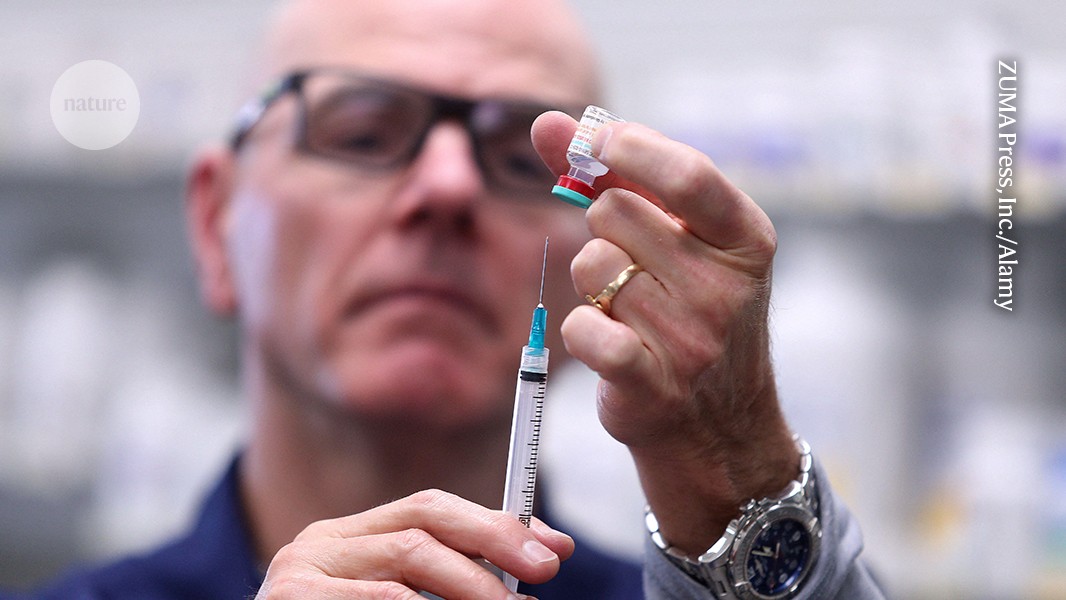
The shingles vaccine, called Shingrix, contains viral proteins and immune-boosting compounds.
Credit: ZUMA Press, Inc./Alamy
The shingles vaccine currently used in the United States has been linked to a lower risk of cardiovascular disease and heart failure, according to a study involving more than 70,000 people who received either Shingrix or an older shingles vaccine.1 The findings were reported on August 26 in Nature Medicine.
The results are “particularly exciting” because they are more robust than those from earlier studies, says Emily Leyens, an epidemiologist specializing in vaccine development at Kaiser Permanente, a healthcare provider in Pasadena, California.2 However, more research is needed to determine whether the shingles vaccine directly reduces the risk of heart disease, heart failure or other cardiovascular events. “We cannot definitively conclude that there is a causal relationship,” says Leyens, who was not involved in the study.
Shingles: the second act of chickenpox
Shingles is a painful skin rash caused by the varicella-zoster virus, the same virus responsible for chickenpox. After a person recovers from chickenpox, the virus can remain dormant in the body and reactivate later in life. Shingles is most common among adults aged 50 and older.
Earlier observational studies have suggested that Shingrix, a recombinant vaccine made from varicella-zoster virus surface proteins and immune-boosting compounds, could provide benefits beyond shingles prevention. These potential benefits include a reduced risk of cardiovascular disease and dementia.3
However, many previous studies compared people who received the shingles vaccine with those who remained unvaccinated. This type of comparison can make the vaccine’s apparent benefits seem larger than they really are because people who choose vaccination may already be healthier than those who do not, says study co-author Maxime Taquet, a psychiatrist at the University of Oxford in the United Kingdom. Taquet previously investigated the relationship between shingles vaccination and dementia risk.3 “I realize this is a very biased way of answering the question,” Taquet says.

Link between influenza and cardiovascular disease shows why vaccination is essential
To address this limitation, Taquet and his colleagues analyzed electronic health records from TriNetX, a database containing medical information from people across the United States. The researchers compared cardiovascular health outcomes in two groups of more than 36,000 adults aged 60 and older. One group received Shingrix, the recombinant shingles vaccine, while the other received Zostavax, a discontinued vaccine containing an inactivated form of the virus.
Shingrix replaced Zostavax in the United States in October 2017. This change enabled researchers to conduct a natural experiment by comparing health outcomes among people who received the two vaccines.
The researchers tracked cases of cardiovascular disease, heart failure and stroke for up to seven years after vaccination. They also examined each group’s “disease burden”, or the amount of time participants lived with a diagnosed cardiovascular condition.
Over the seven-year follow-up period, people who received Shingrix remained free of cardiovascular disease for an average of 9% longer than those who received Zostavax. The finding suggests that the recombinant shingles vaccine could help prevent or delay the onset of heart disease.
Recipients of Shingrix were also 10% less likely to be diagnosed with heart disease and 12% less likely to develop heart failure than those who received Zostavax. Among men, the recombinant vaccine was associated with a 12% lower risk of stroke.
Source: www.nature.com