


Over time, astronomers can determine whether the orbit of a newly discovered star is affected by the rotation of Sgr A*.
Credit: ESO/GRAVITY/L. Calzada
These observations strongly suggest that Sgr A*, the supermassive black hole at the center of the Milky Way, is rotating. Its spin should influence the precession of stellar orbits that pass close to the black hole, offering astronomers a way to measure the black hole’s rotation.
However, the effect of black hole spin decreases with the cube of the distance from Sgr A*. To detect it, researchers need to either find a star traveling extremely close to the black hole or observe a nearby star for a sufficiently long period. For most stars currently known near the Galactic Center, that second option could require thousands of years.
Unless astronomers discover another star on an even tighter orbit, they will need more advanced image processing and increasingly precise measurements of known stellar trajectories—or a great deal of patience—to identify the influence of Sgr A*’s spin.
An Extremely Eccentric Orbit Around Sgr A*
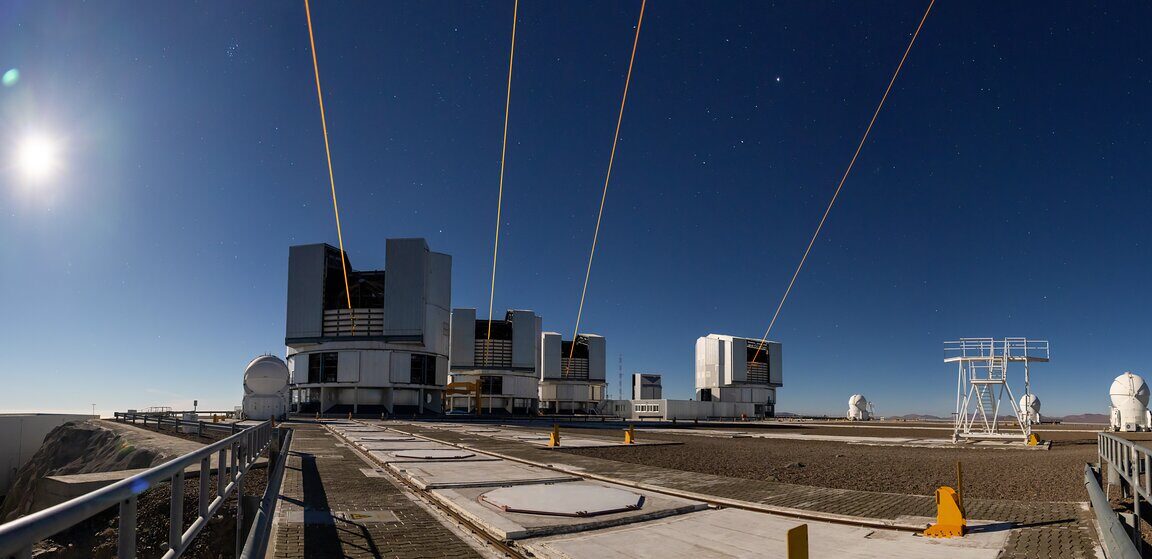
The latest discovery comes from a research program using the European Southern Observatory’s Very Large Telescope Interferometer and its GRAVITY instrument. GRAVITY combines light from four separate telescopes, producing the resolving power of a single telescope with an effective diameter of about 130 meters.
Since 2017, astronomers have used GRAVITY to track stars orbiting in the immediate vicinity of Sgr A*. Although the instrument does not directly produce conventional images, researchers can process its measurements to reconstruct detailed images and determine the positions of individual stars.
In 2023, the team identified a star moving away from the black hole and designated it S301. After monitoring the star for several months, the researchers estimated its orbit, used that model to predict its location in older observations, and confirmed that the object was a genuine star.
The data indicate that S301 made its closest approach to Sgr A* in early 2023, passing nearer to the black hole than any other known star. The strongest orbital models suggest that S301 completes one revolution in just 8.7 years—more than three years faster than the previously known record holders in the region.
S301’s orbit is also highly eccentric, forming a severely elongated ellipse. A perfectly circular orbit has an eccentricity of zero, while an eccentricity greater than one indicates an unbound trajectory in which the object is not gravitationally captured. S301 has an estimated eccentricity of 0.9832, placing it very close to the threshold for escaping Sgr A*’s gravitational influence. For comparison, Pluto’s orbital eccentricity is about 0.25.
Source: arstechnica.com