


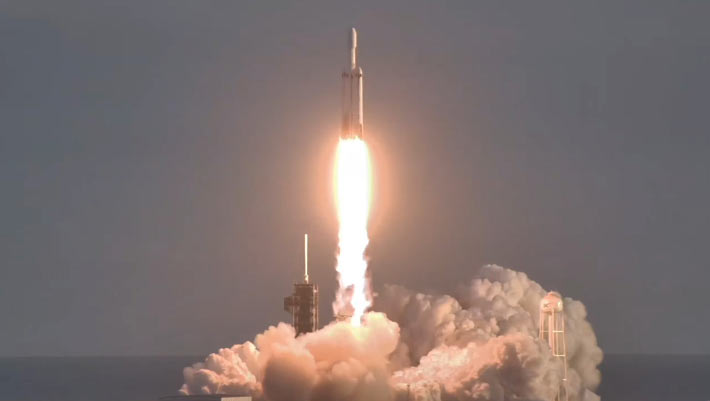
NASA’s Nancy Grace Roman Space Telescope launched from Kennedy Space Center’s Launch Complex 39A aboard a SpaceX Falcon Heavy rocket at 7:26 a.m. EDT (11:26 UTC) on August 30, 2026. The space telescope has begun a three-month, 1.5-million-kilometer (930,000-mile) journey to its operational destination at the second Sun-Earth Lagrange point, known as L2.
NASA’s Nancy Grace Roman Space Telescope launches on August 30, 2026, at 7:26 a.m. EDT aboard a SpaceX Falcon Heavy rocket from Launch Complex 39A at Kennedy Space Center in Florida. Image credit: NASA.
NASA’s Nancy Grace Roman Space Telescope will help astronomers investigate some of the deepest mysteries in astrophysics, including how the universe evolved, what its ultimate fate may be, and whether life exists beyond Earth.
To make its highly sensitive observations, the Roman Space Telescope will operate from a vantage point approximately 1.5 million kilometers from Earth, on the side of our planet opposite the Sun.
At the second Sun-Earth Lagrange point, or L2, the gravitational forces of the Sun and Earth help maintain a stable orbit. This location will give Roman an unobstructed view of deep space while reducing the fuel needed for station-keeping.
Named after Nancy Grace Roman, NASA’s first chief astronomer and widely recognized as the “mother of the Hubble Space Telescope,” the Roman Observatory features a field of view at least 100 times wider than Hubble’s. During its mission, the telescope could measure light from as many as one billion galaxies.
“Roman is exactly the success story we want to see across NASA,” said NASA Administrator Jared Isaacman.
“Achieved ahead of schedule and on budget, this mission reflects more than a decade of dedicated efforts by NASA employees and industry partners.”
“Now, Roman will provide us with a new atlas of the universe, pushing the boundaries of discovery and demonstrating what is possible when America’s space program combines bold ambition with disciplined execution.”
“Roman will be a discovery machine that will bring us closer than ever before to answering humanity’s deepest questions about the history of the universe,” said Nicky Fox, associate administrator for NASA’s Science Mission Directorate.
“With its wide field of view and rapid research speed, Roman will usher us into a new era of discovery, make the invisible visible, and lay the foundation for humanity’s search for life beyond our solar system.”
The ground control team at NASA’s Goddard Space Flight Center received telemetry from the spacecraft within seven minutes of liftoff. Approximately 30 minutes into the flight, the rocket’s core stage separated from the observatory, while the Falcon Heavy booster returned safely to the launch site.
Roman’s solar panels and lower instrument shade were successfully deployed approximately 83 minutes after liftoff. About 70 minutes after launch, control of the spacecraft was transferred from NASA’s Near-Earth Tracking Network to the Deep Space Network, which operates ground stations in Australia, Spain, and California.
The telescope’s primary wide-field instrument, a 300-megapixel infrared camera, is scheduled to be activated several weeks into the journey.
During the three-month commissioning phase, engineers will calibrate and test Roman’s systems. NASA is targeting the release of the space telescope’s first public images in early 2027.
Once fully operational, the Nancy Grace Roman Space Telescope is expected to produce approximately 1.4 terabytes of data each day. Artificial intelligence tools and citizen scientists will help researchers process and analyze the mission’s enormous volume of observations.
“We’ve never been able to look at space the way Roman will before,” said Julie McEnery, Roman’s senior project scientist at NASA’s Goddard Space Flight Center.
“There’s no telling what more we’ll know and see by this time next year.”
Source: www.sci.news