


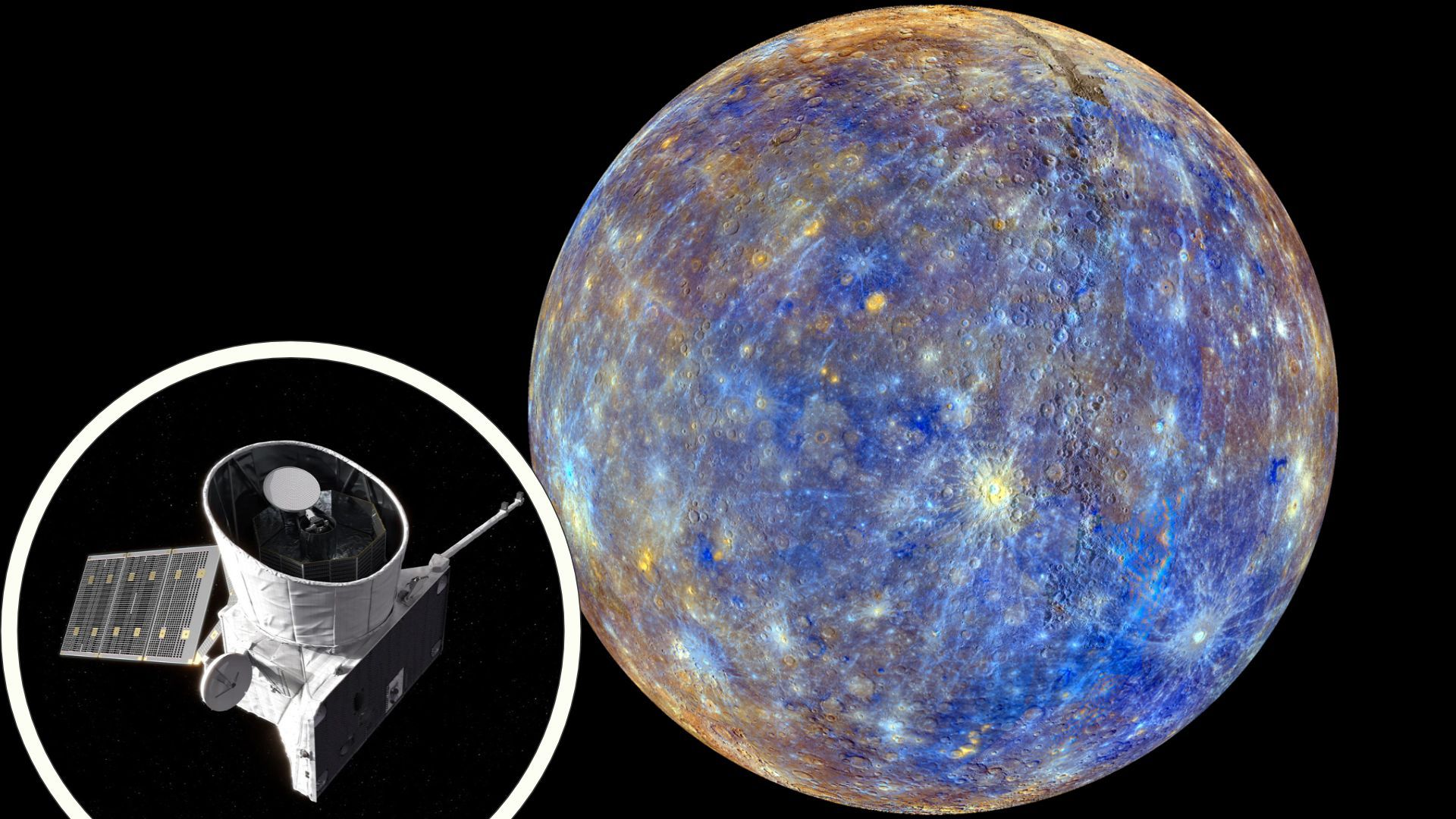
After eight years of traveling through the inner solar system, the European-Japanese BepiColombo mission has entered orbit around Mercury, making it only the second spacecraft mission in history to do so. A mission scientist confirmed on Saturday, November 21, that the spacecraft had reached Mercury’s orbit and was transmitting data to the ground team. However, the orbit insertion was not entirely successful: a software glitch prevented BepiColombo’s thrusters from firing for the full 37 minutes required to slow its approach.
BepiColombo reaches Mercury despite an unexpected problem
The European Space Agency (ESA) said on Monday that it is investigating the software issue and its effect on the spacecraft’s orbit. The agency said BepiColombo remains “safe” and is expected to begin a year of intensive scientific observations of Mercury in the coming months, provided the mission can continue as planned.
A complex journey to the inner planet
Built jointly by ESA and the Japan Aerospace Exploration Agency (JAXA), BepiColombo consists of two spacecraft stacked together during their journey. The ESA-built Mercury Planetary Orbiter (MPO) and JAXA’s Mercury Magnetospheric Orbiter (Mio) carry separate scientific instruments. They will eventually separate into different orbits around Mercury and operate as two probes, collecting complementary data about the planet.
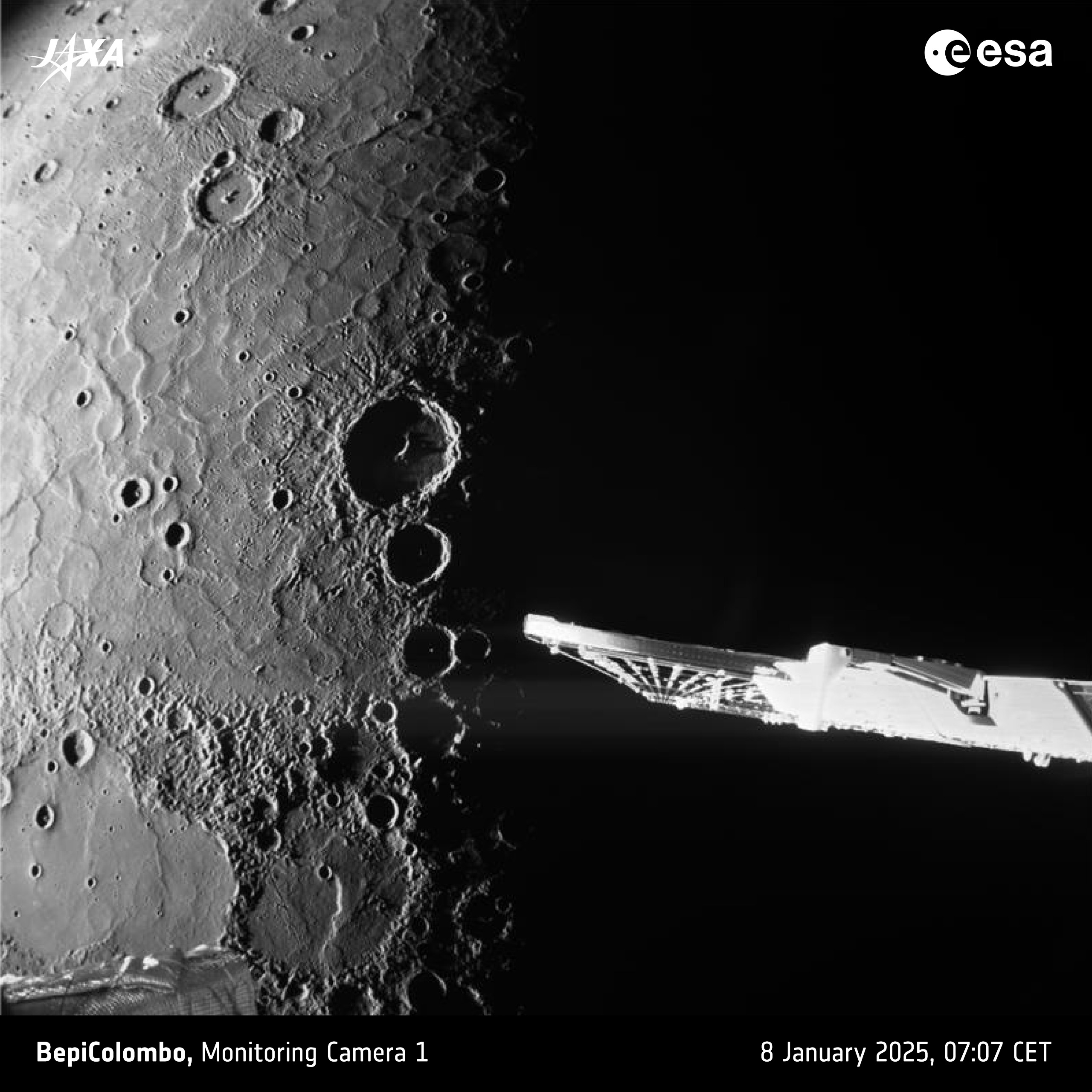
The pair of spacecraft launched together aboard an Ariane 5 rocket in October 2018. Since then, BepiColombo has traveled past Earth, the Moon and Venus, and has made six flybys of Mercury. During one of those encounters, in January 2025, the mission captured an exceptionally close view of Mercury’s north pole.
This complicated sequence of planetary flybys was necessary to prevent BepiColombo from gaining too much speed and overshooting Mercury’s orbit, according to ESA. Mercury lies about 36 million miles (58 million kilometers) from the sun, roughly one-third of the distance between Earth and the sun. Reaching the planet is difficult because the sun’s powerful gravity can pull a spacecraft off course.
Only one other spacecraft, NASA’s MESSENGER, has successfully entered orbit around Mercury. MESSENGER orbited the planet from 2011 to 2015 after a seven-year journey through space.
What BepiColombo will study
If ESA determines that BepiColombo can proceed as planned, the mission will spend the next several months placing both probes into their operational orbits and preparing to create the most detailed map of Mercury yet.
MPO and Mio are expected to separate in early December. Mio will enter a highly elliptical orbit around Mercury’s poles, while MPO will spend several more months adjusting its path before reaching a lower, circular polar orbit in March 2027, according to ESA. Scientific operations are scheduled to begin in April.
The two spacecraft will observe Mercury from different vantage points and orbit the planet several times a day. MPO is expected to complete one orbit about every two hours. Together, the probes will build the most comprehensive map of Mercury ever made.
The mission’s instruments will examine Mercury across the electromagnetic spectrum, including through X-ray, gamma-ray and ultraviolet observations. They will also make detailed measurements of the planet’s magnetic field.
These observations could help scientists address long-standing questions about the least-explored planet in the solar system. Researchers want to determine what Mercury’s interior is made of, understand the origin of its magnetic field, and learn more about how planets form and evolve. The mission may also reveal whether movements in Mercury’s crust are still active.
By precisely tracking the spacecraft’s orbit and position, radio experiments could provide new tests of Einstein’s theory of general relativity. Further updates from ESA are expected as BepiColombo begins the first mission to study Mercury from orbit in more than a decade.
Source: www.livescience.com