


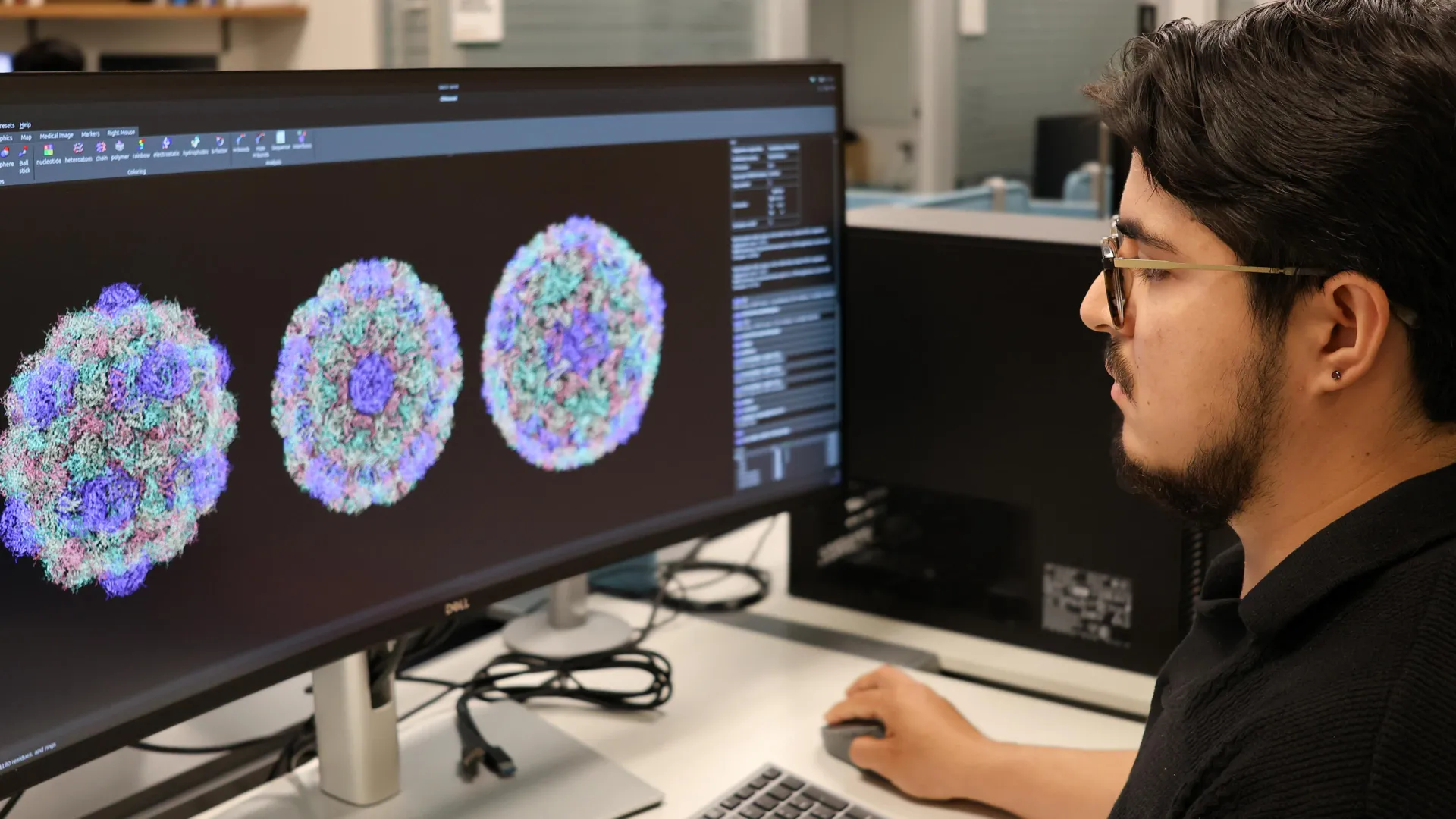
Researchers at the University of Miami have identified a previously unknown group of viruses that could help fill gaps in evolutionary history. The discovery reveals an unexpected relationship between viruses and small protein compartments called capsulins, offering new clues about how some of the earliest biological structures developed and suggesting that viruses may have functions scientists have largely overlooked.
A complex relationship between viruses and capsulins
The study, published in Nature Communications, challenges traditional explanations for the origin of capsulins. Scientists previously believed that these cellular compartments evolved from viruses. The new evidence instead points to a more complex relationship in which viruses and capsulins may have evolved repeatedly over millions of years.
The findings could have implications for biotechnology and for understanding the origin and early evolution of life. They also raise the possibility that viruses perform biological functions beyond those typically associated with infection.
A mysterious virus and the HK97 fold
At the center of the discovery is a protein that folds into a distinctive three-dimensional structure known as the HK97 fold. These proteins can assemble into protective shells and are found in both viruses and capsulins.
The newly identified virus has a smaller and simpler genome than other viruses that produce protein shells associated with the HK97 fold. It also has properties linked to both viruses and capsulins, and may represent an evolutionary intermediate between them. Studying these rare viruses could help researchers understand how increasingly complex biological systems first emerged.
“What’s so interesting about HK97-fold proteins is that they can form a shell that encases the biochemical reactions of cell lineages, archaea, and bacteria. But they also serve a genetic purpose in viruses, preserving and protecting the viral genome,” said the study’s first author, Abelardo Aguilar, a Ph.D. student in the Department of Biology, College of Arts and Sciences, University of Miami.
“These proteins build a compartment with two distinct roles. This has direct implications for the study of the origin of life and its early evolution, because if you think about it, the core of life is to confine reactions, but also to confine information that can be inherited so that those reactions can occur in the future.”
AI helps identify viruses hidden in billions of DNA sequences
To find the previously unknown viruses, Aguilar collaborated with the study’s lead author, Antoni Luque Santolaria, an associate professor in the Department of Biology. Luque also holds adjunct positions in the Department of Physics in the Faculty of Arts and Sciences and the Department of Chemistry, Environmental and Materials Engineering in the Faculty of Engineering. The project brought together collaborators from multiple institutions.
Instead of growing the virus in the laboratory, the researchers searched a large genetic database containing billions of DNA sequences. They combined bioinformatics, models of protein behavior, and artificial intelligence tools—including protein language models and AlphaFold—to investigate the structures encoded by those sequences.
The database included IMG/M, a resource associated with the U.S. Department of Energy’s Joint Genome Institute and the University of California, Berkeley. Its genetic information comes from environmental samples collected around the world, including soil, seawater, wastewater, human intestines, and many other locations.
This approach allows scientists to study viruses that have never been successfully grown in the laboratory, greatly expanding the number of organisms and evolutionary relationships that can be examined.
“The vast majority of viruses cannot be grown in the lab. But now, through sequencing, we have access to information about viruses that have unknown hosts and cannot be cultivated in the lab, but are ubiquitous,” Luque explained. “This means there are multiple questions about evolution and how viruses have adapted to the world that we can now explore bioinformatically.”
Viral protein shells may have unexpected roles
In addition to identifying a new virus, the researchers proposed a possible molecular explanation for how viruses and capsulins may have evolved from one another.
Their model focuses on the procapsid, an immature viral protein shell, or capsid, that may provide a pathway between the two types of structures. These shells could support genetic functions, such as containing viral DNA, as well as metabolic functions involving chemical reactions.
This possibility challenges the usual view of viral capsids as structures that primarily package and protect genetic material. Some forms may also create an environment in which biochemical reactions can occur.
“One implication of this study is that the viral capsid may also facilitate biochemical reactions, which could shed light on the potential role of the capsid in the environment as a whole,” Aguilar explained.
Further research is needed to establish these potential functions. However, the findings suggest that scientists may need to look beyond the infectious stage of viruses to understand their full role in nature.
“When we look at viruses, we tend to focus only on infectious particles. This study points out that we may need to start focusing more on non-infectious versions of viruses and other functions that virus-like particles may have that have been overlooked so far.”
AI tools expand the search for unknown viruses
The study also demonstrates how artificial intelligence and computational biology are changing virus research. By combining analytical tools with knowledge of protein structure and physical behavior, scientists can investigate evolutionary questions that were previously difficult to address.
Supported by the Gordon and Betty Moore Foundation and the National Science Foundation, the project provides a framework for studying other poorly understood viruses and their biological capabilities.
The researchers believe these techniques could also be useful beyond evolutionary biology, including efforts to understand newly emerging viruses and pathogens.
“If we have the right questions and can combine them with the right tools and physical insights, researchers have the opportunity to interrogate viruses in ways we haven’t had the opportunity to do before,” Luque said. “There are questions about evolution, but there are also questions about emerging pathogens and emerging viruses. The set of tools we use has the potential to advance in a variety of settings.”
Source: www.sciencedaily.com