


A new study suggests that whatever scientists eventually learn about the last common ancestor of humans and chimpanzees, one trait may be difficult to dispute: it was likely capable of climbing trees.
Between 6 and 7 million years ago, humans and chimpanzees evolved along separate paths after diverging from a shared last common ancestor (LCA). Reconstructing what this ancestor looked like and how it moved is essential to understanding human evolution, including the origins of bipedalism.
One important question is how the last common ancestor moved through forest habitats. Did it travel horizontally along high branches, climb tree trunks vertically from the ground, or use a combination of both strategies?
What feet can reveal about vertical tree climbing
Chimpanzees are highly skilled vertical climbers. Their ankles can flex much farther than human ankles, helping them climb tree trunks efficiently. Monkeys, on the other hand, have traditionally been viewed as relying primarily on their arms when moving through trees.
That distinction has influenced theories about whether the last common ancestor of humans and chimpanzees had feet resembling those of modern apes or monkeys. However, new video evidence from West Africa is challenging that assumption.
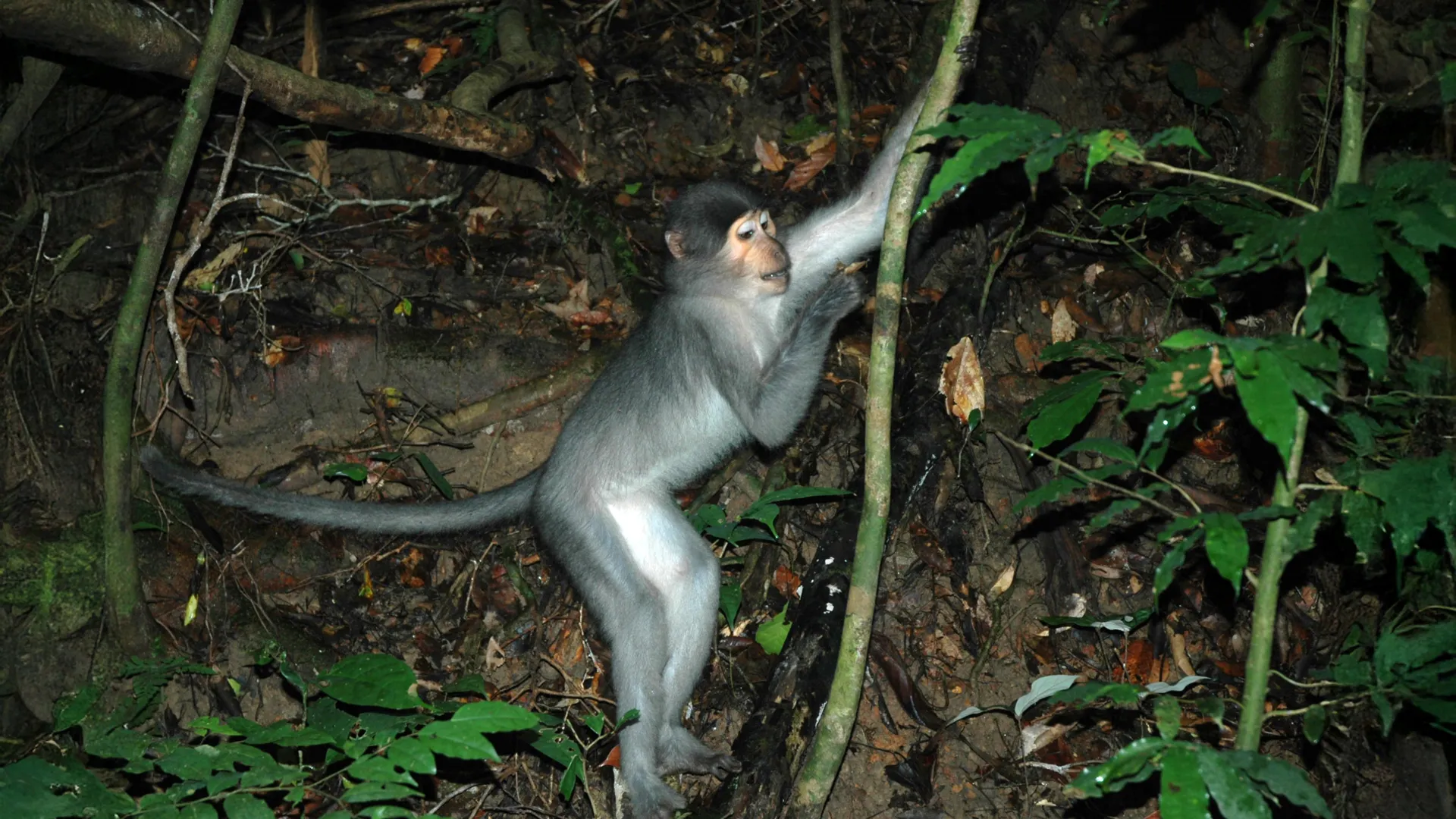
Researchers from Ohio State University studied wild sooty mangabeys whose feet lack the highly flexible ankles seen in chimpanzees. Detailed video observations and biomechanical measurements revealed that these monkeys can flex another part of the foot enough to climb narrow, vertical tree trunks while searching for food, avoiding danger, or finding a place to sleep.
“People are inferring behavior from fossils, but some say monkeys can’t climb vertically like great apes,” said study first author Luke Fannin, an assistant professor of anthropology at Ohio State University. “We’re talking about functional equivalence here; just because they don’t have chimpanzee-like legs doesn’t preclude vertical climbing.”
The findings were published this week in Proceedings of the National Academy of Sciences.
New clues about human evolution
Understanding how the last common ancestor of humans and chimpanzees looked and moved could help scientists trace the evolutionary changes that eventually led to habitual bipedal locomotion—the form of movement regularly used only by humans today.
Humans are apes, but this discovery suggests that an ancestor with ape-like feet may have been able to climb vertically in a manner comparable to modern apes, even if its anatomy was not identical to a chimpanzee’s.
“Part of paleoanthropology is understanding how our evolution happened, and that’s often understood through the characteristics of the way we move, because modern humans move very differently than our cousins, chimpanzees, who are our closest living primate relatives,” Fannin said. “And we’re trying to understand why.”
Fannin collected high-resolution videos of wild mangabeys at the Taï Monkey Project field station in Côte d’Ivoire. The project is co-directed by W. Scott McGraw, a professor of anthropology at The Ohio State University and the study’s lead author.
“The great thing about having video is that we can capture exactly what the monkeys are doing in high resolution, so we can see what loads are actually being put on the joints. We used to have intuition, but this method is much more accurate,” McGraw said.
Monkeys use unexpected flexibility to climb trees
When a chimpanzee climbs a tree, its ankle can flex upward by approximately 45 degrees. Most human ankles, by comparison, flex by about 20 degrees.
Sooty mangabeys achieved a similar degree of movement through a different part of the foot. Fannin measured approximately 46 degrees of midfoot flexion as the monkeys climbed vertically.
The finding complicates competing theories about how the last common ancestor moved through forest environments. Some theories propose that effective vertical climbing required advanced, ape-like feet, while others suggest that the ancestor may have possessed more monkey-like foot anatomy.
“What’s great about this paper is that it adds clarity, but it also makes the picture more vague,” McGraw said. “The idea that vertical climbing requires advanced ape-like legs and is an especially difficult behavior is not necessarily true. Monkeys living in West African forests can perform biomechanically demanding movements with remarkable skill.”
“The videos that Luke made in the Taï Forest are particularly important because they provide some of the first kinematic recordings of locomotor behavior in monkeys, which has been largely unrecognized or underappreciated.”
Why humans still have a connection to trees
Vertical climbing is not limited to nonhuman primates. Some modern hunter-gatherer and foraging communities include highly skilled climbers. In humans, however, climbing ability is thought to depend more on flexible ligaments, tendons, and muscles than on the underlying bone structure of the foot.
Fannin and McGraw also note that although bipedalism is a defining feature of modern humans, climbing remains part of human behavior. Our tendency to stand, reach, and move toward higher ground may reflect a deep ancestral connection with trees that extends beyond skeletal anatomy.
“Arborealism is fundamental to understanding primates, including ourselves, because it has shaped large parts of our bodies, including our hands and feet, wrists and ankles, and claws,” McGraw said.
Fannin added: “Regardless of where you start, we don’t know it yet, but vertical climbing may be universal, and anatomy will find a way to perform that behavior. I think we need more fossils to resolve whether the last common ancestor was more ape-like or monkey-like.”
This research was supported by Dartmouth College, the Explorers Club, the National Science Foundation, the Emory National Primate Research Center, the British Primate Society, and a Schmidt Science Postdoctoral Fellowship.
Carmen Pape, formerly of Ohio State University, also contributed as a co-author.
Source: www.sciencedaily.com