


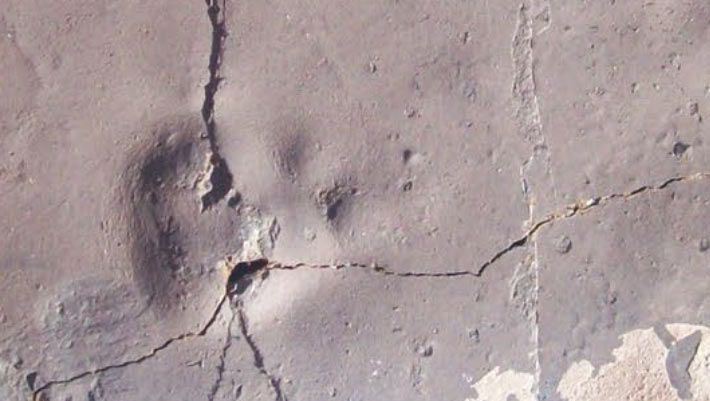
A 55-million-year-old fossil footprint discovered on a remote Antarctic island is the first known footprint of a mammal from Antarctica and the oldest direct evidence of a carnivorous mammal on the continent.
Slab T-373, which supported railroad tracks on King George Island, Antarctica. Scraper – 10 mm. Image credit: Mancilla-Vera et al., doi: 10.1007/s00300-026-03539-1.
The specimen, designated T-373, preserves partial hand and foot prints dating to the Eocene epoch, approximately 55 million years ago. It was collected from the Fossil Hill Formation on the Fildes Peninsula of King George Island.
The region contains an exceptionally rich record of fossilized plants, feathers, and animal traces. Because of its scientific importance, the site is protected as an Antarctic Specially Protected Area.
“The earliest known mammalian or mammal-like footprints date to the Late Triassic,” said Dr. Héctor Mancilla-Vera of the Chilean Antarctic Research Institute and the National Museum of Antarctica, together with colleagues from Chile, Patagonia, and Argentina. “However, the diversity and abundance of mammal fossils increased substantially toward the end of the Mesozoic, when teeth and skeletal remains became more common.”
“Following the Cretaceous-Paleogene mass extinction, the global fossil record of terrestrial mammals—including bones, teeth, and footprints—became considerably richer.”
The South American mammal fossil record is closely linked to that of Antarctica, although Antarctic discoveries remain comparatively rare. Terrestrial mammal fossils from Antarctica consist mainly of isolated teeth and, less frequently, skeletal remains.
Most of these fossils come from Eocene and Oligocene rocks on Seymour, or Marambio, Island in West Antarctica. This geographic concentration highlights how incomplete the Antarctic Paleogene mammal record remains, particularly on a continent that no longer supports native terrestrial mammals.
The T-373 footprint is small—approximately the size of a large coin—but its anatomy provides important clues about the animal that made it.
The print features three rounded toe pads arranged in an arc, a rounded triangular heel pad, and no visible claw marks. These characteristics are consistent with a small, cat-sized mammal that walked on its toes, or in a digitigrade posture.
Using a formula that estimates body mass from footprint area, the researchers calculated that the animal weighed approximately 1.3 kilograms.
The size and shape of the trace closely resemble footprints made by sparassodonts—an extinct group of South American predatory mammals related to modern opossums. Sparassodonts, which included weasel-like and saber-toothed forms, were widespread in Patagonia during the Eocene.
“T-373 represents a naturally preserved, partially complete manus and pes trace,” the paleontologists said. “It is characterized by a rounded triangular metatarsal pad, at least three circular digits arranged in an anterior arc, and a digitigrade posture.”
The estimated body mass of the trackmaker also falls within the size range of small sparassodonts, strengthening the interpretation that the footprint was made by one of these extinct South American predators.
No fossilized sparassodont bones or teeth have yet been discovered in Antarctica. Nevertheless, the footprint provides the strongest evidence so far that these mammals reached the continent.
The researchers suggest that sparassodonts may have crossed the land bridge that once connected Antarctica and South America, before the continents separated and Antarctica’s climate became increasingly cold.
Until now, scientists thought that the main terrestrial predators in Antarctica’s Eocene forests were small early birds and flightless “terror birds.” The new footprint indicates that mammals also occupied a predatory role in the ecosystem, adding a previously unknown component to the ancient Antarctic food web.
“T-373 constitutes the first direct fossil evidence of a terrestrial mammal in an Eocene Antarctic ecosystem,” the scientists concluded. “This discovery supports the hypothesis that endemic South American predators had reached high southern latitudes by the early Paleogene.”
The study also provides new insight into the structure of West Antarctica’s ancient coastal ecosystems. These environments supported herbivores, small mammals, birds, and now a predatory mammal, revealing a more complex food web than previously recognized.
The findings are reported in the following study: “The first mammal footprints from the Eocene in Antarctica”, published in Polar Biology.
_____
H. Mancilla-Vera et al. 2026. The first mammal footprints from the Eocene in Antarctica. Polar Biology 49, 101; doi: 10.1007/s00300-026-03539-1
Source: www.sci.news