


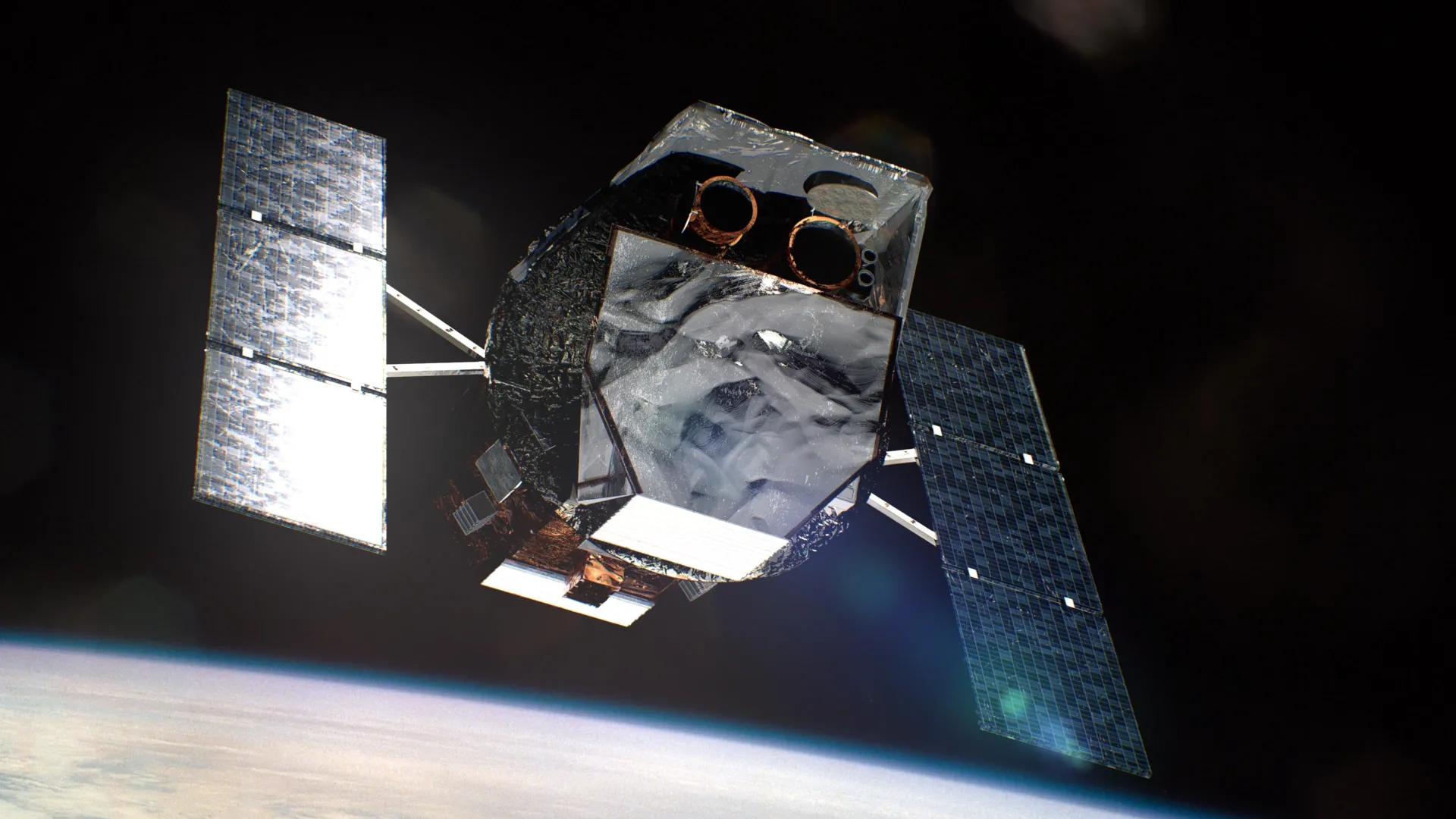
NASA’s Neil Gehrels Swift Observatory has resumed space observations with two of its three scientific instruments after plans to boost the telescope into a higher orbit were abandoned.
NASA switched Swift’s ultraviolet/optical and X-ray telescopes back on Wednesday, August 26. Both instruments had been shut down in February as engineers worked to reduce atmospheric drag and extend the observatory’s time in low Earth orbit while preparing for a possible orbital boost.
Swift’s third instrument, the Burst Alert Telescope, has not yet returned to scientific operations. NASA paused the instrument in April to reduce the spacecraft’s power consumption, allowing engineers to position its solar panels in a configuration that creates less atmospheric drag. The team expects to restore the telescope to data-collection operations within a few weeks.
NASA’s Swift Observatory resumes cosmic observations
For 21 years, NASA’s Neil Gehrels Swift Observatory has been one of the agency’s most versatile space telescopes. Swift is especially important for observing the universe across multiple wavelengths and detecting sudden, short-lived cosmic events.
When Swift detects a burst, it can quickly turn toward the source and notify observatories on Earth and in space. This rapid response gives astronomers an opportunity to study fleeting cosmic events before they disappear.
One of Swift’s biggest challenges is its position in low Earth orbit. Although the spacecraft travels hundreds of miles above Earth, the upper atmosphere still contains enough particles to create drag. That drag gradually slows Swift and causes its orbit to decay.
Swift does not have an onboard propulsion system capable of raising its orbit, so the observatory cannot directly counteract the effects of atmospheric drag.
Solar activity is increasing atmospheric drag
The situation has become more urgent because recent solar activity has expanded Earth’s upper atmosphere. When the Sun becomes more active, increased solar energy heats the atmosphere and pushes its outer layers farther into space.
This expansion increases atmospheric drag on satellites operating in low Earth orbit. For Swift, it has resulted in a faster-than-expected loss of altitude.
In September 2025, NASA contracted Katalyst Space to launch a spacecraft capable of approaching Swift, capturing the observatory and lifting it into a higher orbit.
Katalyst spent a year designing, building, testing and launching the spacecraft, named LINK, before guiding it toward Swift for the planned orbital boost.
Planned Swift orbital boost canceled
LINK launched in July aboard a Northrop Grumman Pegasus rocket. Later that month, however, the spacecraft experienced problems controlling its orientation.
On August 19, NASA and Katalyst announced that LINK would no longer attempt to capture and raise Swift’s orbit.
The mission is not completely over. Katalyst will continue guiding LINK close to Swift to conduct rendezvous and proximity operations. These maneuvers will test technology that could support future satellite-servicing missions, including operations that require one spacecraft to work closely with another.
Swift’s time at higher altitude is running out
NASA previously estimated that Swift’s low-drag operating mode could keep the observatory above 185 miles (300 kilometers) until October.
That altitude represents an important threshold. Once Swift drops below 185 miles (300 kilometers), maneuvering the observatory will become more difficult, and its descent is expected to accelerate as atmospheric drag increases.
With scientific observations now underway again, the Swift team expects the observatory to reach that altitude within the next month or two.
Until then, NASA’s Swift Observatory will continue studying the universe and collecting valuable data while its orbit gradually declines.
Source: www.sciencedaily.com