


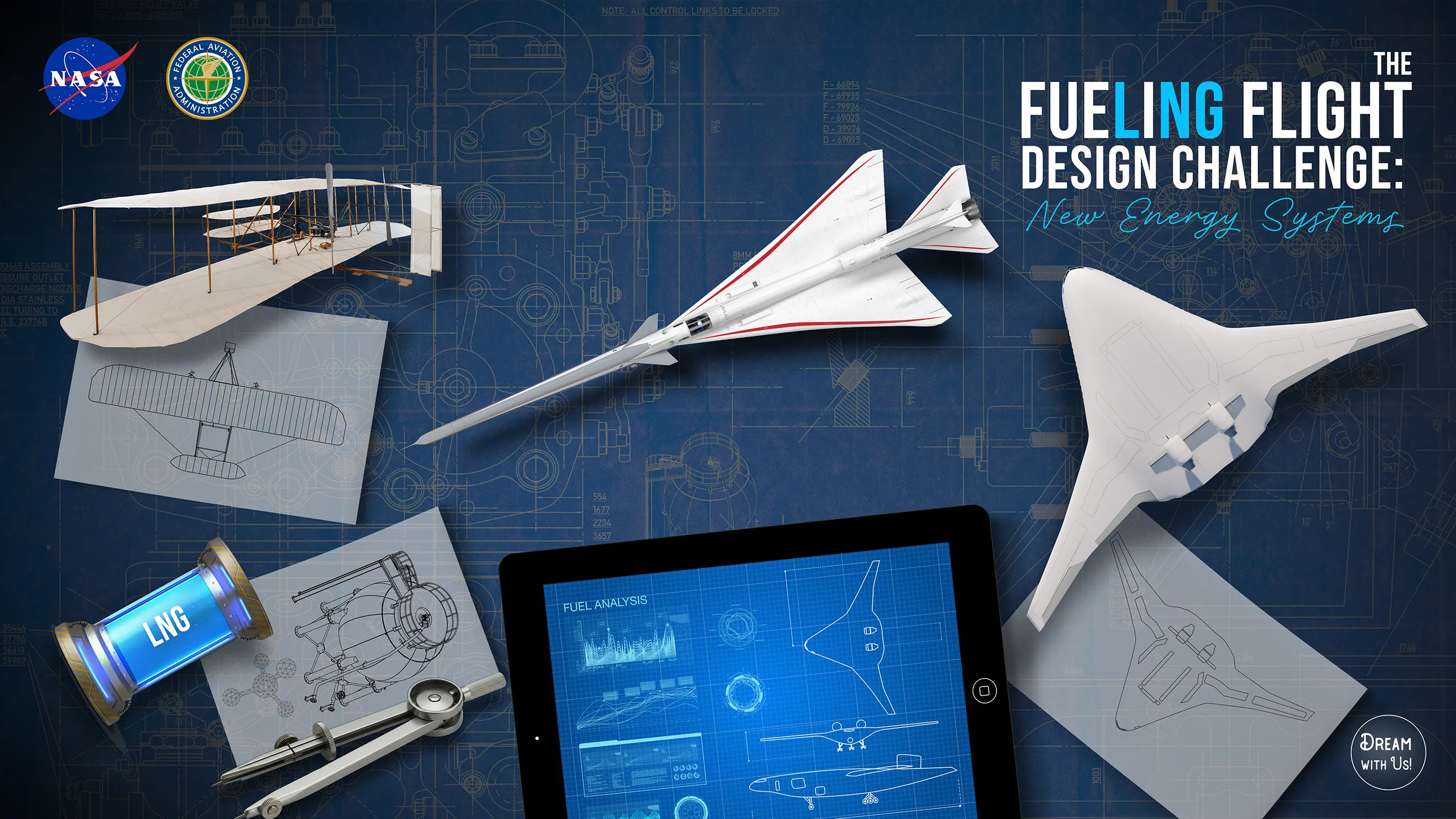
2026–2027 NASA Dream with Us Design Challenge: LNG Cargo Aircraft Engineering Competition
Design a more efficient cargo aircraft powered by liquefied natural gas (LNG) in the Refueling Flight Design Challenge: New Energy Systems.
About the 2026–2027 Refueling Flight Design Challenge
The theme of the 2026–2027 challenge is “Refueling Flight Design Challenge: New Energy Systems.” The NASA Dream with Us Design Challenge asks middle school and high school students to explore how new aviation fuels can change aircraft design, airport infrastructure, and the future of air transportation.
As more aircraft join the U.S. National Airspace System (NAS), NASA, the FAA, universities, and aviation industry partners are investigating ways to improve safety, reduce the cost of flight, develop new aircraft fuels, and reduce the time passengers and cargo spend in the air.
This year’s challenge focuses on adding liquefied natural gas (LNG) to the aviation environment. Teams will research LNG, its potential use in aviation, the benefits of adding new fuel sources, and the changes aircraft and airports would need to make to support those fuels.
The challenge includes separate modules for middle school and high school teams. The high school module is designed for students in grades 9–12, while students in grades 6–8 use the middle school module. Teams that include both middle school and high school students will compete in the High School Challenge.
Traditional commercial aircraft have commonly used a “tube and wing” configuration. New technologies, materials, manufacturing methods, and fuel systems may allow designers to develop different aircraft configurations. Airports may also need new infrastructure to handle multiple fuel types, different aircraft designs, gateway configurations, and designated areas for different aircraft.
The future of aviation fuel and aircraft design will depend in part on the researchers and engineers who address these challenges today.
High school cargo aircraft design project
More than 62 million tonnes of air cargo are transported around the world each year, representing more than 33% of global trade by value and approximately $8.3 trillion annually. Even a small improvement in air-cargo efficiency could have a significant economic impact.
A major air cargo company is considering replacing part of its fleet with new aircraft and is interested in efficient designs that use different fuel types. Your team will develop a conceptual cargo aircraft for presentation to an air cargo company.
The aircraft must use liquefied natural gas (LNG). Because LNG must be stored differently from traditional jet fuel, the aircraft design will need to adapt. These storage requirements may also create opportunities for innovative and aerodynamically efficient aircraft designs.
Aircraft design requirements
Air carriers have provided the following requirements for the conceptual LNG-powered cargo aircraft:
- Crew: Two pilots. Each pilot weighs 190 pounds and carries 30 pounds of luggage.
- Takeoff field length: No more than 12,000 feet at maximum takeoff weight, sea level, ISA+15°C, with a balanced field over 35-foot obstacles on a dry-pavement runway.
- Landing field length: No more than 12,000 feet at maximum landing weight, sea level, ISA+15°C, on dry pavement.
- Approach speed: No more than 150 knots at maximum landing weight, sea level, and ISA.
- Range: 3,000 nautical miles at maximum payload weight.
- Cruising altitude: 35,000 to 40,000 feet.
- Cruising speed: Mach 0.8.
- Preliminary mission: 30 minutes of loitering at 13,000 feet and Mach 0.8.
- FAA Aircraft Design Group: ADG IV.
-
Cargo:
- Gross cargo weight: 125,000 pounds.
- Cargo volume: At least 15,000 cubic feet.
- Unit load devices: Freight must be transported using standard ULDs. Teams may choose the specific ULD type. The ULD weight is included in the total shipment weight.
Teams will be provided with jet engine performance information.
Who can participate?
The High School Challenge is open to students in grades 9–12 attending public, private, parochial, or homeschool programs in the United States. Children of U.S. military personnel stationed overseas may also participate.
The 2026–2027 Dream with Us Design Challenge begins on September 25, 2026. The middle school application period begins September 25, 2026, and ends January 22, 2027, at 11:59 p.m. ET.
Schools, organizations, and community groups should inform parents and guardians that each team is limited to one entry. Team registration requires someone who is at least 13 years old to create an account. Adult team sponsors may create registrations on behalf of their teams.
Entries must be submitted through the submission link on the Dream with Us Design Challenge webpage. Every participant must provide a signed permission form from a parent or legal guardian agreeing to the applicable terms, requirements, and submission forms.
Important: Teams may not use artificial intelligence tools for challenge-related work. This includes publicly available browser-based generative AI services, AI-assisted code generators, and AI-generated images. All submissions must be created solely by team members without assistance from AI systems.
Engineering design notebook requirements
The final product is an engineering design notebook. Judges will evaluate the work based on the material submitted in the notebook.
Teams should review the scoring rubric before beginning research and design work. Use the scoring rubric headings as the headings in the engineering design notebook, and complete each section as the project progresses.
Engineering design template: Insert template here.
Scoring rubric: Insert rubric here.
Projects will be evaluated by industry experts based on:
- Impact
- Practicality
- Originality
- Ease of communicating the idea
Projects will go through several levels of review. Top teams will be invited to participate in the Finalist Stage and present their projects virtually to industry judges. A panel of Blue Ribbon judges will select award recipients and determine which projects receive recognition.
Submission requirements
High school student entries will be submitted through NASA Gateway and the Dream with Us Design Challenge webpage. Each entry must include:
- A signed permission form completed by each participant’s parent or legal guardian.
- A presentation submitted in PDF format. PDFs may not exceed 10 MB. Each participant must register for the challenge through NASA Gateway, but only one student may submit a team project on behalf of the team.
- Artwork submitted as a high-resolution .jpg or .png image of the original artwork. The longest side must be at least 2,400 pixels. Artwork created using AI will not be accepted.
-
An engineering notebook that meets accessibility standards.
- Include descriptive alt text for all images, diagrams, and graphics. Alt text should clearly and concisely describe the purpose and content of each visual for users of screen readers.
- Microsoft Word: Right-click an image, select Edit Alt Text, and enter a description.
- Sample alternative text on PC: Right-click the image, select Inspect Accessibility Properties, and use the Web Inspector to locate the alt-text option and enter a description.
- Sample alternative text on Mac: Right-click the image and select Inspect Accessibility Properties to open the Web Inspector. The highlighted gray area shows the image’s alt text in the code. Select the gray arrow next to “Image” if necessary to view the complete alt text.
Research resources for LNG aircraft design
The following resources can help teams begin their research. This list is not exhaustive, but it provides a strong starting point.
AACES 2050
Basic experimental testing and modeling of LOX/CH4 engines at high pressures
“With jet fuel supplies tight, can other fuels meet demand?”
2026–2027 challenge timeline
- September 25, 2026: Challenge published.
- To be decided: Information session. Check back for updates.
- December 8, 2026: Registration deadline.
- January 25, 2027: Submission deadline.
- March 19, 2027: Selection and announcement of finalists.
- April 2, 2027: Finalist presentation held virtually.
- April 9, 2027: Winner announcement.
Support for educators and students
Educators who want to support one or more teams and students who want to get involved can look for updates on the Dream with Us Design Challenge webpage. A mid-term check-in is planned for October, with dates to be published later.
Questions?
For additional information, contact the NASA Aeronautical STEM team at [email protected].
Source: www.nasa.gov