


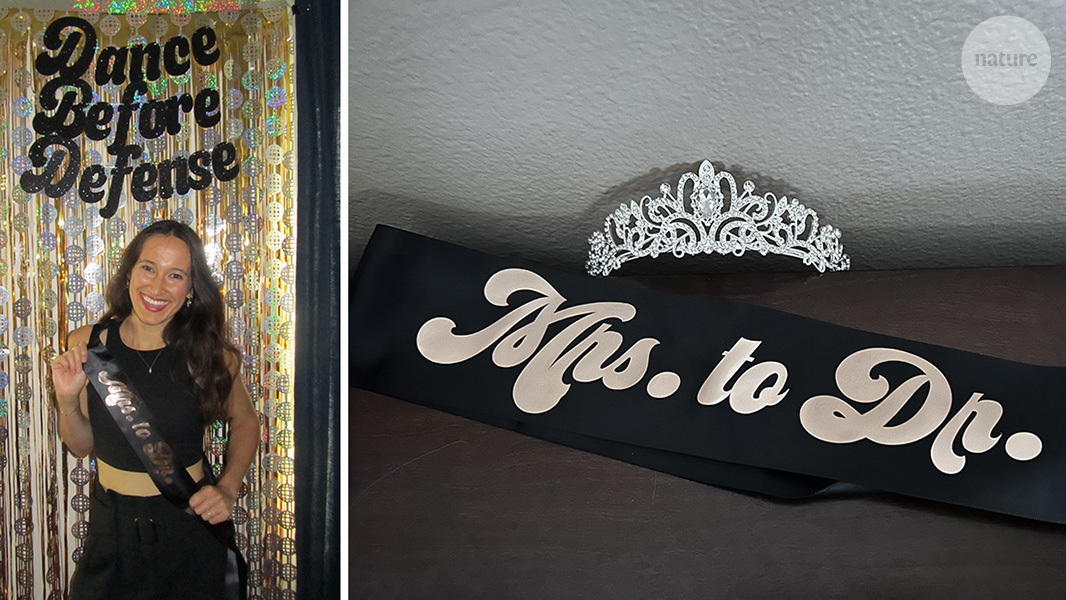
Anu Lee’s doctoral party featured elements often associated with bachelorette celebrations, including a sash, tiara and themed photo booth.
In June, Anu Lee invited close friends and family to her home in St. Paul, Minnesota, to celebrate an important academic milestone. The gathering had a theme, Lee wore a tiara and guests marked her transition from graduate student to doctor.
It was not a bachelorette party or baby shower. Instead, the celebration was a “doctoral party” held to honor Lee’s upcoming PhD thesis defense. The University of Minnesota hydrologist wore a “Mrs. to Doctor” sash and incorporated her research into the festivities. Guests posed in a photo booth with signs reading “Funds please” and completed a mock exam featuring trivia about Mr. Lee.
Lee believes academic milestones deserve the same recognition as more traditional life events. “While we only recognize traditional milestones like getting married and starting a family, there are many other things worth celebrating,” she says. Earning her PhD was the result of years of effort and support from others, but it was also something she had built herself. “It was a team effort, but it was also something that I really built on my own and I wanted to honor that.”

7 tips for a smooth lab exit
Research careers can be demanding, and major academic achievements can happen at any point in the year. Deciding when and how to celebrate a thesis defense, tenure appointment or other career milestone is usually a personal choice. Nature’s Careers team asked researchers how they mark these turning points. Their celebrations ranged from deeply personal and extravagant to as simple as sharing cake with a colleague. Everyone agreed that researchers should make time to recognize their achievements.
Keep academic celebrations low-key
Some researchers enjoy being the center of attention, while others feel uncomfortable celebrating themselves. Academic leaders say that creating a supportive lab culture through humor and shared celebrations can strengthen professional relationships, recognize hard work and encourage a healthier work-life balance. Strong connections among colleagues can also improve laboratory cohesion and support innovation.1.
Celebrations can be spontaneous or carefully planned, and asking colleagues to help organize them is perfectly reasonable.
How principal investigators share wisdom through humor
When Rachel Martin, a biophysical chemist at the University of California, Irvine, learned that she had received tenure in 2011, the campus was quiet because it was summer vacation. Martin read the approval email at about 10 a.m. on a Tuesday while sitting in her faculty office. “I went outside to see who was around, but no one was there except for one of my friends,” she recalls.
After Martin shared the news, her friend immediately called a bar where members of the department often met for drinks after work. Although the bar was closed, she used her “professorial voice” to persuade the bartender to let them in for a celebratory beer. “It was just the two of us sitting there in the dark, but it was amazing. I still remember it all these years later,” Martin says.
Other researchers celebrate by taking part in rituals passed down through generations of students. In June, Robert Maples completed his PhD in immunology at the University of Texas Southwestern Medical Center in Dallas. Over the years, he had watched at least four students wear hot-pink feather boas and cowboy hats after successful thesis defenses. The tradition began at an earlier party and was later adopted by his adviser, Julie Pfeiffer. After defending his own thesis, Maples could finally join the group.

Robert Maples marked his successful thesis defense with poop emoji cakes inspired by his research on gastrointestinal viruses, along with the pink hat and feather boa worn at earlier lab celebrations.Credit: (L) Robert Maples. (R) Philip Maples
“After the defense, we had a little party and I wore that hat with pride the entire time,” he says. Maples also defended his thesis in a Hawaiian shirt. “It took me longer than other students to complete my degree, but I was really happy to finally be part of that lineage.”
Go all out for student milestones
Researchers may prefer to celebrate their own achievements quietly. But several scientists told Nature that they are more willing to organize elaborate celebrations when their students reach major academic milestones. It may be easier to recognize the effort made by someone else, Martin says. A successful PhD defense can also represent a larger life transition than earning tenure, and family members may not always understand the years of work required to complete a doctorate.
“That’s why I make sure everyone does a great job of defending their thesis,” Martin says.
Maria Ávila-Arcos, a paleogenomics researcher at the National Autonomous University of Mexico in Mexico City, takes a personalized approach to celebrating her students. When one student who loved the Star Wars films completed a major milestone, Ávila-Arcos took them to a themed restaurant. Half of the venue resembled a tavern on the planet Tatooine, while the other half was designed like the interior of an Imperial starship. The group ordered pizzas shaped like Millennium Falcons and drank from lightsaber cups served by Stormtroopers.
How to show appreciation for your lab mates: 8 ways to express gratitude at the end of the year
Ávila-Arcos’s own promotion to tenure was celebrated with similar enthusiasm, reflecting the difficulty of her career path. As part of the tenure process, many Mexican universities create permanent positions tailored to an applicant’s research and then advertise them publicly. In Ávila-Arcos’s case, the position focused on paleogenomics and pre-Hispanic populations.
Source: www.nature.com