


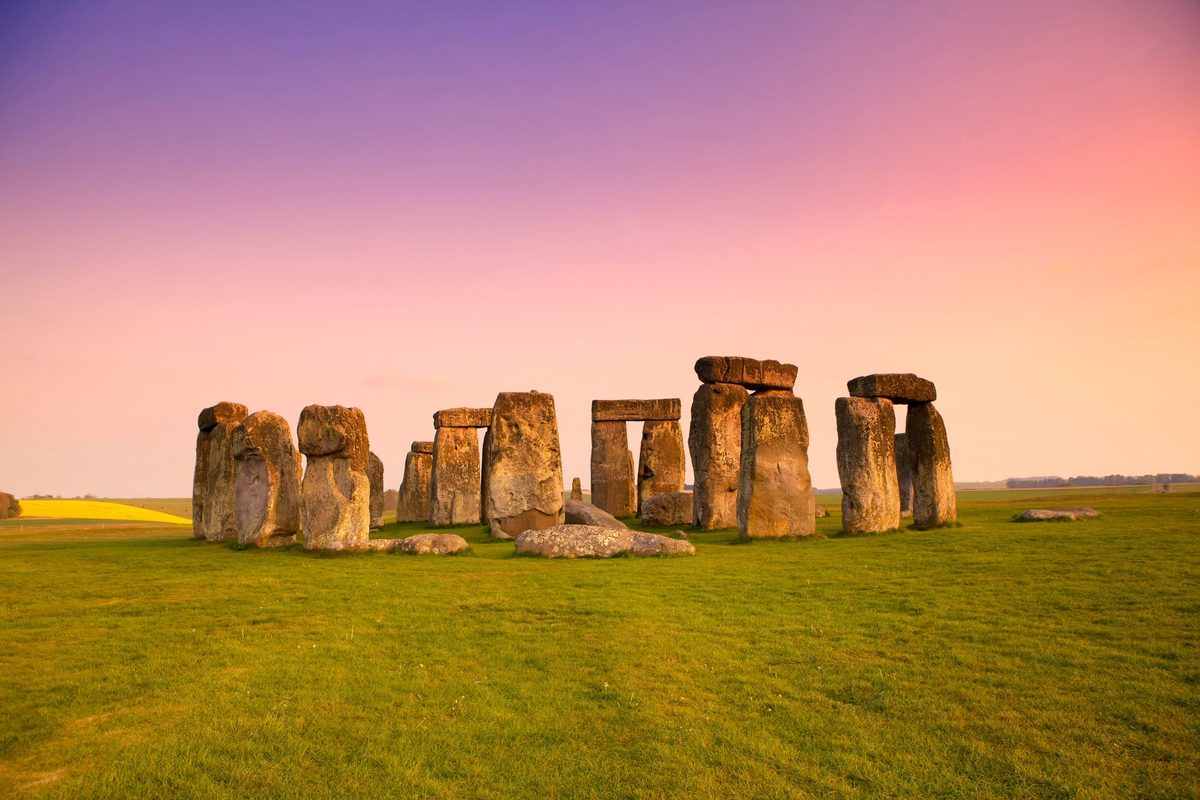
One of the most fascinating Stonehenge mysteries is the journey of its altar stone, which traveled 700 km (435 miles) from Scotland to southern England. Recent research indicates that glaciers played a crucial role in its transportation.
The monument’s centerpiece is a massive sandstone slab weighing 6 tonnes, believed to have reached Salisbury Plain around 5,000 years ago. While previous studies identified its origins in northeast Scotland, the question of how it traversed such a great distance remained unanswered.
Researchers from Sheffield Hallam University and Curtin University studied ancient ice flows and hypothesized that glaciers transported the altar stone from the Orcadian Basin in northeast Scotland to Dogger Bank during the last Ice Age, approximately 33,000 to 11,700 years ago.
Today, Dogger Bank is submerged under the North Sea but was once part of Doggerland, a prehistoric landmass connecting Britain to mainland Europe. As there are no natural sources of large stones in this area, any rocks found there are likely glacial transport remnants.
According to Dr. Remy Veness, co-lead author of the study published in the Quaternary Science Journal, “Our recent discoveries reveal that the altar stone originated in northeast Scotland, prompting a debate on how it traveled 700 kilometers to Salisbury Plain.”
Dr. Veness also noted, “This suggests that the people of Doggerland may have attached significant cultural value to the altar stone long before its incorporation into Stonehenge.
“The altar stone must have held enough significance for people to move it at least twice: first, to prevent it from being submerged by rising sea levels at the end of the last Ice Age, and then to return it to its final resting place on Salisbury Plain.”
Co-lead author Dr. Anthony Clark, a professor at Curtin School of Earth and Planetary Sciences, emphasized that the discovery indicates glaciers carried the altar stone toward Doggerland, with Neolithic communities handling the rest of the transport to Stonehenge.
“Our modeling suggests that glaciers may have moved the stones partway during the last Ice Age, possibly to Dogger Bank, but they still had to be transported hundreds of kilometers by humans,” Dr. Clark explained.
The study posits that while glaciers facilitated the stone’s southward journey, no direct glacial route connects its Scottish source to Stonehenge. Instead, the Neolithic people likely transported the stones gradually overland, via coastal pathways, and along rivers.
This monumental task of moving such large objects over great distances highlights a previously unappreciated level of planning, cooperation, and understanding of the landscape among Neolithic communities.
“Transporting stones of this magnitude over long distances would have necessitated careful organization, coordination, and tremendous determination,” Dr. Clark stated.
Read more:
Source: www.sciencefocus.com