


NASA’s Curiosity Rover Reaches 5,000 Sols and Climbs More Than 1 Kilometer on Mars
Written by William Farrand, Senior Researcher, Institute of Space and Astronautical Science
Earth Plan Date: Friday, August 28, 2026
NASA’s Curiosity rover has reached two remarkable milestones on Mars. The rover has climbed more than 1 kilometer (0.62 miles) above its landing site at the bottom of Gale Crater and is marking 5,000 Martian days, or sols, on the Red Planet.
Curiosity Climbs More Than 1 Kilometer on Mars
Curiosity has become a world-class mountaineer—at least by Martian standards. The rover recently passed the 1,000-meter elevation mark while ascending the slopes of Mount Sharp in Gale Crater.
As a member of the Mars rover science team, I was thrilled when NASA’s Spirit rover reached the summit of Husband Hill in Gusev Crater in August 2005. However, Spirit climbed approximately 106 meters (348 feet) from its landing site. Curiosity has now traveled more than 1,000 meters above its original elevation, making this a particularly impressive achievement in Mars exploration.
Curiosity Marks 5,000 Martian Days
Saturday, August 29, marks 5,000 Martian days since Curiosity landed on Mars. A Martian day, known as a sol, lasts approximately 24.6 hours—slightly longer than an Earth day.
This milestone is a testament to the engineers, scientists, and mission teams who have kept Curiosity operating and conducting science on Mars for more than a decade.
Investigating the Martian Sand Ridge “Chocolatal”
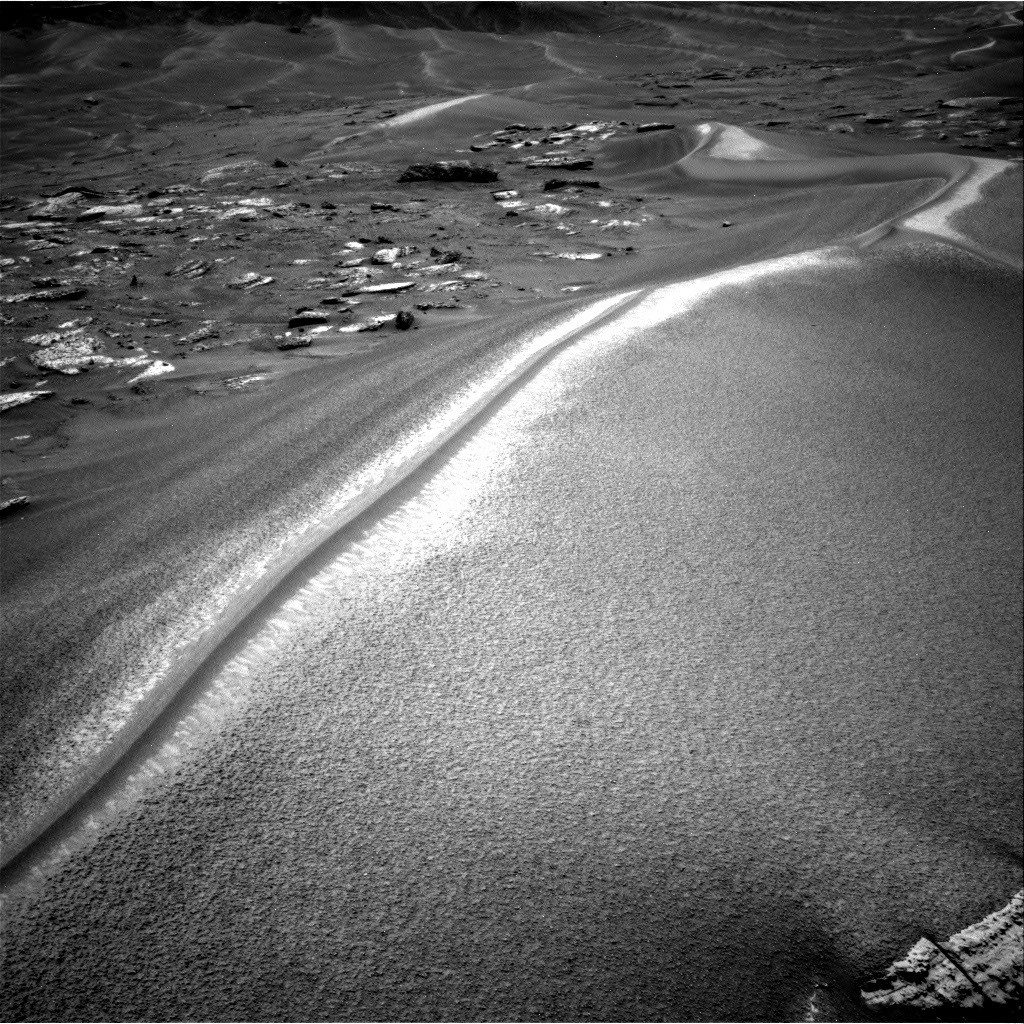
Curiosity is also studying large, elongated wind-formed ripples that the team has named Chocolatal. Scientists are investigating whether this landform can be classified as an eolian transverse ridge, or TAR.
TARs have been identified across Mars using images from orbit. Their long axes are generally oriented perpendicular to the dominant local wind direction. Although this is not the first potential TAR examined by Curiosity, Chocolatal’s higher position on Mount Sharp could provide new insights into how these features form and evolve.
Researchers want to determine whether Chocolatal is made of the same granular material found in lower-elevation TARs or whether it contains different grain sizes and internal layers. Additional questions include how the ridge formed, whether it is still active, how it moves, and what processes may have caused it to become stable.
Curiosity Examines Rocks and Sand Ripples
Earlier in the planning week, Curiosity was traveling toward Sand Ripple when it encountered several interesting geological targets. Monday’s mission included an on-site survey of light-colored rock formations along the rover’s route.
Some nearby rocks displayed thick, dark coatings or residual layers. These features were analyzed using the rover’s ChemCam laser-induced breakdown spectroscopy, or LIBS, instrument. Mastcam and ChemCam Remote Micro-Imager mosaics were also planned for nearby buttes and more distant sand ripples.
Detailed Analysis of Chocolatal
During the mid-week planning session, Curiosity moved to within a few meters of Chocolatal. ChemCam targeted sand at the base of the ridge as well as nearby bedrock. The rover also captured a high-resolution Mastcam mosaic of the ripples from a distance.
The planned drive carried one of Curiosity’s wheels into the sandy ridge before the rover reversed slightly. This maneuver positioned the rover for contact science within the newly created wheel scuff and groove during the weekend plan.
The final planning session included activities for landmark Sol 5000. The rover’s MAHLI instrument was scheduled to capture a mosaic of the trench’s right wall. These images will help scientists examine layering and identify changes in grain size.
The MAHLI mosaics are named in honor of the late Paul Geisler, a leading researcher in Martian TAR studies who worked with the MAHLI team until his untimely passing earlier this year.
The science plan also included in situ APXS measurements of the rippled surface and ChemCam LIBS observations of the top of Chocolatal. The feature resembles a serpentine “mohawk” formation. LIBS measurements were also planned for a dark band along its sides and behind the rover’s wheel scuff.
Additional activities in the three-sol plan included a Mastcam mosaic, an atmospheric dust-devil survey with Navcam, a Navcam over-the-horizon survey, and APXS atmospheric measurements.
Looking Ahead to the Next 5,000 Sols
After 5,000 sols of exploration, Curiosity continues to deliver important scientific discoveries about Mars, Mount Sharp, and the planet’s geological history. The rover’s science and engineering teams are already looking forward to the next 5,000 Martian days.
Source: science.nasa.gov