


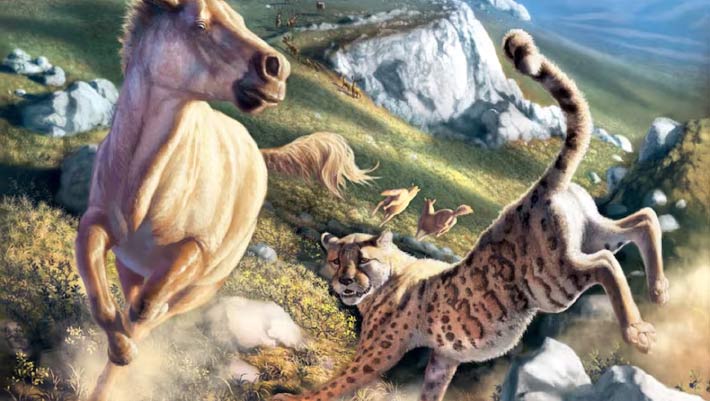
For decades, scientists have described Miracinonyx trumani as North America’s prehistoric answer to the African cheetah (Acinonyx jubatus). However, a new study led by researchers at the University of California, Santa Cruz, suggests that the extinct “American cheetah” was far more adaptable than its nickname implies.
Miracinonyx trumani lived across North America during the Pleistocene Epoch, which lasted from approximately 2.5 million to 13,000 years ago. Fossil evidence indicates that the extinct cat stood about 90 centimeters tall, measured roughly 2.5 meters from its head to the tip of its tail, and weighed approximately 70 kilograms.
With its slender body, elongated forelimbs, and broad snout, Miracinonyx trumani shared several physical traits with modern fast-running animals, including cheetahs and horses. Fossils found alongside those of pronghorns—often called the “American antelope”—previously led researchers to believe that this extinct feline pursued similarly swift prey across open grasslands.
New genetic, isotopic, and geographic evidence now presents a more complex picture. Rather than being a specialized grassland sprinter, Miracinonyx trumani appears to have been an adaptable predator capable of surviving in a wide variety of environments.
“These cats were incredibly flexible, much like mountain lions in their range today,” says Dr. Molly Cassatt-Johnston, a researcher at the University of California, Santa Cruz.
The researchers identified loss-of-function mutations in genes involved in regulating circadian rhythms. These genetic changes may indicate that the animals adapted to the extreme seasonal changes in daylight experienced at high northern latitudes.
To investigate the species’ evolutionary history, Cassatt-Johnston and her colleagues analyzed ancient DNA from four Miracinonyx trumani specimens. One fossil came from Natural Trap Cave in Wyoming, while three were recovered from Canada’s Yukon Territory. The team used these remains to sequence the first high-coverage nuclear genome from the species.
“It’s very difficult to imagine prehistoric species that we’ve never seen before without comparing them to animals we know,” Cassatt-Johnston says. “However, this approach can limit our understanding of the complexity, unique evolutionary history, and behavior of ancient animals.”
Genetic analysis confirmed that Miracinonyx trumani was more closely related to the modern puma (Puma concolor) than to the African cheetah. The findings support and expand earlier conclusions based on more limited mitochondrial DNA evidence.
The puma and Miracinonyx lineages are estimated to have diverged approximately 2.6 million years ago. This means the extinct cat’s cheetah-like appearance was likely the result of convergent evolution. In other words, its streamlined body evolved independently in response to similar hunting pressures in open habitats rather than because it shared a recent ancestor with the African cheetah.
The Yukon fossils also extend the known geographic range of Miracinonyx trumani more than 20 degrees farther north. The remains show that the species inhabited Arctic grasslands and tundra between approximately 31,000 and 34,000 years ago—well beyond the temperate grasslands where many earlier fossils were discovered.
Two Yukon specimens were initially identified as mountain lions because they were found far outside the previously expected range of Miracinonyx trumani.
Chemical signatures preserved in fossil bone collagen revealed significant dietary differences between populations. Wyoming specimens displayed isotope values typical of a terrestrial predator with a mixed diet in an open grassland ecosystem.
By contrast, Yukon specimens showed nitrogen isotope values approximately six times higher than those of other carnivores in the region. The researchers say this pattern is best explained by a diet that relied heavily on salmon and other fish migrating hundreds of kilometers inland from the ocean.
The genomes also contained several dysfunctional genes shared by both populations. Two of these genes help regulate circadian rhythms, potentially reflecting reduced evolutionary pressure from daily light cycles at high latitudes. Another gene associated with sour taste perception also appears to be disrupted across several cat species.
Both populations had relatively low genetic diversity, comparable to that of some highly inbred endangered cats living today. However, the researchers found no evidence of the severe genetic bottlenecks observed in species such as the Iberian lynx (Lynx pardinus).
Taken together, the findings suggest that Miracinonyx trumani was not simply a specialized predator that chased pronghorns across the plains. Instead, it was a highly adaptable feline capable of exploiting different prey and habitats across an enormous geographic range.
“Unfortunately, there are probably other extinct species that have been reduced to smaller dimensions than they should be,” Cassatt-Johnston says. “The fossils of Miracinonyx trumani suggest that the ‘American cheetah’ was far more adaptable than its nickname suggests.”
“These carnivores ranged from the Arctic to 48 degrees north latitude,” says Matthew Wooller, a professor at the University of Alaska Fairbanks. “They demonstrate specialized adaptations at both ends of their range while also consuming two very different food sources.”
Beth Shapiro, a professor at the University of California, Santa Cruz, says that low genetic diversity alone did not determine the species’ eventual extinction.
“Miracinonyx trumani persisted for a very long time without the severe inbreeding signals that might have been expected before its collapse,” Shapiro says. “Its decline appears to have been gradual rather than sudden, which may explain why the species was unable to adapt to changing climate conditions.”
The study was published in the journal Current Biology.
_____
Molly Cassatt-Johnston et al. Habitat and dietary diversity of the Pleistocene American “cheetah,” Miracinonyx trumani. Current Biology, published online September 4, 2026. doi: 10.1016/j.cub.2026.07.072
Source: www.sci.news