


Archaeologists Discover First Evidence of Celtic Fort Near Notre-Dame in Paris
Archaeologists excavating the courtyard of the Hôtel-Dieu hospital on Paris’s Île de la Cité have uncovered the first substantial evidence of a Celtic fort linked to the ancient settlement of Lutetia, just steps from Notre-Dame Cathedral.
The fortification appears to have been destroyed by fire around the time Julius Caesar conquered the region in 52 B.C. Charred building materials, burnt seeds and fire-scarred sections of the wall suggest that the Gauls may have deliberately burned their settlement to prevent it from falling into the Roman army’s hands.
A Gallic fortification beneath a Paris hospital
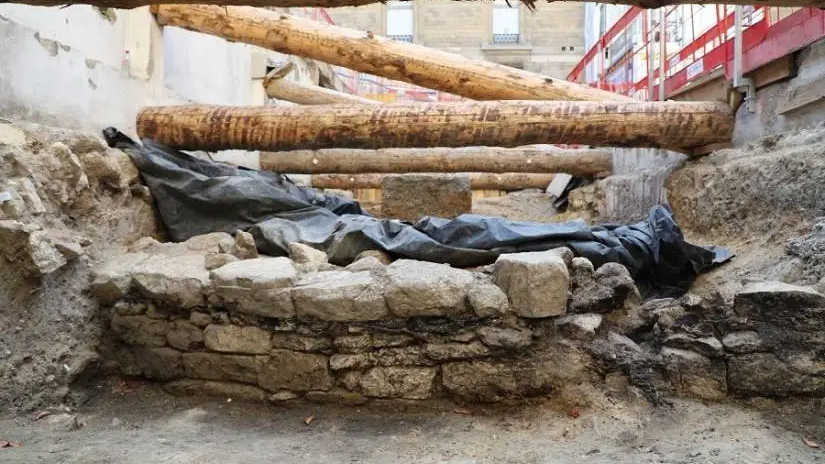
“The structure of the wall, with its large blocks and interlocking beam system, immediately led us to believe that it was a wall of Gallic tradition,” Dorothée Chaouly-Dreux, chief curator of heritage at the Île-de-France regional archaeology department, said in a translated statement.
Archaeologists began excavating the courtyard of the Hôtel-Dieu in February 2026. The hospital is located on the small Île de la Cité, an island in the Seine River near Notre-Dame Cathedral. There, the team found a 20-metre stone-and-timber wall typical of Celtic fortifications.
Evidence of Lutetia’s destruction by fire
The discovery supports ancient accounts of Lutetia, a pre-Roman Celtic settlement that served as the capital of the Parisian people living along the Seine during the 1st century B.C.
As part of the Gallic Wars, which lasted from 58 to 50 B.C., Julius Caesar and his army fought the Battle of Lutetia in 52 B.C. According to Caesar’s account of the Gallic War, the Gauls burned Lutetia and cut the bridge so that the Roman army could not capture the city.
The newly discovered wall, along with nearby burnt wooden buildings, charred surfaces and burnt seeds, appears to match that account. The evidence indicates that the settlement was destroyed by fire more than 2,000 years ago.
Wooden elements and a Gaulish spear
Early carbon-14 dating suggests that some of the wooden elements date from between 200 B.C. and 10 B.C. Archaeologists also found the tip of a Gaulish spear at the foot of the wall.
“The first result is carbon-14 dating. Some of the wooden elements suggest a range from 200 BC to 10 BC, and in addition, the tip of a Gaulish spear was found at the foot of the wall,” Chaouly-Dreux said.
These findings provide archaeological evidence that Lutetia was located on an island in the Seine and that its inhabitants burned the settlement, as Caesar described in his Gallic War.
Discovery may solve the mystery of Lutetia’s location
“This discovery fills an archaeological gap. Lutetia’s location has been debated for centuries,” Stéphane Deschamps, regional archaeology curator for the Île-de-France regional archaeology department, said in a statement. “Today, given this wall and its context, we may hold the key to the mystery.”
The remains of the wall and other artifacts were exposed to fire and are therefore extremely fragile. Because the walls cannot be completely preserved, archaeologists plan to use 3D photogrammetry to create replicas and make the discoveries accessible to the public.
Find out how much you know about the Celts with our Celtic quiz.
Source: www.livescience.com