


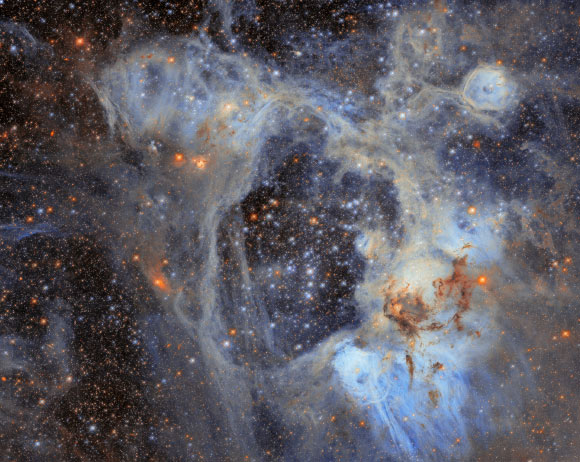
New NASA/ESA Hubble Space Telescope images reveal the dramatic beauty of LHA 120-N44, a star-forming emission nebula located approximately 160,000 light-years from Earth in the Large Magellanic Cloud, a satellite galaxy of the Milky Way.
This Hubble image shows the LHA 120-N44 emission nebula. Image credit: NASA / ESA / Hubble / D. Gouliermis.
LHA 120-N44, commonly known as N44, is located about 160,000 light-years away in the constellation Dorado, within the Large Magellanic Cloud.
“N44 is dominated by two features: a vast central cavity and a dense, dusty shell of gas,” Hubble astronomers said in a statement.
The central cavity is a giant stellar superbubble measuring approximately 210 by 140 light-years across.
Bright, massive stars at the center of N44 created this enormous cavity through powerful stellar winds and a series of supernova explosions. These energetic events expelled much of the gas and dust left over from the stars’ formation.
As the central star cluster cleared away the surrounding material, the expelled gas gathered into a dense shell around the superbubble.
The compressed shell is now a site of active star formation, making N44 an important target for astronomers investigating how new stars are born.
Using the Hubble Space Telescope, astronomers cataloged approximately 500,000 stars across the region. About 30,000 of these objects are still in the early stages of hydrogen fusion.
“Each feature within the broader star-forming complex N44 was cataloged by astronomer Karl Henize in the 1950s,” the researchers said.
One of these structures is a small bubble near the upper-right corner of the Hubble image, known as N44F.
N44F is an interstellar bubble shaped by the intense stellar wind of a single hot, massive star.
Earlier Hubble observations of N44F showed how the star’s powerful winds and radiation sculpted the surrounding gas and dust, producing a prominent column of dense material.
Source: www.sci.news