


Blood Falls in Antarctica May Be Fed by Ancient Seawater Trapped Beneath a Glacier
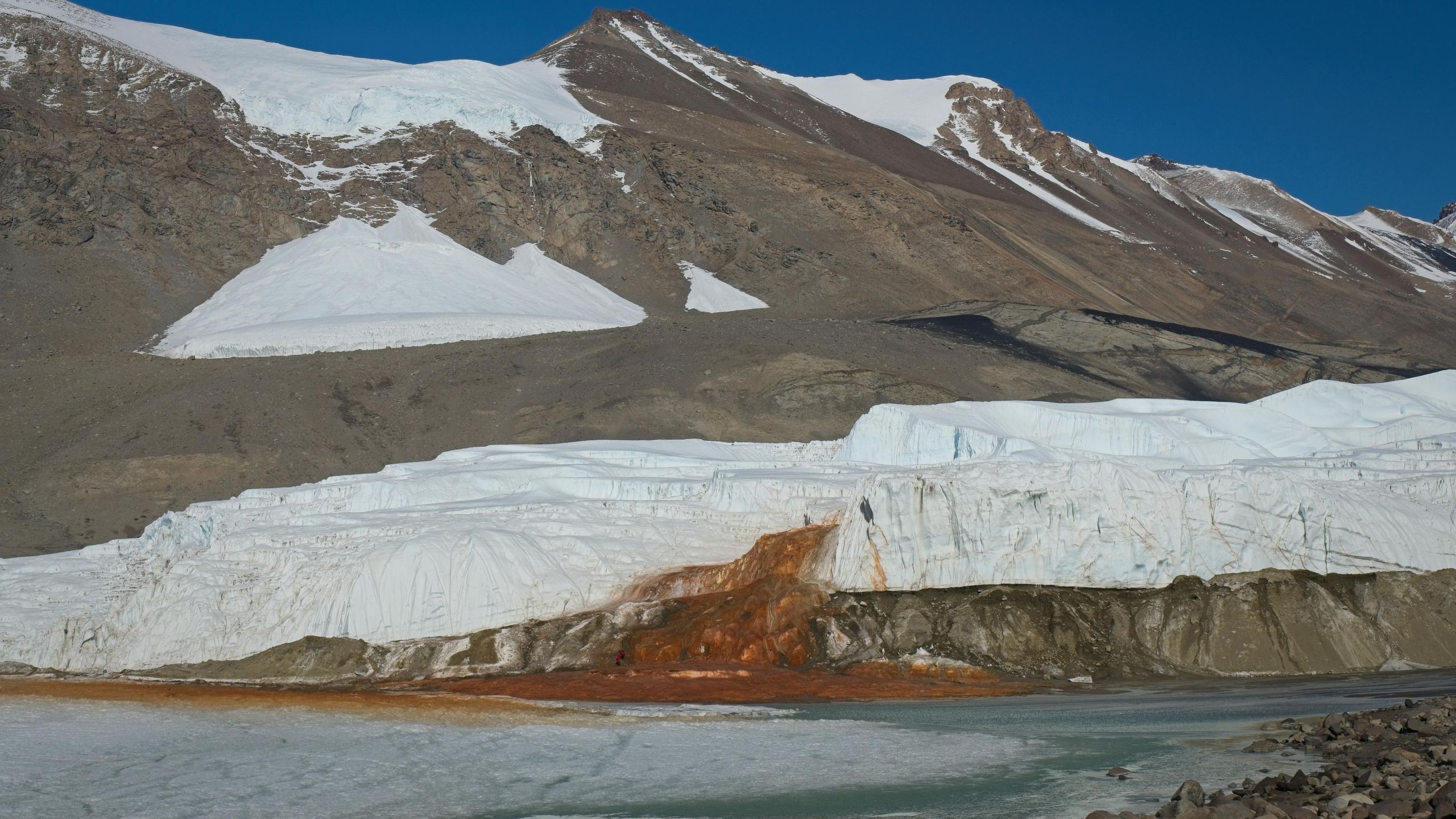
Blood Falls, a striking red waterfall at the end of Taylor Glacier in East Antarctica’s Taylor Valley, may be fed by ancient seawater trapped beneath the ice. The eerie crimson color comes from iron-rich brine that oxidizes when it reaches the surface, creating the appearance of blood flowing from the glacier.
Scientists have long debated where the salty water originated. New research suggests that the brine contains a distinct community of marine microorganisms, supporting the theory that it is the remnant of seawater trapped beneath Taylor Glacier when sea levels fell and the glacier advanced across the valley.
Previous studies had also proposed a seawater origin for the brine based on its chemical composition and the bacteria found within it. The latest findings add molecular and genetic evidence to that explanation.
“Findings in this study reveal a dominance of marine eukaryotic lineages in the Blood Falls area” compared with the wider McMurdo Dry Valleys, the researchers wrote in a study published Monday, Aug. 3, in Nature Geoscience. “This marine signal is less prominent but still detectable in the prokaryotic structure,” they added.
Eukaryotes are organisms whose cells contain a membrane-bound nucleus and other internal compartments. Prokaryotes, including bacteria and archaea, are generally single-celled organisms whose DNA is not enclosed within a nucleus.
Genetic clues beneath Blood Falls
To identify the microorganisms living around Blood Falls, researchers used several genetic techniques to analyze 167 samples of water, sediment and air collected from the waterfall and locations throughout the McMurdo Dry Valleys.
Some scientists have argued that Blood Falls may not come directly from seawater. Instead, they suggested that marine bacteria and chemical signatures could have been carried inland from the ocean by strong winds, which are common in the McMurdo Dry Valleys.
To test that possibility, the researchers compared microorganisms from Blood Falls with microbial communities found across the surrounding region. Their goal was to determine whether the waterfall contained a distinct biological signature that could have survived from ancient conditions beneath the glacier.
The results showed that the crimson brine and red-stained sediments at Blood Falls contained a greater proportion of eukaryotes related to ocean microorganisms than samples from other parts of the Dry Valleys. Slightly more than 9% of the eukaryotes found at Blood Falls were shared with oceanic samples, while the wider Dry Valleys showed only about 1% similarity.
Most of the remaining eukaryotes, along with the majority of the prokaryotes identified in the study, had freshwater or terrestrial origins.
Researchers examined microorganisms near Blood Falls to determine whether the site contains a distinct microbial community.
Image credit: Bryan Minnea
The air around Blood Falls contained only a very small proportion of marine microorganisms. That finding suggests that modern winds cannot fully account for the marine biological signature found in the brine and nearby sediments.
How old is the water beneath Taylor Glacier?

The brine feeding Blood Falls most likely consists of ancient seawater trapped beneath Taylor Glacier as ice advanced across the valley.
Image credit: MARK RALSTON/POOL/AFP via Getty Images
Based on the genetic evidence, the researchers concluded that ancient seawater is the most likely source of the microorganisms now found at Blood Falls. Winds may have influenced the microbial community in the past, but their effect today appears to be too limited to explain the site’s marine signature.
Previous estimates suggest the brine could have become trapped more than 1 million years ago, during a warmer period when sea levels were higher and Antarctica had less ice cover. As the climate cooled and Taylor Glacier expanded, seawater may have been sealed beneath the ice.
However, the exact age of the brine remains unknown. Researchers say additional genetic surveys, more detailed microbial mapping and further sampling will be needed to determine when Taylor Glacier advanced over the ancient seawater pool.
Zoumplis, A., Füssy, Z., Kaul, D., Schulte, N., Zheng, H., Lampe, R. H., Brylka, K., Venepally, P., Mikucki, J. A., McKnight, D. M. and Allen, A. E. (2026). Molecular evidence for a relict marine community in an Antarctic Dry Valleys subglacial brine-fed system. Nature Geoscience.
Antarctica quiz: Test your knowledge of Earth’s frozen continent
Source: www.livescience.com