


This story originally appeared in Capital B and is part of a Climate Desk collaboration.
California Law Could Provide Cash Assistance to Families Living Near Oil Wells
In the 1950s and ’60s, Regina Martin became so accustomed to the oil pump jack near her home that she thought all her children lived near one. Her family became “sick,” she recalled, as she smelled the lingering, sulfurous odor of rotten eggs.
It wasn’t until she was an adult that Martin began to see a connection between growing up near the nation’s largest urban oil field and her own illness, as well as the asthma that affected her sister.
Black communities have long lived near oil wells and pollution
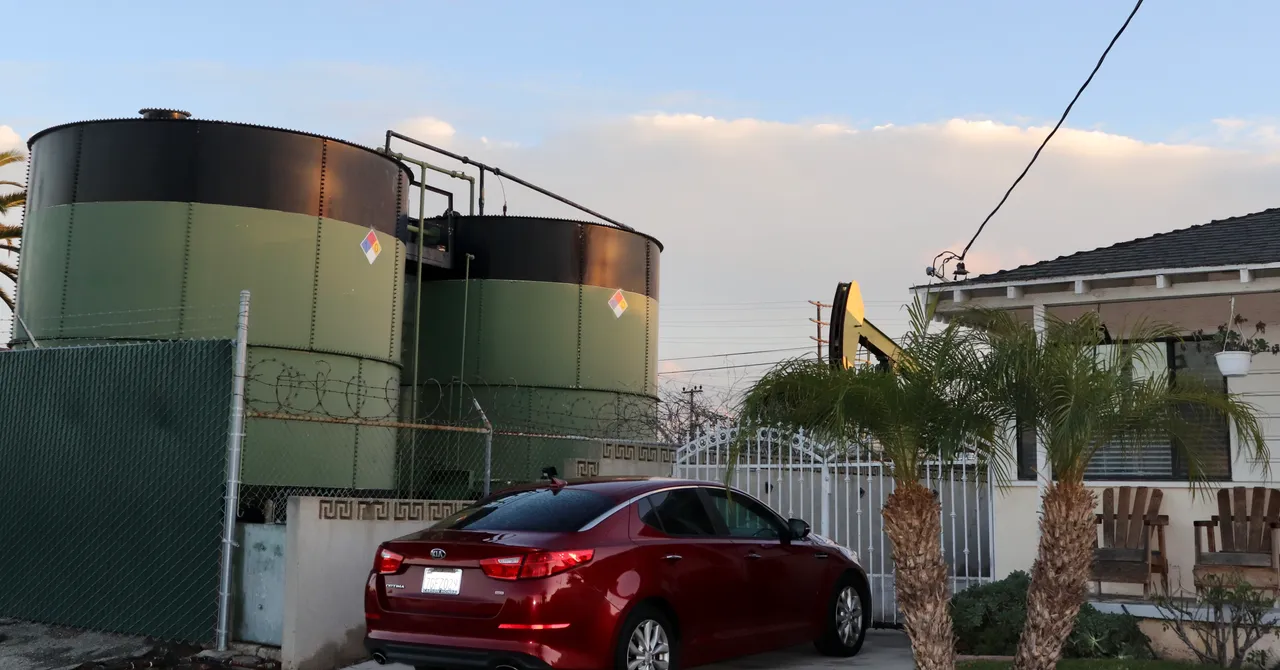
For more than a century, Black people in Los Angeles and throughout the United States have been disproportionately likely to live near oil wells, which pump oil from deep underground. Contamination from these drilling sites has been linked to birth complications, child development problems, respiratory diseases, and cancer.
Now, a new California law is turning that lived experience into a broader public policy question: What is owed to communities exposed to generations of pollution? And what happens if support is not provided to families who have endured the harm?
California’s AB 1661 would provide payments to affected families
California lawmakers passed AB 1661, which directs $5 million collected from penalized oil wells in Inglewood to provide direct cash assistance to 1,000 nearby families experiencing respiratory and reproductive health effects. Some of Los Angeles County’s Blackest suburbs and urban areas, including Inglewood, Ladera Heights, and Baldwin Hills, surround oil fields.
The bill was introduced by Rep. Isaac G. Bryan and is expected to be signed by Gov. Gavin Newsom by October. The initial arrangement would provide up to $5,000 to each of 1,000 affected households. The money would come from the state’s Community Repair and Reinvestment Fund for people living near oil fields.
For Black communities living near refineries, highways, landfills, and oil wells, the fund could represent something bigger than a single well or payment. It raises the question of whether money can begin to repair damage accumulated over generations—including lives cut short by illness, household wealth lost to medical costs and declining property values, and the anxiety of raising children amid pollution.
Advocates call the plan environmental compensation
Bryan and other advocates call the approach environmental compensation. They say it could become a model for requiring industrial companies to help repair damage caused to people living near contaminated sites.
To Tiana Shaw-Wakeman, Environmental Justice Program Director at Black Women for Wellness in Los Angeles, the law could provide a model for national organizing.
“My hope has always been born at the community level, at the grassroots level,” she said. “We saw how grassroots organizing has created long-term change in local communities, and that it can and is being replicated across the country.”
Inglewood residents seek repair for decades of pollution
For Bryan, who represents the community surrounding the Inglewood oil field, the cash assistance program addresses the long battle over the field’s legacy. Bryan, the first Black lawmaker to chair California’s Natural Resources Committee, said his constituents have faced declining life expectancy and rising rates of asthma and heart disease for decades.
“The company is essentially just exploiting the community, not investing in the community, not caring about the community, and sometimes it feels like they’re ignoring the broader community,” Bryan told Capital B. “This repair has been a long time coming.”
Powered by Capital B
Source: www.wired.com