


236-Million-Year-Old Fossil Reveals Earliest Evidence of Live Birth in Mammal Relatives
Paleontologists studying a 236-million-year-old cynodont fossil from Argentina have identified the earliest evidence of viviparity, or live birth, in the evolutionary lineage that led to mammals. The discovery pushes the origin of this reproductive strategy back by approximately 90 to 95 million years.
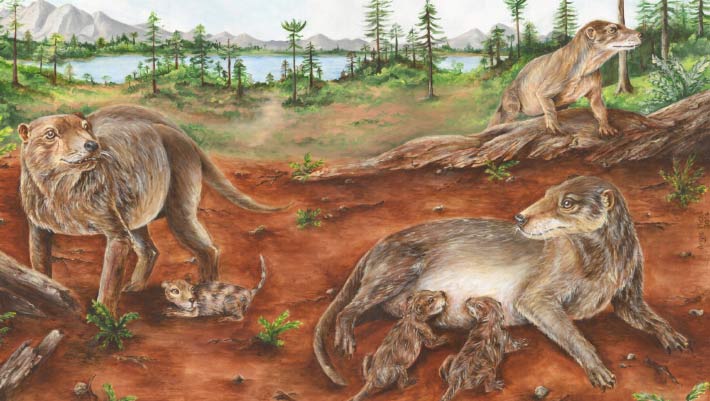
Life reconstruction of Chiniquodon theotonicus, showing a pregnant female (left) and a female nursing several relatively large newborns (right). Image credit: María de los Ángeles Miceli Barro.
“Viviparity is an important evolutionary innovation in mammals. It is a defining feature of modern mammals and likely played a major role in their evolutionary success,” said paleontologist Dr. Leandro Gaetano of Argentina’s National Council for Scientific and Technical Research (CONICET) and his colleagues.
Viviparity, the production of live young, differs from oviparity, the ancestral reproductive condition in which animals lay eggs. Although live birth has evolved independently more than 150 times among vertebrates, researchers have traditionally associated its origins in the mammalian lineage with much later therian mammals.
Modern therians—including marsupials and placental mammals—share a suite of co-adapted traits linked to live birth, including placentation, lactation, and complex hormonal regulation. Monotremes, such as the platypus and echidna, still lay eggs despite possessing a limited form of placentation involving the absorption of secretions from the oviduct.
For their study, the researchers examined fossilized remains of Chiniquodon theotonicus, a cat-sized cynodont that lived in what is now northwestern Argentina during the Triassic Period, approximately 236 million years ago.
The team prepared thin sections of the animal’s femur and ulna and examined them under a microscope. They identified distinct changes in the bone tissue near the center of each bone. These changes correspond to a “neonatal line,” a microscopic marker formed around the time of birth.
Neonatal lines are well documented in modern mammals, but this is the first time scientists have reported the feature in such an ancient, non-mammalian cynodont. The finding provides evidence that Chiniquodon theotonicus may have given birth to live young rather than laying eggs.
By measuring the circumference of the bones along the neonatal line, the researchers estimated that the animal weighed approximately 1.68 kilograms at birth. Its estimated adult body weight was about 12 kilograms.
Newborns therefore accounted for roughly 10% to 20% of the adult body mass—a proportion much closer to that seen in modern placental mammals than in egg-laying reptiles and birds. The ratio also differs from that of marsupials and monotremes, whose offspring are typically much smaller and less developed at birth.
A statistical comparison involving approximately 1,900 mammal species, 2,600 reptile species, and 780 bird species consistently placed the fossil close to placental mammals in terms of newborn-to-adult body size.
“We show for the first time that live birth existed in at least one mammalian ancestor, Chiniquodon theotonicus, which lived approximately 236 million years ago,” Dr. Gaetano said.
According to the researchers, this suggests that viviparity may have appeared in the mammalian lineage at least 90 to 95 million years earlier than previously believed.
The discovery challenges the long-standing assumption that all non-mammalian cynodonts laid eggs and that live birth evolved only later among therian mammals, the group that includes modern marsupials and placental mammals.
Scientists have proposed two possible evolutionary scenarios. One possibility is that viviparity evolved early among cynodonts and was later retained by some mammalian lineages. Another is that live birth evolved more than once, while monotremes may represent a later evolutionary reversal to the ancestral egg-laying condition.
“It is very likely that Chiniquodon theotonicus is not a unique example of viviparity among cynodonts,” Dr. Gaetano said.
“This could represent evidence of a broader transition from egg-laying to live birth early in mammalian evolution. However, additional fossil evidence is needed to test this hypothesis.”
The findings suggest that some Triassic cynodonts may have been reproductively more similar to modern mammals than previously recognized.
The study was published in Frontiers in Mammal Science.
_____
Leandro Carlos Gaetano et al. 2026. Early origins of viviparity in mammalian lineages. Frontiers in Mammal Science 5; doi: 10.3389/fmamm.2026.1845319
Source: www.sci.news