


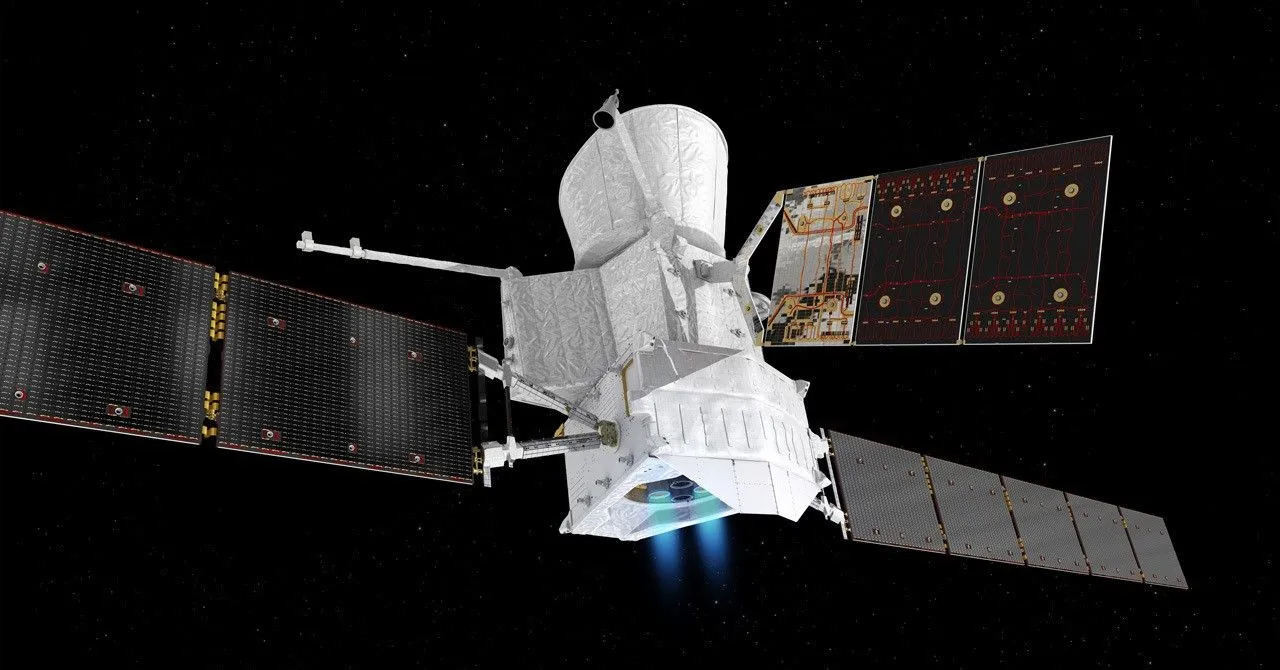
BepiColombo Reaches Mercury After a 6 Billion-Mile Journey and Nine Gravity Assists
BepiColombo is completing an extraordinary odyssey to Mercury. The space probe, named after prominent Italian scientist Giuseppe “Bepi” Colombo, who developed the gravity-assist technique that makes many interplanetary missions possible, was originally scheduled to arrive at Mercury last year. A propulsion-system failure forced the spacecraft to reduce power and change course, delaying its arrival by nearly a year. After eight years in space, BepiColombo has now begun its descent into low orbit around Mercury.
BepiColombo completes its final approach to Mercury
On September 3, ground control confirmed that the propulsion module had successfully separated from the rest of the vehicle. The milestone marked the end of the final stage of the joint mission between the European Space Agency (ESA) and the Japan Aerospace Exploration Agency (JAXA). After an arduous journey covering more than 200 million kilometers from Earth, communications from the spacecraft indicated that all was well.
Why Mercury is so difficult to reach
Mercury has been explored only twice, both times by NASA spacecraft. Even without a propulsion accident, the planet’s position closest to the Sun makes it especially difficult to reach. As a spacecraft moves toward the center of the solar system, it essentially “falls” from Earth toward the Sun’s much greater gravity. The challenge is not reaching Mercury—it is slowing down enough to remain there. That requires substantial fuel for braking and orbital insertion.
A spacecraft can also use the gravity of other planets to slow down, but doing so requires a more complicated route that loops between multiple planetary bodies. So far, BepiColombo has traveled about 6 billion miles (9.9 billion kilometers), circling Earth once, Venus twice and Mercury six times. In total, the mission has used nine gravity-assisted maneuvers to control the spacecraft’s speed.
Surviving Mercury’s extreme temperatures
Mercury’s proximity to the Sun creates another major challenge. The planet’s surface can become extremely hot, exceeding 800 degrees Fahrenheit, or about 430 degrees Celsius. Because Mercury has essentially no atmosphere, nighttime temperatures can plunge to -290 degrees Fahrenheit (-180 degrees Celsius). BepiColombo must withstand both extremes as well as the dramatic daily temperature fluctuations between them.
Two spacecraft will study Mercury
Once in position, BepiColombo will split into two separate probes. The Mercury Planetary Orbiter (MPO) will study Mercury’s surface and internal structure, while the Mercury Magnetospheric Orbiter, called MIO, will examine the planet’s magnetic field and tenuous atmosphere.
This will be the first time that multiple spacecraft orbit Mercury at the same time. Together, the probes are designed to provide a more comprehensive picture of the planet than a single spacecraft could produce.
Source: www.wired.com