


Nature Briefing: RNA Therapy for ALS, AI Agents and the Future of Scientific Discovery
Hello Nature readers. Would you like to receive this briefing free in your inbox every day? Sign up here.
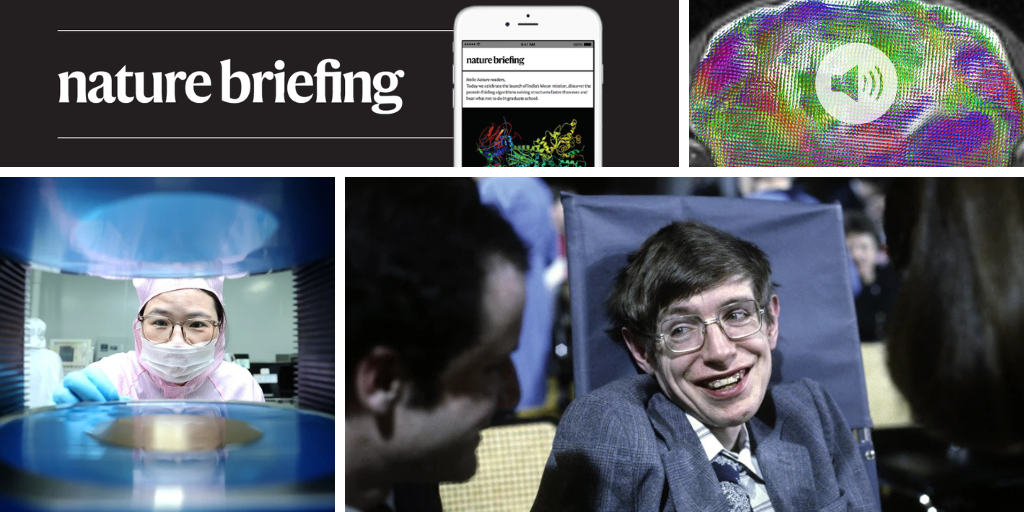
Stephen Hawking worked on the black hole information paradox throughout his life.
Credit: Santi Visalli/Getty
RNA therapy shows promise for rare genetic ALS
RNA therapy for a rare form of amyotrophic lateral sclerosis (ALS) has shown promising results in the first people receiving it. One year after starting treatment, his symptoms had improved and he continued to work as a doctor.
Antisense oligonucleotide therapy uses short strands of genetic material to target RNA produced by the defective gene CHCHD10. Approximately 5% to 10% of people with ALS have a known genetic mutation. The treatment could eventually benefit them and others with neurodegenerative diseases caused by rare mutations.
Nature | 7 min read
Reference: MED paper
Sanctioned Chinese companies publish more papers and patents
Chinese companies subject to US government sanctions appear to obtain more scientific patents and publish more papers than companies that are not sanctioned.
It is unclear whether being placed on the US Entity List directly led to an increase in innovation. However, the findings could point to unintended consequences of technology restrictions.
“Whether you support technology regulation or not, it’s important to recognize that there can be costs,” said political economist Dinsha Mistry.
Nature | 7 min read
Reference: Science paper
Features and impressions
Psychotropic drugs may have shaped ancient Andean rituals
Chavín de Huántar, a 3,000-year-old temple complex in the Peruvian Andes, has long been considered a religious center. New evidence suggests that rituals may have been intensified by psychotropic drugs.
Advances in detecting minute traces of chemicals and biological substances, combined with a more open research environment surrounding hallucinogens and other drugs, are adding to evidence about what happened at the site.
Latest short stories from the Nature Futures series
As nature declines, how can we grieve for the world we never knew? This is the first published creative work by environmental researcher Hannah Cox.
“Hopefully it’s the first of many,” she wrote. “I want to write to remind you that we are part of nature and will always be part of nature.”
Nature | 6 min read
Five science books to read this week
Andrew Robinson’s top five science books include a study of the relationship between astrology and science, a celebration of polio vaccine pioneer Albert Sabin, and a vision of the social world that exists around, outside of and in opposition to money.
Nature | 4 min read
This week’s Nature Podcast
Hosts Benjamin Thompson and Nick Petrich-Howe speak with researchers about a study in which human brain organoids were transplanted into mice genetically engineered to lack large portions of the cerebral cortex.
Nature Podcast | 27 min listen
Subscribe to Nature Podcast on Apple Podcasts,
Spotify,
YouTube Music
or RSS.
Penguin Hunting Puzzle
In today’s Penguin Hunting Puzzle, Leif Penguinson explores a natural limestone arch at Le Lavant des Arcs near Notre-Dame-de-Londres, France. Can you find the penguin?
The answer will be in Monday’s email. Thanks to Nature Briefing photo editor and penguin wrangler Tom Horton.
Stay connected with Nature Briefing
This newsletter is constantly evolving. Let us know what you think by emailing [email protected].
Thank you for reading,
Flora Graham, Nature Briefing Editor-in-Chief
Contributed by Nicola Jones
- Nature Briefing: Careers — insights, advice and award-winning journalism to help you optimize your work life.
- Nature Briefing: Microbiology — microorganisms and the roles they play in health, the environment and our food system.
- Nature Briefing: The Anthropocene — climate change, biodiversity, sustainability and geoengineering.
- Nature Briefing: AI and Robotics — 100% written by humans, of course.
- Nature Briefing: Cancer — a weekly newsletter written with cancer researchers in mind.
- Nature Briefing: Translational Research — biotechnology, drug discovery and pharmaceuticals.
Source: www.nature.com