


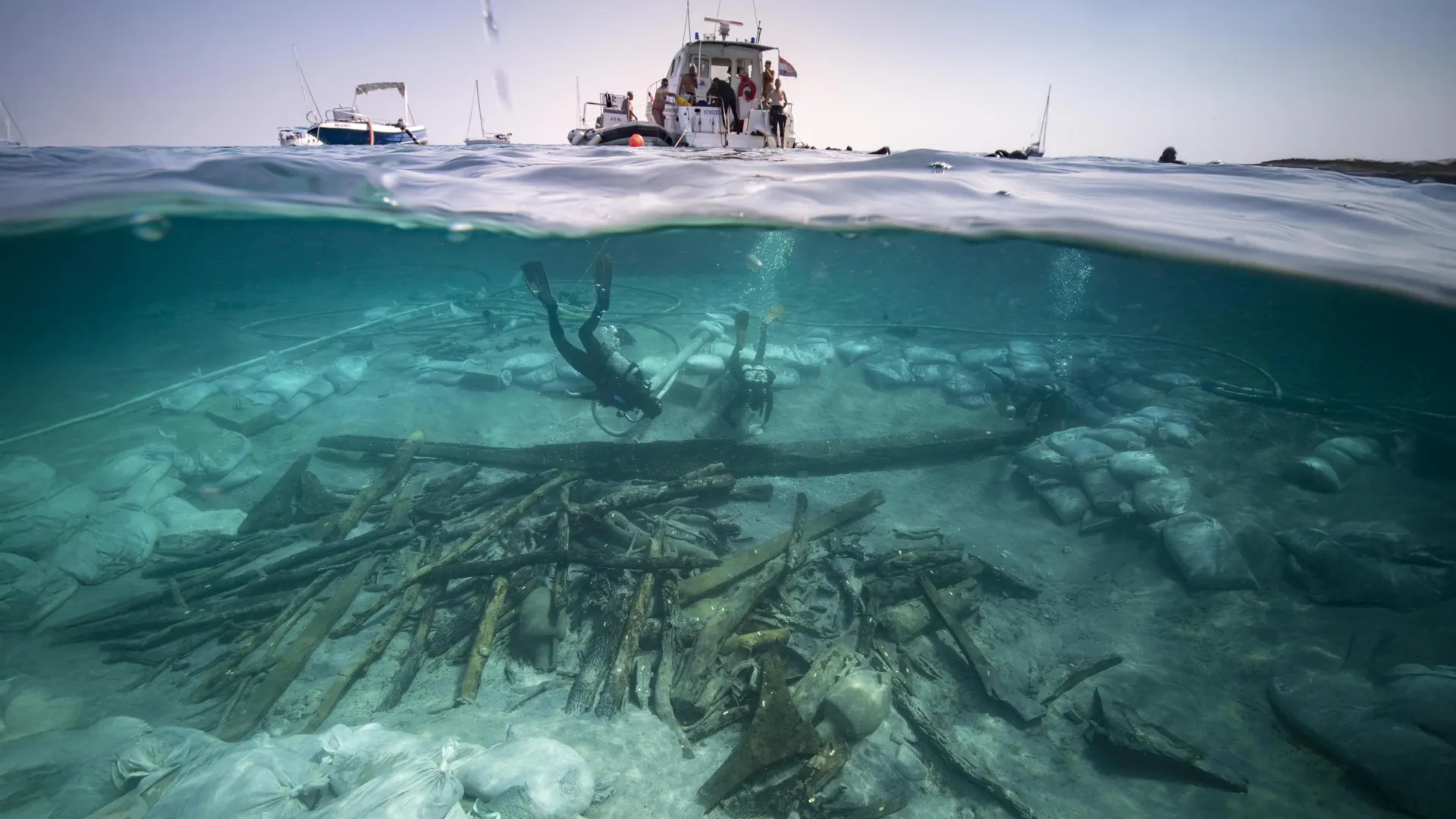
Ancient ships required durable protection from seawater, salt, microorganisms, and marine organisms. Yet until the mid-20th century, researchers paid limited attention to the non-wood materials used in early shipbuilding. As a result, the waterproof coatings that helped ancient vessels survive at sea remain poorly understood.
New research published in Frontiers in Materials is helping close that knowledge gap. French and Croatian researchers analyzed the protective coating found on the Roman Republic shipwreck Ilovik Parzine 1, which sank off the coast of modern-day Croatia approximately 2,200 years ago.
“In archaeology, organic waterproofing materials have received little attention. However, they were essential for navigation on seas and rivers and provide important evidence of ancient naval technology,” said lead author Dr. Armel Charrier, an archaeologist at the Institute for Interaction and Systems Mass Spectrometry in Strasbourg. “Our analysis showed that the ship had two different coatings: one made from pine tar, also known as pitch, and another made from a mixture of pine tar and beeswax. Pollen analysis also helped identify plant species that grew in the surrounding environment when the coating was produced or applied.”
Pine tar and beeswax protected the ancient hull
Discovered in 2016, the Ilovik Parzine 1 shipwreck and its cargo have been studied in several investigations. This latest research is the first to combine molecular analysis with pollen analysis to identify ancient ship coatings and reconstruct the vegetation surrounding the production and application of those materials.
The study was conducted in collaboration with the Department of Underwater Archaeology of the Croatian Institute for Nature Conservation and the “ADRIBOATS” program of the Camille Julien Center at Aix-Marseille University in France.
“Some regions of the Adriatic Sea have distinctive characteristics that encouraged local communities to develop specialized shipbuilding traditions,” Charrier said. “Studies like ours provide insight into those traditions and reveal the technical knowledge and diversity of ancient shipbuilders.”
To examine the waterproof coating, the researchers carried out structural, molecular, and pollen analyses. They used techniques including mass spectrometry, which can identify and measure unknown substances in complex organic mixtures.
The team analyzed 10 coating samples to determine the biological origin of the natural materials used to protect the vessel. Molecular fingerprinting revealed compounds associated with pine trees and showed that all the samples were dominated by heated softwood resin, or softwood tar, commonly known as pitch.
One sample, however, contained a different formulation made from beeswax and tar. Known in Greek shipyards as zopissa, this mixture could improve the flexibility of the coating and make it easier to apply, particularly in warm conditions.
Ancient pollen preserved in sticky ship pitch
Because pitch is naturally sticky, it can trap pollen from nearby plants and preserve it for long periods. By identifying the pollen embedded in the coating and measuring its relative abundance, researchers were able to determine where some of the pitch may have been produced or reapplied during repairs.
The pollen recovered from Ilovik Parzine 1 represented a broad range of environments. Some grains came from landscapes typical of Mediterranean and Adriatic coastlines and valleys, including holly oak and pine forests, maquis shrubland, olive trees, and hazel trees.
Pollen from alder and ash pointed to riverbank and coastal vegetation found along the shoreline and in the nearby hinterland. Smaller quantities of fir and beech pollen were also detected. These trees are associated with mountainous regions and are characteristic of the northeastern Adriatic coast, where the Istrian and Dalmatian mountains lie close to the sea.
Evidence of repeated repairs across the Adriatic
The analysis suggests that the ship received four or five separate applications of waterproof coating over time. Although the stern and central section appear to have been treated with the same material, researchers identified three different coating batches on the bow.
This pattern may indicate that the vessel underwent repeated repairs using waterproofing materials sourced from different parts of the Mediterranean.
Earlier research on the ship’s ballast identified Brundisium, now Brindisi on Italy’s southeastern coast, as a possible construction site. The new pollen evidence suggests that at least some of the ship’s protective coating may also have been applied there.
Other coating layers may have been added along the northeastern Adriatic coast, closer to the location where the shipwreck was eventually discovered.
“It is clear that ships traveling long distances require repairs, but proving that process archaeologically is difficult,” Charrier concluded. “Pollen analysis was particularly valuable because it helped distinguish between different coatings that had nearly identical molecular profiles.”
Source: www.sciencedaily.com