


Rubin Observatory Discovers Aquarius IV, One of the Faintest Galaxies Ever Seen
The Vera C. Rubin Observatory in Chile has revealed a previously unknown galaxy orbiting the Milky Way. Named Aquarius IV, the object is described in a non-peer-reviewed research note as one of the lightest, faintest and most distant satellite galaxies ever observed.
The discovery offers an early look at the observatory’s ability to uncover faint objects in our cosmic neighborhood. Aquarius IV is an ultrafaint dwarf galaxy (UFDG): a small, ancient collection of stars that is thought to be dominated by dark matter.
What are ultrafaint dwarf galaxies?
Ultrafaint dwarf galaxies are among the smallest and dimmest galaxies in the universe. They contain no more than a few hundred thousand stars, compared with roughly 100 billion stars in the Milky Way.
Astronomer Joshua Simon of the Carnegie Institution for Science Observatory, who was not involved in the research, said these galaxies are almost entirely made of dark matter. Between 99% and 99.9% of their mass is dark matter, while stars account for only 0.1% to 1%.
Scientists estimate that hundreds of these satellite galaxies may orbit the Milky Way, but only about 60 have been identified so far. Their faintness makes them difficult to detect, even when they are relatively close to our galaxy.
Rubin Observatory’s powerful camera spotted the faint galaxy
The Vera C. Rubin Observatory is designed to repeatedly scan the night sky every few nights. Its car-sized, 3,200-megapixel camera can detect objects up to 100 million times fainter than those visible to the unaided eye.
That capability makes the observatory especially well suited to finding ultrafaint dwarf galaxies. However, the new discovery was not made with data from the observatory’s full Legacy Survey of Space and Time (LSST). Instead, researchers analyzed an earlier test dataset collected between April 2025 and January 2026.
The dataset, known as Data Preview 2, covered approximately 7% of the night sky.
How researchers identified Aquarius IV
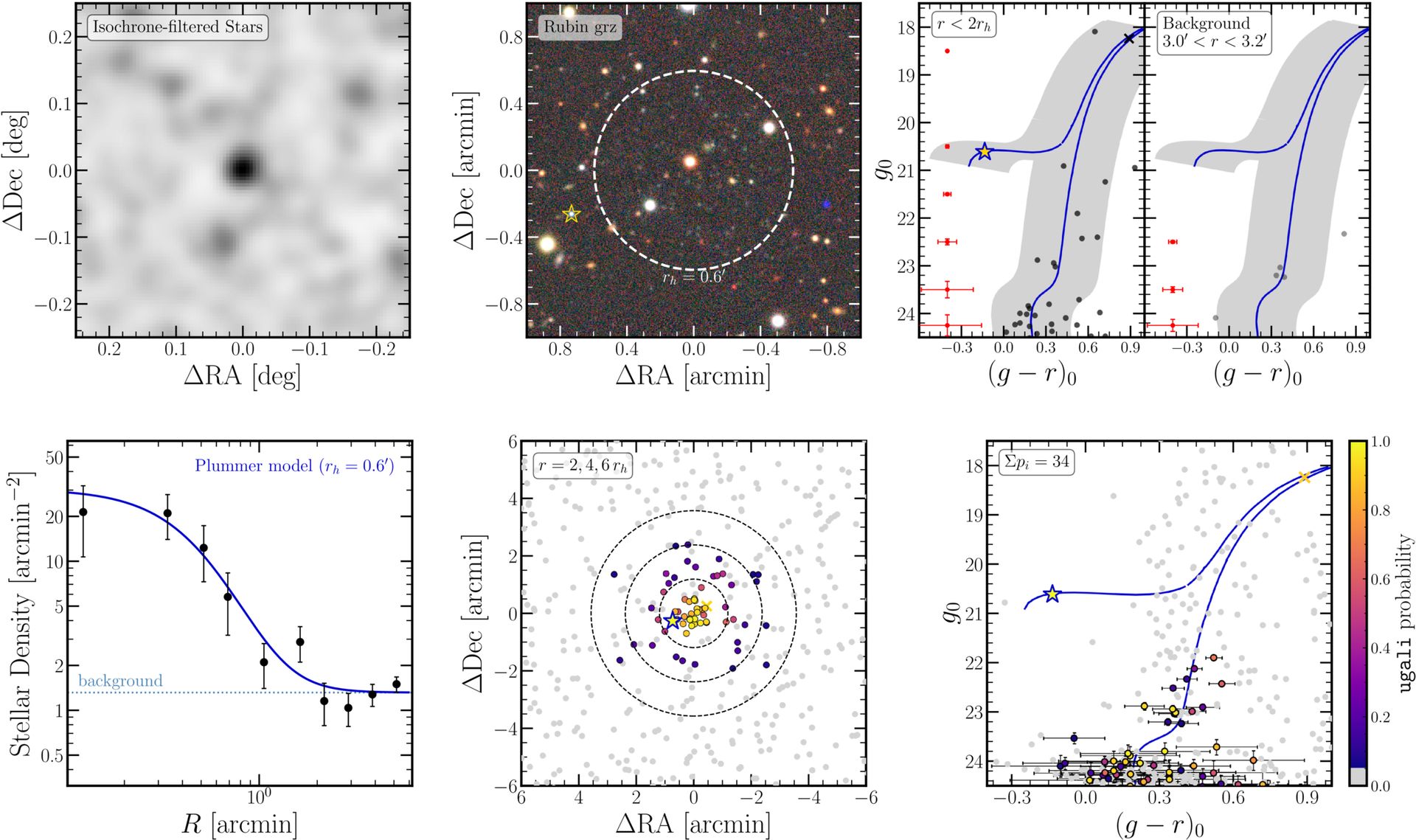
Using computer models, researchers searched the test data for groups of stars with similar brightness and color. Those characteristics suggested that the stars formed and evolved together.
The stars in Aquarius IV are estimated to be about 13 billion years old—roughly the age of the universe. By analyzing their properties, the researchers distinguished the group from foreground stars and more distant galaxies located in front of or behind the observed region.
The researchers reported their findings in the August issue of AAS Research Notes, a publication that presents ongoing research that has not been peer-reviewed.
The candidate galaxy was detected with a statistical significance of 8 sigma. According to the researchers, that means the probability that the observed cluster is a random collection of stars is approximately 1 in 1.6 quintillion.
Aquarius IV is extremely faint and far from the Milky Way
Researchers also checked the discovery against older images from the Dark Energy Camera on the National Science Foundation’s Victor M. Blanco 4-meter Telescope in Chile. Those images were made with a 570-megapixel camera and revealed a faint star that had previously been overlooked.
The older data produced a lower statistical significance of 6 sigma, corresponding to a chance of approximately 1 in 100 billion that the result was a random fluke. Even so, the analysis supported the existence of the small galaxy.
Aquarius IV lies in the direction of the constellation Aquarius. Researchers estimate that it is approximately 359,000 light-years from the center of the Milky Way. For comparison, the Milky Way is about 100,000 light-years across.
Ashay Pai, a physics graduate student at the University of Chicago and co-author of the study, described Aquarius IV as one of the faintest and most compact ultrafaint dwarf galaxies known at such a distance.
Pai estimated that Aquarius IV has a mass equivalent to about 1,500 Suns. That makes it tiny compared with the Milky Way, whose mass is equivalent to approximately 1.5 trillion Suns, according to NASA.
The galaxy’s absolute magnitude—its intrinsic brightness—is estimated at −1.9. That makes Aquarius IV approximately 14 million times fainter than the Milky Way.
Why the discovery matters for dark matter research
Simon said the discovery appears solid, although Pai cautioned that follow-up observations will be needed to confirm the object’s identity.
Studying ultrafaint dwarf galaxies can help scientists improve their map of the nearby universe and investigate the nature of dark matter. Dark matter does not interact with light, yet it makes up about 85% of all matter in the universe.
The ancient stars in ultrafaint dwarf galaxies also offer a rare glimpse into the early universe. Because they formed shortly after the Big Bang, they may provide clues about how the first galaxies developed.
Rubin Observatory could find many more hidden galaxies
Pai said the Rubin Observatory could discover as many as 100 ultrafaint dwarf galaxies during the LSST survey, which officially began in June. The project is expected to create the most detailed cosmic time-lapse record ever made.
By repeatedly imaging the sky, the survey is expected to reveal millions of changes each night. Those observations could lead to many more discoveries, including additional faint satellite galaxies orbiting the Milky Way.
Research source: Cerny, W., Pai, A., Drlica-Wagner, A., Pace, A. B., Ferguson, P. S., Geha, M., Tan, C. Y., Campana, S., Carlin, J. L., Crnojević, D., Ji, A. P., Limberg, G., Massana, P., Mau, S., Medina, G. E., Mutlu-Pakdil, B., Sakowska, J. D., Shipp, N. and Stringfellow, G. S. (2026). “Vera C. Rubin Observatory’s Initial Data Preview Reveals the Distant Ultra-faint Milky Way Satellite Aquarius IV 2.” AAS Research Notes, 10(8), 239.
How much do you know about our home galaxy? Find out with our Milky Way quiz.
Source: www.livescience.com